Nigerian-born, London-based artist Babájídé Ọlátúnjí is showing more than a decade of work concerned with Yorùbá identity, symbolic communication and economic value in So Far…, a solo exhibition running at TAFETA Gallery in London until 6 November.
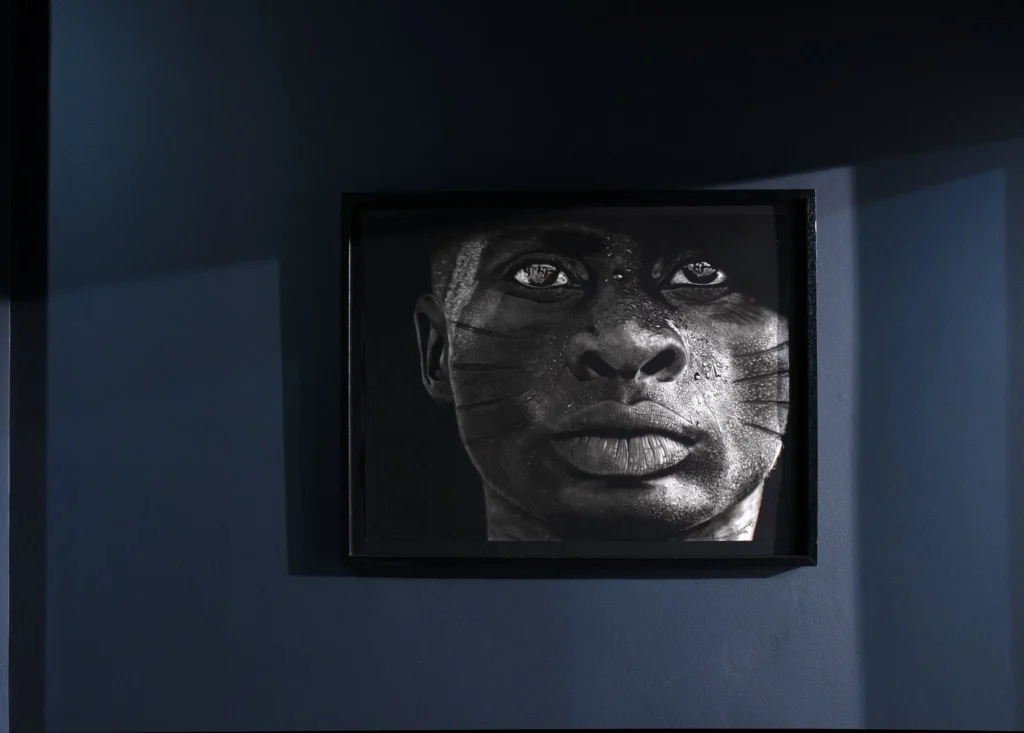
The exhibition opened on 7 October and brings together drawings, portraits and sculpture from several bodies of work rather than arranging them as a strict chronology. TAFETA said the selection includes Ọlátúnjí’s Scarfed portraits within the wider Tribal Marks project, the Àrokò series, Making Money and recent sculptural investigations from The Cowrie Project.
Across those projects, the artist has repeatedly examined how identity is carried through appearance, inherited knowledge and systems of signs. The Àrokò works address symbolic communication, while the cowrie investigations consider the meanings attached to money and value. Portraiture remains central to the display, including large works executed in charcoal and pastel.
An independent listing by ArtRabbit describes the show as a meeting of projects exploring identity, inherited knowledge, symbolic communication and systems of value. It identifies one of the exhibited works as Aisha in Pumpkin Orange Scarf, a 2025 charcoal and pastel portrait measuring 213 by 152 centimetres.
Ọlátúnjí, born in 1989, works from studios in London and Ìbàdàn. His official biography says he is a self-taught painter who studied Botany at Ọbáfẹ́mi Awólọ́wọ̀ University in Ilé-Ifẹ̀. His practice draws on the art and antiquities of south-western Nigeria as well as European old masters, combining careful observation with imagined figures and narrative scenes.
His choice of materials has widened as the ideas have developed. Alongside charcoal, pastel and paint, he has used ground cowrie shells in work that connects physical material with cultural memory. The current exhibition places those experiments beside the outsized hyperrealistic portraits that have become a recognisable part of his studio practice.
The show also gives London visitors a compact view of how his subjects have evolved. Tribal Marks considered the relationship between facial markings, history and identity. Àrokò turned towards forms of communication embedded in Yorùbá culture. The Cowrie Project moved the enquiry into exchange, value and the social meanings built around materials that have travelled through African history.
Ọlátúnjí’s work has previously appeared in institutions and collections outside Nigeria. His biography records that he was selected for a curated section of the Royal Academy Summer Exhibition in 2017 and that his work is held by the Bank of England Museum and the Mott-Warsh Collection. His monumental painting History of the Yorùbás was also unveiled at the John Randle Centre for Yorùbá Culture and History in Lagos.
So Far… follows another London presentation in September. At Fitzrovia Chapel, Ọlátúnjí staged The Umberman, a multimedia project pairing ten oil-on-copper paintings with ten original songs. The chapel described it as the first time he had brought painting and original music together as equal parts of one body of work.
Fitzrovia Chapel said the September project drew on his earliest encounters with art and music, including sketches by his older brother, Olumide, and weekend mornings listening to records from his father’s collection. Ọlátúnjí recalled the insistent guitar rhythms of Sunny Ade among those memories. The detail places his recent move into songwriting within a creative life that began with both images and sound.
That earlier project dealt with love, grief, displacement and the search for belonging through the experiences of a fictional dark-skinned man. The move from its tightly paired paintings and songs to the wider survey at TAFETA gives audiences a chance to see the longer path behind that experiment, including the cultural sources and technical methods to which the artist has returned across different series.
The exhibition is part of a busy autumn season for African and diaspora art in London. Its focus is narrower than a large fair or group show, allowing viewers to follow one artist’s sustained engagement with Yorùbá history across works made in Nigeria and Britain. The selection also connects a London gallery audience with projects already represented in Lagos through the John Randle Centre.
TAFETA Gallery is at 83 Charlotte Street, London W1T 4PR. So Far… is open from noon to 6pm, Wednesday to Saturday, and continues until Friday 6 November. The gallery is closed on Sunday, Monday and Tuesday.