Fighters linked to the Islamic State group killed 48 civilians in Mali’s eastern Ménaka region in an overnight attack from Sunday into Monday, according to a member of the country’s National Transitional Council.
Moussa Ag Acharatoumane, a Tuareg leader who sits on the military-appointed legislative body, said the victims included children and elderly people. He attributed the killings to the Islamic State in Sahel Province, commonly known as ISSP, but the group had not claimed responsibility by Tuesday evening.
The reported death toll has not yet been independently verified, and Mali’s military authorities have not issued a public casualty account for the civilian attack. Acharatoumane said the assailants accused residents of revealing militant positions to the Malian army during operations in the area.
The violence occurred as Mali’s armed forces announced a strike on what they described as a major militant base about 65 kilometres southwest of Ménaka town. In a statement issued on Monday, the army said intelligence had identified a site containing fighters, military equipment and logistical supplies before it was targeted.
The military statement did not say that the strike and the reported massacre formed part of the same incident. Acharatoumane’s account, however, indicated that the civilians were attacked after being accused of supplying information used by the army.
The killings add to the insecurity facing communities in the Ménaka region, an area near Mali’s borders with Niger where Islamic State fighters have established a significant presence. The organisation competes for territory and influence with Jama’at Nusrat al-Islam wal-Muslimin, an al-Qaeda-linked coalition also active across Mali and neighbouring states.
Civilians in the region have repeatedly been exposed to attacks, displacement and accusations of supporting one armed faction or another. Access for independent observers is limited, making it difficult to verify casualty figures quickly or establish responsibility for individual attacks.
The Ménaka report comes amid renewed scrutiny of the conduct of all armed actors in Mali. Human Rights Watch said in a report released this week that apparent indiscriminate drone strikes and other abuses by Malian forces and their Russian partners had killed scores of civilians during a counter-insurgency campaign between April and August.
Data cited in that report recorded 47 drone strikes causing 94 civilian deaths during the five-month period, compared with 22 strikes and 44 civilian deaths in the corresponding period a year earlier. The organisation also documented abuses attributed to insurgent and separatist groups.
Mali’s security crisis has continued despite successive military takeovers in 2020 and 2021 and the authorities’ decision to deepen security cooperation with Russia after ending long-standing partnerships with France and other Western countries.
The military governments of Mali, Burkina Faso and Niger have formed a regional alliance and pledged to confront armed groups operating across their borders. Their forces have nevertheless struggled to prevent attacks on soldiers, public infrastructure and remote communities across the central Sahel.
Ménaka has been one of the principal operating areas of Islamic State in Sahel Province. The region’s distances, weak state presence and recurring armed competition have left rural communities vulnerable, while insecurity has made the delivery of food, healthcare and other basic services more difficult.
No information was immediately available about funerals, survivors or the number of people displaced by the latest attack. Authorities had also not announced any arrests or a formal investigation by Tuesday evening.
The reported killings require further official confirmation, including the identities of the affected communities and the precise location of the attack. The army’s separate operation southwest of Ménaka was described as successful, but officials did not publish an assessment of militant casualties or release evidence linking the targeted base to the civilian deaths.
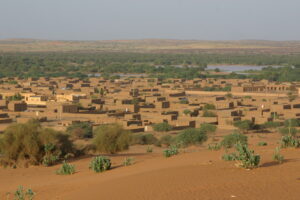
Image: Animali. Source. Licence. October 2007 archival photograph of Ménaka; not the 2026 attack, victims or aftermath. Display versions may be resized or cropped.