Authorities in South Africa’s Eastern Cape have closed two beaches after a 65-year-old woman was killed by a shark while swimming off Orient Beach in KuGompo on Tuesday morning.
Eastern Cape police said officers were called to the beach at about 7am on 20 October 2026. They found the woman with severe injuries, and she was declared dead at the scene. Police have opened an inquest into her death.
The Buffalo City Metropolitan Municipality confirmed the fatal attack and closed Orient Beach and nearby Eastern Beach until further notice. It also issued warnings covering other local beaches and urged residents and visitors to obey safety notices and instructions from officials.
The woman had been swimming with members of an open-water swimming community when she signalled that she was in distress. Fellow swimmers brought her back to the shore, where a medic in the group attempted to save her.
Mike Loewe, a member of the local swimming community, told South Africa’s public broadcaster that the woman had recently retired from work as a nuclear radiographer. He also described her as a musician and a courageous swimmer who regularly entered the water.
Her name had not been officially released by police or the municipality at the time of reporting. Authorities did not identify the species of shark involved, and there was no official evidence supporting speculation about the animal responsible.
The municipality said it was deeply saddened by the death. Its closure of the two beaches was imposed as a precaution while authorities assessed the area and continued their response.
No reopening date had been announced. Beachgoers were advised to remain out of the water at the affected locations and to exercise caution elsewhere along the Buffalo City coastline.
KuGompo, formerly known as East London, lies on South Africa’s southeastern coast and has several beaches used by swimmers, surfers and other water-sports participants. Orient Beach is close to the city’s harbour and is regularly visited by local open-water swimmers.
South Africa’s coastline supports several shark species and is also associated with shark-viewing and cage-diving tourism. Fatal attacks nevertheless remain uncommon when compared with the number of people who use the country’s beaches.
Data from the International Shark Attack File recorded 29 unprovoked shark bites in South Africa between 2012 and 2021. Six of those incidents were fatal. The figures represent an average of fewer than three reported unprovoked bites each year during that period.
Shark researchers generally caution against identifying a species from injuries or unverified witness accounts. Authorities had not announced whether marine specialists were examining the incident or whether shark-monitoring measures would be introduced before the beaches reopened.
The attack has affected a close local swimming community. Loewe said the woman’s death had devastated swimmers who knew her, while the group members who responded to her distress had tried to return her to the beach as quickly as possible.
The police inquest will formally record the circumstances of the death. Such an inquiry does not itself imply criminal conduct and is ordinarily used when authorities need to establish the facts surrounding an unnatural death.
Buffalo City officials asked the public to respect the temporary closures and avoid entering the water at Orient and Eastern beaches. Further information about the reopening of the beaches is expected after the municipality and relevant safety authorities complete their assessment.
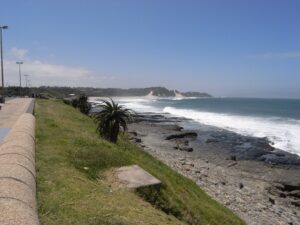
Image: Lysippos. Source. Licence. 2008 archival coastline photograph from East London, now KuGompo. The particular beach is not identified as Orient Beach; not the attack or emergency response. Display versions may be resized or cropped.