Nigeria’s proposed National Policing Bill has moved to legal-review stage after a presidential working group submitted the draft framework and 29 consequential amendment bills to the Federal Ministry of Justice.
The package was delivered to the Attorney-General of the Federation and Minister of Justice on Monday, 19 October 2026, according to a statement issued on Tuesday by Femi Gbajabiamila, Chief of Staff to President Bola Ahmed Tinubu and chairman of the working group.
The ministry is expected to examine whether the proposed laws meet legislative drafting standards, conform to established conventions and avoid conflicts with existing legislation. The Presidency said the validated drafts should be returned to the working group by Friday, 30 October.
After receiving the reviewed package, the group is due to consider it one more time before presenting it to President Tinubu. Any executive bill approved at that stage would still have to be transmitted to the National Assembly and pass through the federal legislative process.
The submission does not create state police services, and the proposed National Policing Bill is not yet law. It is an implementing framework being prepared while state Houses of Assembly consider a separate constitutional amendment intended to permit a dual policing system.
Gbajabiamila said the constitutional process must be completed before the National Policing Bill can be sent to the National Assembly. The Presidency did not publish the full draft or identify all 29 laws covered by the consequential amendment bills in Tuesday’s statement.
The proposed framework is designed to provide for a Federal Police Service operating alongside State Police Services. The working group’s public information portal says a state would not begin operational policing merely because the Constitution permitted it. Each participating state would need its own enabling law and would have to meet national minimum standards before certification.
The portal says the draft is intended to address recruitment, training, inspections, complaints, criminal-information systems, data sharing, firearms control, federal intervention, funding support and transitional arrangements. Earlier planning documents described a proposed principal statute of 20 substantive parts and 10 schedules, although the final structure will not be known until the reviewed text is released.
The 29 related bills are intended to deal with laws written for Nigeria’s present centralised system. A dual structure would require existing references to the Nigeria Police Force, police powers, command arrangements and institutional responsibilities to be examined and, where necessary, amended. The Presidency has not yet supplied a public list showing which statutes are affected.
The legal-review handoff is separate from the constitutional ratification process already under way in the states. The National Assembly transmitted the Constitution of the Federal Republic of Nigeria, 1999 (Sixth Alteration) Bill, 2026, to the 36 state legislatures in September.
At least 24 state Houses of Assembly must approve the constitutional change before it can proceed through the remaining amendment stages. Podium News reported earlier in October that Edo, Osun, Oyo and Rivers had approved the proposal at that point, leaving the measure well short of the required two-thirds threshold.
The reform has been promoted as a response to the pressures on a single federally controlled police structure serving communities affected by insurgency, kidnapping, banditry, communal violence, oil theft and organised crime.
Supporters argue that locally recruited officers could provide stronger knowledge of languages, terrain and community networks, while shorter command structures could improve emergency response. Governors have also complained that they are publicly held responsible for security without exercising operational control over police commands in their states.
Opponents and civil-society groups have warned that state forces could be used against political opponents, protesters, journalists and minority communities unless their powers are restrained by enforceable safeguards. Funding disparities are another concern, as states have sharply different capacities to pay salaries, maintain equipment and finance training, welfare, forensic services and independent oversight.
The working group says the framework is intended to establish common standards, readiness certification and inspection. Publication of the reviewed draft will allow lawmakers, security professionals and the public to assess whether its complaint mechanisms, command rules, financing arrangements and protections against partisan abuse are strong enough.
The Justice Ministry’s review is now the immediate administrative step. The working group expects to receive the validated package by 30 October, but presentation to the President and transmission to the National Assembly remain dependent on the completion of the preceding processes.
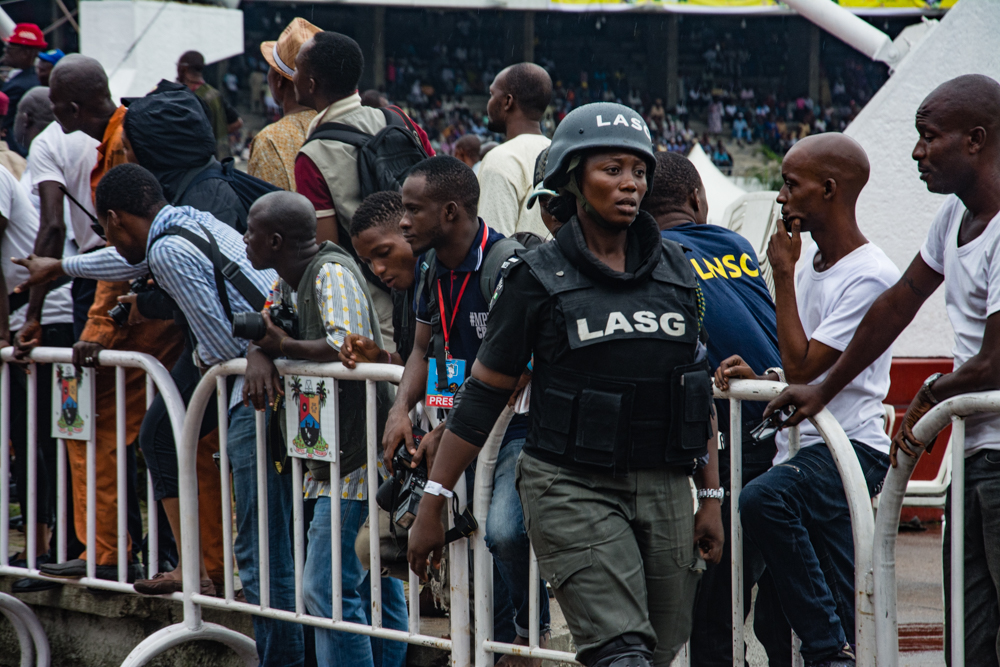
Image: Olasunkanmiariyo. Source. Licence. 14 May 2016, Eyo festival in Lagos. Archival policing illustration; does not depict the 2026 bill submission or establish state police. Display versions may be resized or cropped.