Adire’s familiar patterns begin with a practical act of protection: parts of a cloth are tied, stitched or covered so that they resist dye, leaving a design when the fabric is opened or the resist removed.
The Yoruba textile tradition is closely associated with women’s work in south-western Nigeria. Indigo-dyed cotton wrappers became a medium for skilled pattern-making, trade and named designs, with Abeokuta and Ibadan among its major production centres.
The Victoria and Albert Museum traces the technique to the nineteenth century and the use of the term àdìrẹ to the early twentieth. Its account describes how imported cotton shirting expanded the material available to makers in the 1920s, encouraging experimentation.
Different methods produce different effects. Raffia bindings keep dye from reaching selected sections of the fabric. Stitching can create lines and repeated shapes, while starch applied before dyeing protects a painted or stencilled design.
The British Museum’s terminology record distinguishes these methods rather than treating every Adire cloth as simple tie-dye. It notes that folding, stitching, tying and starch-resist work can appear together on a single textile.
One cloth acquired in Abeokuta in April 1971 demonstrates that combination. Catalogued as Akete, translated as “caps” or “owner of caps”, it contains alternating stripes, spirals and small circles. Stitched areas form narrow bands, while numerous tiny tied circles create other parts of the pattern.
The museum records the textile as two lengths of machine-woven cotton sewn together. That construction reflects the wrapper format in which many historic Adire cloths circulated, with the finished fabric offering a broad surface for repeated designs.
Adire eleko introduced another way of drawing on cotton. The specialist gallery Adire African Textiles describes makers painting cassava-starch paste onto the fabric before dyeing. Stencils cut from the tin lining of tea chests provided a further means of repeating motifs.
The gallery’s historical account links these developments to women becoming both artists and entrepreneurs as imported shirting reached Yoruba towns. The cloth was a commercial product responsive to buyers, as well as an expression of technical knowledge.
Names distinguish designs and connect them to subjects beyond decoration. A British Museum cloth called Ogunpari, meaning “war is finished”, was purchased in Ibadan’s Oje market in July 1971. Its stencilled composition places seated kings and royal symbols inside a repeated arrangement of rectangular panels.
Another named design, Ibadan Dun, celebrates the city itself. A 1971 museum example includes Mapo Hall’s pillars, birds, utensils and religious objects within 21 separate patterned sections. Its machine-sewn hems carry the maker’s signature.
The V&A also records signed cloths, including examples marked with a scorpion-like symbol. The museum has not been able to connect that mark with a maker’s name. The surviving sign nevertheless records an individual’s claim to the work.
Patterns have travelled into new forms of dress. By the 1960s, the V&A notes, Adire was being tailored into garments including men’s shirts and finding audiences outside Nigeria. Later practice incorporated wax resists and block-printing alongside hand-tying and folding.
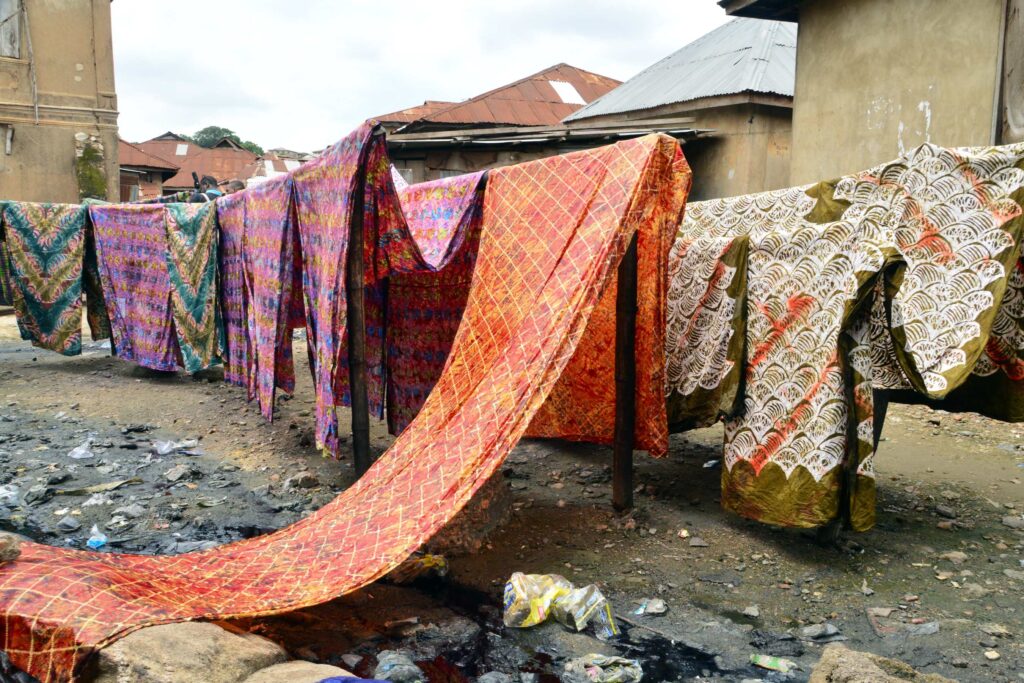
The photograph accompanying this feature shows fabrics hanging in Abeokuta in August 2018. It is an archive view of the textile-making city, not a photograph of a current festival or a demonstration of any single historic indigo pattern.
Archive photograph: Omoeko Media / Wikimedia Commons, 15 August 2018, CC BY-SA 4.0. Image resized by WordPress. Sources: V&A, British Museum collection records and Adire African Textiles.