UNICEF says its digital learning partnership with Airtel and the Nigerian government has reached about one million students and connected nearly 2,000 schools. The figures appear in an update published on 22 October after a delegation visited schools and youth programmes in Lagos and met federal officials in Abuja.
The partnership has also reached more than 20,000 teachers, including over 19,000 trained in digital literacy, according to UNICEF. These are programme reach figures, rather than a published assessment of changes in examination results or employment outcomes.
The Lagos visits included Government Senior College, Agege, and St George’s U.N.A. Primary School, where the delegation saw students and teachers using digital resources.
For students, access includes the opportunity to return to lessons outside the classroom. Polatose Adjola, identified as Government Senior College’s head girl in reporting by the News Agency of Nigeria, said the Learning Passport provided explanations, exercises and classwork for subjects she found difficult.
Adjola told NAN that revisiting material after school helped her understand challenging topics. Her account describes one learner’s experience of the platform; it is separate from the national reach figures in the partners’ statement.
The programme removes data charges for access to specified platforms through zero-rating. The latest statement names the Nigeria Learning Passport, the Federal Ministry of Education’s Inspire and Ignite platforms, its digital education management information system and YOMA.
The delegation also met the Office of the Vice President and education ministry in Abuja. Its discussions addressed connectivity, teacher training, online safety, inclusive design and sustainable financing.
The partnership predates the current administration. In December 2022, Airtel and UNICEF announced plans to connect 620 primary schools and benefit 300,000 students with internet access and devices. That announcement placed the Nigerian work within a five-year partnership and identified the Learning Passport as a platform developed by the education ministry, UNICEF and Microsoft.
The Learning Passport’s total registration figures cover a wider population than the students reached through this particular partnership. UNICEF’s October update records more than 2.5 million registered students and nearly 100,000 registered teachers on the platform. They should not be added to the partnership’s one million students as if they were separate groups.
UNICEF had already announced one million Learning Passport subscribers in June 2024. At that point, it described more than 15,000 curriculum-aligned resources, including interactive lessons, digital textbooks and self-paced modules for primary and secondary education, with support for teachers and parents.
The 2024 programme description identified Mathematics, Science, English and Social Studies among its core subjects, with videos, quizzes and interactive activities. It also recorded content in English, Hausa, Igbo and Yoruba. Teacher resources formed another part of the offer, alongside materials learners could work through at their own pace.
The education ministry’s current eLearn directory lists the Learning Passport for learners and teachers at basic and senior secondary levels. It lists Ignite for teachers and lesson planning, while Inspire covers learners from basic through tertiary education. YOMA appears under skills and personal development.
Learners and teachers can find the official links through the ministry’s eLearn directory. The Learning Passport’s own website describes online, mobile and offline capability, with states able to adopt it as a learning-management system or use it alongside existing digital provision.
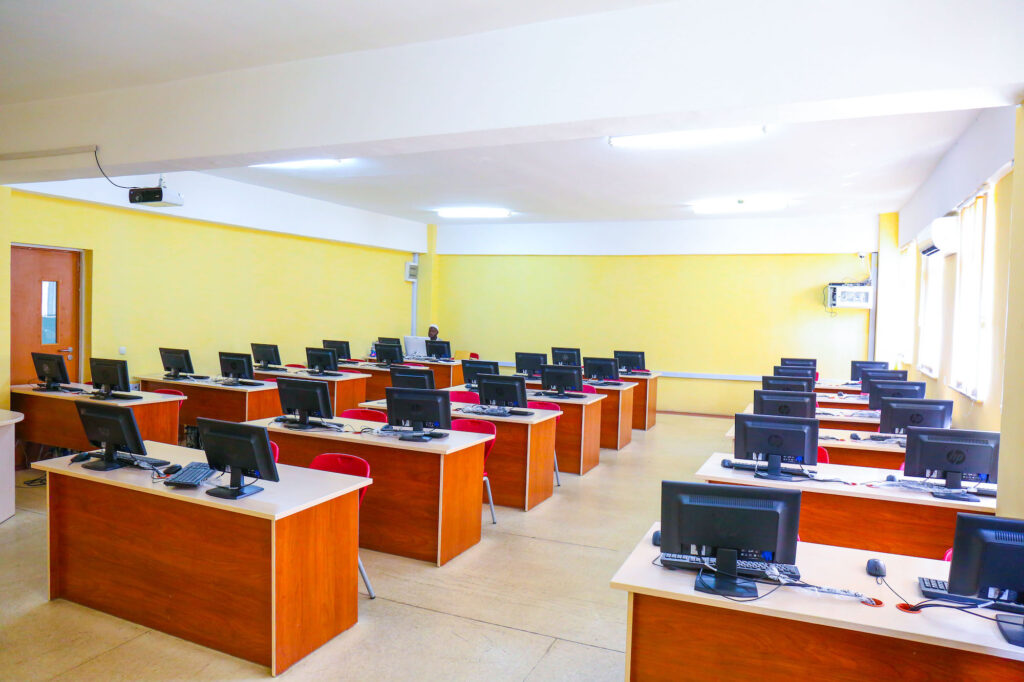
Archive illustration: computer laboratory at Nile University of Nigeria, 7 June 2021, by Chris Ikpemi, CC BY-SA 4.0. This is not an Airtel or UNICEF-supported classroom, a participating school or the October delegation. Source; licence. Resized for display.