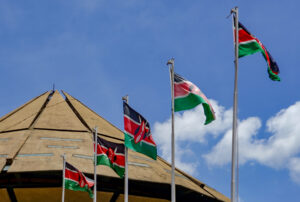
Kenyan flag in Nairobi, 17 April 2016. Archive photograph used for country context, not the outbreak or patients. Photograph: <a href="https://commons.wikimedia.org/wiki/File:Nairobi,_Kenya_(49665369407).jpg">Nina R/Wikimedia Commons</a>, <a href="https://creativecommons.org/licenses/by/2.0/">CC BY 2.0</a>.
Kenya has reported its second Ebola death after a 65-year-old woman died while receiving care for Bundibugyo virus disease. Seven other patients remain under treatment, the health ministry said on 23 October.
The woman was a close relative and direct contact of Kenya’s first confirmed patient, who also died. She had been in quarantine when she developed symptoms on 13 October and entered an infectious disease unit that day.
Director-General for Health Patrick Amoth said she died early on Friday evening despite supportive care. The ministry’s statement, reported by Kenya Broadcasting Corporation, put the country’s cumulative total at nine confirmed cases.
Officials said all confirmed infections remained within one cluster of known contacts, with no evidence of community transmission. That assessment describes the information available to investigators; it does not establish that further infections cannot occur.
The ministry said trained teams would arrange a safe and dignified burial in consultation with the family. It also asked the public and media to respect the family’s privacy.
The World Health Organisation had documented the woman’s infection in an update dated 16 October. That account identified her and a 39-year-old man as relatives of the first patient who fell ill while already in quarantine.
Kenya’s first patient had returned from the Democratic Republic of Congo and died on 5 October. WHO described that infection as the first Ebola case ever recorded in Kenya.
WHO says Ebola spreads through direct contact with infected blood or other bodily fluids, or contaminated objects. People do not transmit the virus before symptoms begin. Monitoring contacts can therefore help health teams identify illness and arrange isolation promptly.
Early symptoms can resemble malaria and other common illnesses. WHO lists fever, fatigue, muscle or joint pains, headache and sore throat among the initial signs. Supportive treatment includes fluids to prevent dehydration and care for symptoms.
Featured photograph: Kenyan flags in Nairobi, 17 April 2016, by Nina R/Wikimedia Commons, CC BY 2.0. Archive image for country context; it does not show the outbreak, patients or treatment site. Display versions may be resized or cropped.