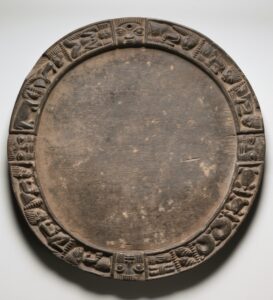
The ọpọ́n Ifá provides the working surface for Yoruba divination, with a smooth centre surrounded by a carved border. Faces, animals and human figures occupy the rim, while the central space receives the powder in which the diviner records signs.
The tray belongs to the equipment of the babalawo, who interprets the signs through the Ifá literary corpus. It has a separate function from the iroke Ifá, the tapper sounded during a consultation, and the àgéré Ifá, the vessel that holds sacred palm nuts.
At Cornell University's Herbert F. Johnson Museum of Art, a twentieth-century wooden tray offers an account of how these objects were made. The museum describes trays carved from a piece of wood using an adze, knives and chisels. Its example, attributed to Yoruba people in south-western Nigeria, measures 18.4 centimetres and entered the collection as a gift from Mr and Mrs William W. Brill.
Cornell's interpretation connects the tray with consultation of Orunmila, the divinity associated with wisdom. It describes a thin layer of wood dust spread across the working surface. The tapper sounds against the board's side, accompanied by praise chants, at the beginning of the session.
The carved face is a recurrent feature. Cornell records differing interpretations among diviners: some understand it as the tray's own face, while others identify Eshu Elegba, the divine messenger. Its account associates Eshu with communication between the earthly and spiritual worlds.
A larger example at the Cleveland Museum of Art places four faces around its circular border. The museum identifies them as Esu, using another spelling of the deity's name. Between them, smaller figures and animals fill panels around the edge.
Cleveland dates the wooden tray to the twentieth century and catalogues its maker cautiously as Yoruba-style. It measures 42 centimetres across and came into the collection through Drs James and Gladys Strain. The catalogue does not name an individual carver.
The museum interprets kneeling figures as possible petitioners. One holds a leashed animal intended for sacrifice. Turtles, curled mudfish and snails also appear. In the museum's reading, these creatures refer to the diviner's connection between human and spiritual realms.
Trays were not restricted to a circular form. The Allen Memorial Art Museum at Oberlin records round, oval and square examples, describing their patterned borders in terms of balance, harmony and order. Its own carved wooden tray dates from the middle of the twentieth century.
Oberlin's account also explains the positioning of the carved face opposite the diviner. Marks made in the central surface direct the priest to a particular passage of a memorised sacred text. The consultation brings the marked surface, recitation and interpretation together.
UNESCO describes Ifá as a system of interpreted signs, rather than a practice dependent on a person's oracular powers. The literary corpus contains 256 parts, known as odu, subdivided into verses called ese. The organisation says the number of verses is not fixed because the corpus continues to grow.
The tradition is practised among Yoruba communities and in the African diaspora in the Americas and Caribbean. Proclaimed a Masterpiece of the Oral and Intangible Heritage of Humanity in 2005, the Ifá divination system entered UNESCO's Representative List in 2008.
Image: Divination Tray (ọpọ́n Ifá), 1900s, wood. Cleveland Museum of Art, Gift of Drs. James and Gladys Strain, 1993.235. Museum photograph, CC0. Photograph date unconfirmed; resized with the whole object retained.