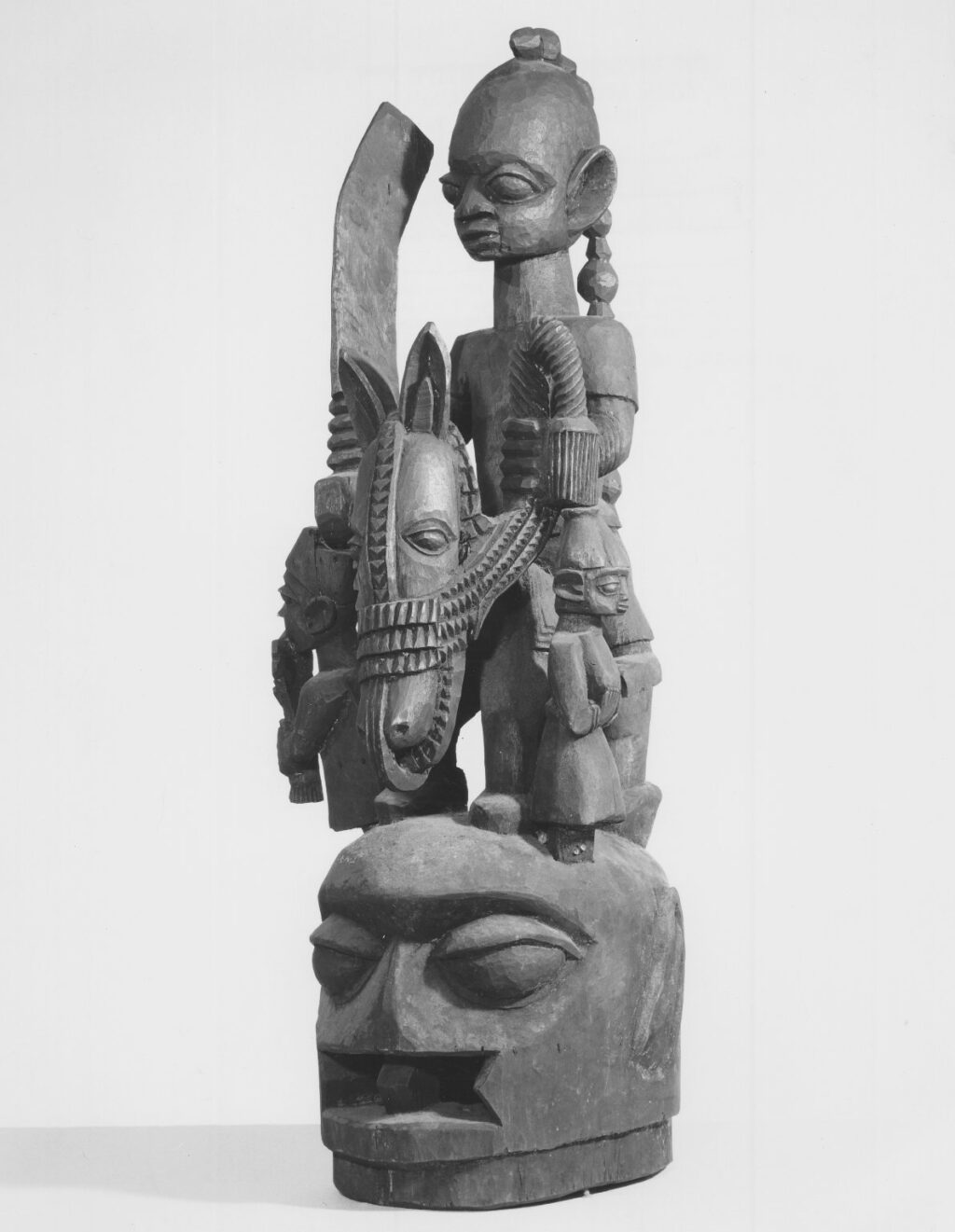
Ẹpa masks place carved scenes of Yoruba life above a performer’s head. Associated especially with Ekiti, these towering wooden headdresses bring mounted warriors, mothers, children and attendants into festivals shaped by the histories of particular communities.
A helmet forms the base, with a sculptural arrangement rising above it. Some helmets have faces looking in opposite directions. The carving can be exceptionally elaborate, but its meaning also depends on the lineage, town and religious setting in which it appears.
Art historian Will Rea’s study, The Ẹpa Masquerades of Èkìtì, published in African Arts in 2019, cautions against treating every similar headdress as part of one uniform festival. He identifies related forms used in ceremonies with different names, including Ẹpa, Elefon and Egbùrù.
Rea’s account draws on his fieldwork and on photographs taken by Phillip Allison at Ikùn-Ọba in 1960. The ceremony recorded there was locally known as Egbùrù. Four masks with different sculptural themes appeared alongside a senior mask bearing that name.
In the performance Rea documented in 1990, the masks greeted particular quarters of the town. Their appearances involved drumming, dancing and oríkì, or praise poetry. That account ties each figure to a community and its relationships, rather than presenting the wooden object as a complete performance in itself.
The National Museum of African Art in Washington describes Ẹpa masks as objects owned and revered by lineage groups. They refer to family and town histories, as well as community values. Its collection includes a large equestrian headdress by Moshood Olusomo Bámigbóyè.
That work stands 140 centimetres high and weighs 18.8 kilograms. A king on horseback occupies the centre, surrounded by tiers of attendants. The museum interprets the horse as a sign of power associated with cavalry traditions to the north. Musicians, warriors and wives gather around the ruler.
Bámigbóyè’s carving in the Cleveland Museum of Art offers another view of a royal gathering. Dated to 1920 to 1930, it is called Atófòjọ́wò, which the museum translates as “You Can Look at It for a Whole Day”. A king and his attendants rise above the helmet.
The Cleveland headdress is largely carved from one piece of wood, although two small figures carrying fans were attached separately. Conservators have examined its surviving colours. Their analysis points to clay in the white paint, charred plant material in the black and earth pigments in other colours.
Such works required strength as well as balance from their bearers. Cleveland records its example at 44.25 pounds, roughly 20 kilograms. The object’s height, weight and crowded carving give a sense of the physical demands involved in carrying it during a festival.
Royal and military subjects form only part of the sculptural vocabulary. A headdress in the Science Museum Group collection depicts a woman working with a pestle and mortar. One child rides on her back, while another holds the mortar. Dated to 1870 to 1920, it records work and family life in the same sculptural form used for imposing riders.
The archive photograph accompanying this feature shows a different Ẹpa mask in Brooklyn Museum, accession 70.107.13. Dated to the late nineteenth or early twentieth century, it places a sword-bearing rider and smaller figures above a broad helmet face. The museum connects its mounted figure with the history of cavalry warfare along the northern edges of Yorubaland.
Archive photograph: Brooklyn Museum, Gift of David R. Markin, accession 70.107.13, via Wikimedia Commons, CC BY 3.0. No current festival is depicted.