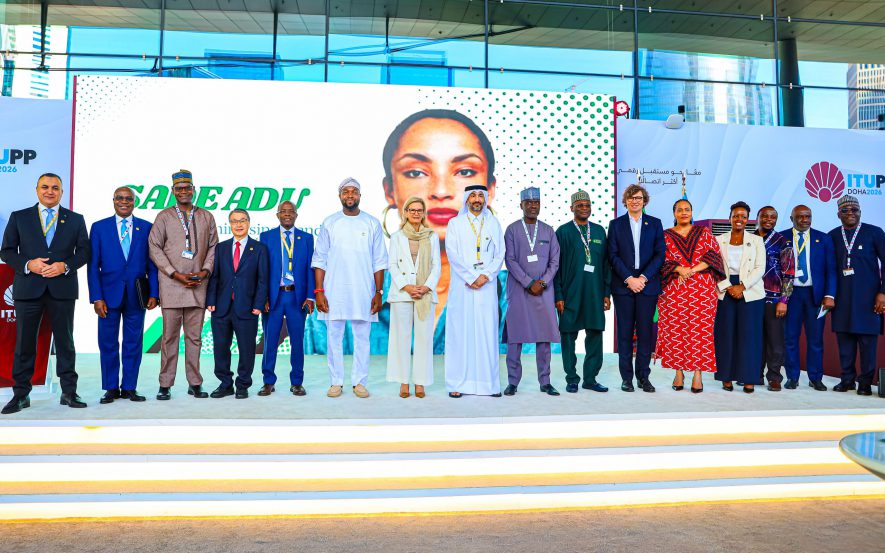
Delegates at the ITU Plenipotentiary Conference 2026 in Doha, Qatar. Photograph: Federal Ministry of Communications, Innovation and Digital Economy.
Nigeria has been re-elected to the Council of the International Telecommunication Union (ITU) for the 2027 to 2030 term, securing 121 votes in the African regional election held at the organisation’s Plenipotentiary Conference in Doha, Qatar, on Monday, 16 November.
The official election results list Nigeria among 13 African countries elected to the 48-member Council. Ghana also received 121 votes. The result gives Nigeria another four-year place on the body responsible for guiding the United Nations agency’s work between Plenipotentiary Conferences.
The Council oversees ITU activities, policies and strategies, manages working groups and prepares draft strategic and financial plans for consideration at the organisation’s next Plenipotentiary Conference. Its decisions help shape international cooperation on telecommunications, digital infrastructure and the rules governing the use of shared communications resources.
Tinubu credits ministers and diplomatic team
President Bola Ahmed Tinubu welcomed the result in a statement issued by the State House on 16 November. He described the re-election as a diplomatic and strategic achievement and urged Nigeria’s representatives to use the renewed mandate to advance digital innovation, telecommunications development and international cooperation.
Tinubu credited the Minister of Foreign Affairs, Ambassador Bianca Odumegwu-Ojukwu, with coordinating Nigeria’s diplomatic engagement, and the Minister of Communications, Innovation and Digital Economy, Dr Bosun Tijani, with leading the delegation to Doha.
The President also recognised Professor Mahmood Yakubu, who served as Deputy Head of Delegation; the Executive Vice-Chairman of the Nigerian Communications Commission, Dr Aminu Maida; Nigeria’s Permanent Representative to the United Nations Office in Geneva, Ambassador Innocent Imejuo; and officials of the communications ministry, the NCC, the Permanent Mission in Geneva and the Nigerian Embassy in Doha.
“I appreciate the dedication, teamwork and professionalism of all members of the Nigerian delegation and diplomatic personnel whose collective efforts contributed to this successful outcome,” Tinubu said.
In a statement published by the Federal Ministry of Communications, Innovation and Digital Economy, Dr Tijani said the result reflected the confidence of ITU members in Nigeria’s contribution to the global digital agenda. He said the country would use its renewed mandate to advance meaningful connectivity, strengthen Africa’s voice and ensure emerging technologies create opportunities for Nigerians.
A longer record of participation
The ministry said Nigeria’s involvement in the ITU Council stretches across several decades, with service on the body dating back to 1973. It described the 2027 to 2030 term as a continuation of the country’s participation in international telecommunications governance rather than a first entry into the organisation’s decision-making structure.
The ministry also pointed to Dr Tijani’s election as Vice-Chair of the ITU Council in June 2025 and his subsequent role as Chair of the 2026 Council session in Geneva. It said the Council endorsed a revised draft strategic plan for consideration at the Doha conference and approved the Union’s operational plan for 2027 during that period.
Nigeria’s work on submarine cable resilience has been another part of its engagement. The communications ministry said Dr Tijani was appointed Co-Chair of the ITU International Advisory Body for Submarine Cable Resilience in 2024, an initiative established with the International Cable Protection Committee. Nigeria hosted an international submarine cable resilience summit in Abuja in February 2025, and the advisory body’s work produced recommendations adopted in July 2026.
Submarine cables carry more than 99 per cent of international data traffic, according to the ministry. Their resilience affects the reliability of internet and telecommunications services across borders, making protection, repair coordination and alternative routing important issues for governments and network operators.
The ministry also cited regional digital infrastructure discussions involving Nigeria and neighbouring countries. These include work with Togo on plans for a regional data park and cooperation with Chad, Burkina Faso and the Republic of Benin on cross-border connectivity. The ministry said Nigeria had advocated a shared regional protocol for infrastructure resilience, including arrangements for rerouting network traffic and coordinating repairs when cables fail.
What the Council seat can and cannot do
The ITU is the United Nations specialised agency for information and communication technologies. It brings together 194 Member States and more than 1,000 companies, universities, civil society organisations and regional bodies. Its work includes international telecommunications standards, radio-frequency spectrum, satellite orbits and efforts to expand connectivity.
Nigeria’s re-election gives the country a place in discussions that shape the agency’s priorities and strategic direction. It does not, by itself, guarantee new funding, lower data prices, additional broadband coverage or the construction of telecommunications infrastructure in Nigeria. Those outcomes depend on domestic policy, investment, regulation and the practical work of public agencies and network operators.
The next term will therefore give Nigeria an opportunity to press for priorities it has identified, including affordable and meaningful connectivity, resilient digital infrastructure, child online protection, digital skills and responsible innovation. The value of the seat will be measured not only by representation in Doha, but by the quality of the country’s contribution to decisions that affect people and businesses across Africa.
The Plenipotentiary Conference continues in Doha until 27 November, with Member States considering the ITU’s strategic and financial plans for the next four years. Nigeria’s renewed Council mandate begins in 2027.