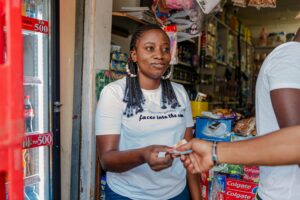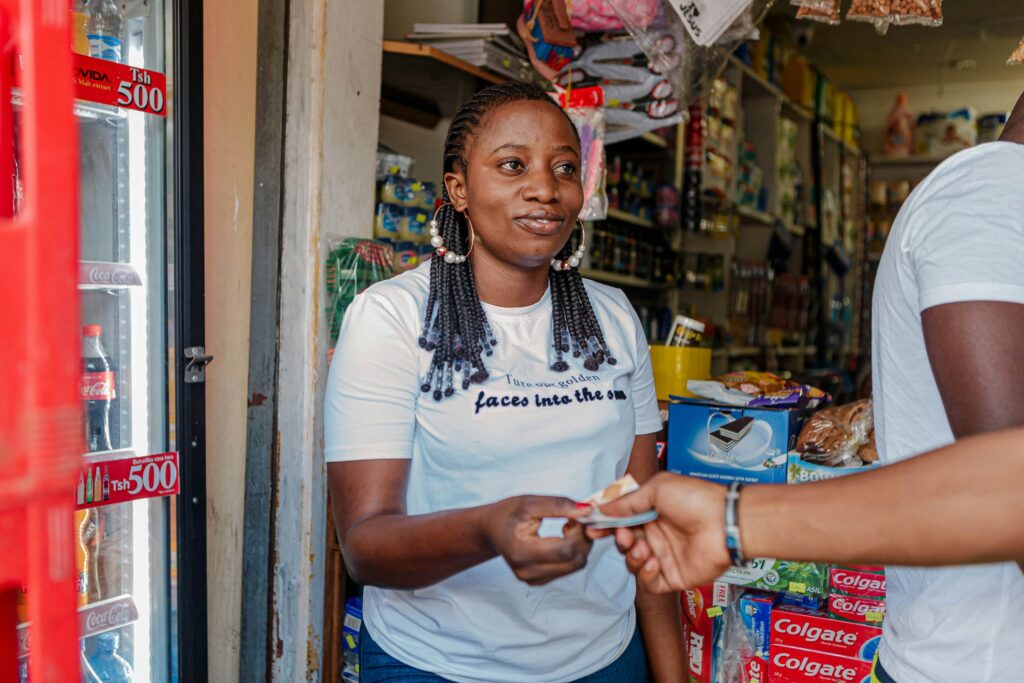
Illustrative photograph of African businesswomen receiving payment at a small shop in Dar es Salaam, Tanzania. Photograph: Ali Mkumbwa/Unsplash.
Formal micro, small and medium-sized enterprises (MSMEs) in emerging market and developing economies faced a credit shortfall estimated at US$4 trillion in 2023, according to new World Bank Group research released on Tuesday, 17 November. The gap increased from US$3.6 trillion in 2019, an 11 per cent rise over four years.
The World Bank said the shortfall limits smaller firms’ ability to expand, trade, compete and create jobs. Its reports describe MSMEs as central to employment and economic activity, accounting for about 90 per cent of businesses and 75 per cent of workers in developing economies.
The figures cover 114 emerging and developing economies. They are not an estimate of Nigeria’s individual financing gap, and the headline US$4 trillion figure applies to formal businesses rather than the full universe of informal enterprises.
Sub-Saharan Africa among the most constrained regions
The International Finance Corporation’s MSME Finance Gap report says smaller firms in sub-Saharan Africa face some of the most severe financing constraints among the regions studied. Financing for smaller businesses has stagnated or declined in parts of the region, even as demand for working capital and investment continues.
The report traces the global formal MSME credit gap from US$3.6 trillion in 2019 to US$4 trillion in 2023. The shortfall is equivalent to about 11 per cent of the combined gross domestic product of the economies covered. The IFC says the gap is concentrated in different regions for different reasons, with Latin America and the Caribbean accounting for about 32 per cent of the total in dollar terms and East Asia and the Pacific about 28 per cent.
Credit is not the only missing source of capital. The World Bank’s Finance and Prosperity 2026 report estimates a separate US$1.4 trillion shortfall in equity investment for early-stage and growth financing of formal MSMEs, equivalent to about 3.3 per cent of GDP. Equity funding can be important for businesses that need patient capital to develop products, enter new markets or expand without taking on more debt.
The informal sector is outside the headline figure
The US$4 trillion estimate covers formal enterprises. The IFC report separately estimates that potential financing demand from informal businesses could represent another US$2.3 trillion. That figure is not added to the headline total because informal firms are harder to measure consistently across countries and are often missing from formal business and credit datasets.
The distinction is particularly relevant in lower-income economies, where informal businesses account for a substantial share of economic activity. A country can therefore have a large financing need that is not fully captured by formal lending statistics. The World Bank cautions that the formal gap should not be read as a complete measure of all the capital smaller businesses need.
The report also estimates a US$521 billion finance gap for women-owned MSMEs, about 13 per cent of the formal MSME gap. The IFC says the figures should be interpreted carefully because comparable gender-disaggregated lending data remains limited. Changes in the estimate are influenced in part by revised data from China and should not automatically be attributed to particular national policies.
Access to credit and business growth
The World Bank’s Finance and Prosperity 2026 report says firms with access to formal loans can record average employment that is 12 per cent higher, with sales and profits about 18 per cent higher. The estimates underline the potential contribution of financing, although access to credit alone does not remove other barriers such as weak infrastructure, uncertain demand, high operating costs and regulatory complexity.
World Bank Group Vice-President for Prosperity Pablo Saavedra identified four recurring obstacles: small businesses can be difficult for financial institutions to assess when they lack digital records, are disconnected from markets and services, face complex regulation and have limited access to suitable finance.
The World Bank Group launched a new MSME strategy in October. It aims to use data and digital tools to help make businesses more visible to lenders, connect them to markets and services, improve the conditions in which they operate and expand access to finance. The Group says it will work with banks, fintech companies and governments through risk-sharing arrangements, equity investment and measures intended to reduce administrative barriers, with particular attention to fragile and conflict-affected countries.
The financing challenge is also tied to the jobs outlook. The World Bank estimates that 1.2 billion young people in developing countries will reach working age over the next 10 to 15 years. Smaller firms will be important to absorbing that workforce, but the reports warn that employment growth will be constrained if viable businesses cannot obtain the capital needed to expand.
For African economies, the findings point to a need for more than additional loan products. Better business records, reliable digital payment histories, credit information, appropriate collateral alternatives, stronger financial institutions and links to larger markets all influence whether lenders can assess smaller firms at a sustainable cost. Governments, banks, investors and technology providers will need to work together if the finance gap is to narrow.
The World Bank’s US$4 trillion estimate is a measure of unmet credit demand among formal MSMEs across developing economies, not a promise of funding and not a country-by-country allocation. Its significance for Africa lies in the scale of the constraint identified for smaller firms and the report’s warning that financing in parts of sub-Saharan Africa is failing to keep pace with business needs.
Illustrative photograph of African businesswomen receiving payment at a small shop in Dar es Salaam, Tanzania. Photograph: Ali Mkumbwa/Unsplash. The image is contextual and does not depict the World Bank reports.
World Bank Group press release, 17 November 2026 and IFC, MSME Finance Gap Report, November 2026.