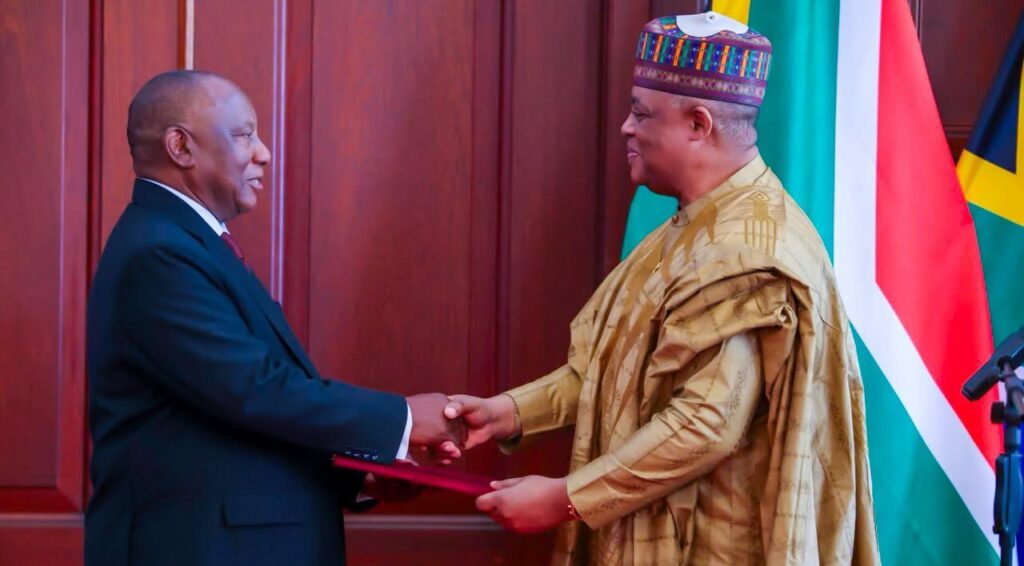
Archival photograph of Nigeria's High Commissioner Femi Fani-Kayode presenting his letters of credence to South African President Cyril Ramaphosa in Pretoria on 13 November 2026. Photograph: Federal Ministry of Foreign Affairs, Nigeria.
South Africa has formally conveyed concerns to Nigeria’s High Commissioner, Olufemi Adewumi Fani-Kayode, publicly known as Femi Fani-Kayode, over the dispute surrounding his presentation of diplomatic credentials to President Cyril Ramaphosa and comments he made afterwards on social media.
The Director-General of South Africa’s Department of International Relations and Cooperation (DIRCO), Zane Dangor, met Fani-Kayode on Tuesday, 17 November. In a statement issued after the meeting, DIRCO said Dangor raised concerns about events following the presentation of the Nigerian envoy’s Letters of Credence and his subsequent social media remarks.
Dangor also reminded the High Commissioner of Article 41 of the 1961 Vienna Convention on Diplomatic Relations. DIRCO said official communication between diplomatic agents and the receiving state should be conducted through established diplomatic channels, including the host country’s foreign affairs ministry.
South Africa’s public broadcaster, the SABC, described the action as a diplomatic démarche. DIRCO’s own statement described a meeting in which concerns were conveyed. It did not announce that Fani-Kayode had been expelled or declared persona non grata.
Dispute over the credentials ceremony
The disagreement followed the presentation of Fani-Kayode’s credentials to Ramaphosa at the Sefako Makgatho Presidential Guest House in Pretoria on Friday, 13 November. Nigeria’s Ministry of Foreign Affairs said the ceremony was an opportunity for the new High Commissioner to convey President Tinubu’s greetings and reaffirm Nigeria’s commitment to strengthening relations with South Africa.
After the event, Fani-Kayode alleged that the South African Presidency had deliberately omitted his introduction, the Nigerian delegation and his speech from the official livestream. He said the addresses of the other diplomats at the ceremony had been broadcast, while the stream returned only after his remarks had ended.
The South African Presidency disputed his account. Spokesperson Vincent Magwenya said Ramaphosa had not intervened in the operations or editorial decisions of the South African Broadcasting Corporation. He said the President had referred Fani-Kayode to the appropriate SABC official to raise his complaint. The Presidency later released a separate video of the Nigerian envoy’s speech.
The Nigerian High Commission defended Fani-Kayode during the public exchange that followed, rejecting the Presidency spokesperson’s characterisation of his conduct and calling for restraint, reconciliation and respect for the bilateral relationship.
Both sides describe the latest meeting as constructive
Fani-Kayode later described his meeting with Dangor as cordial and constructive. In a post on his X account, he said the two officials had discussed mutual concerns about bilateral relations and the events surrounding the credentials ceremony. He said he looked forward to working with DIRCO to strengthen relations between the two countries.
DIRCO also stressed that South Africa remained committed to its strategic partnership with Nigeria. Its statement referred to the longstanding relationship between the countries and said the meeting was intended to preserve cooperation based on mutual respect, friendship and African solidarity.
The episode has placed an early test before a High Commissioner who, in his first public statement after presenting his credentials, pledged to rebuild bridges and address areas of concern through dialogue. Nigeria and South Africa have a long record of cooperation, including Nigeria’s support for South Africa during the struggle against apartheid, but their relationship has also been affected by recurring disputes over migration, xenophobic violence and the safety of Nigerians living in South Africa.
The diplomatic record now contains three distinct positions: Fani-Kayode’s complaint about the livestream, the South African Presidency’s rejection of his account, and DIRCO’s formal reminder that official business should be handled through diplomatic channels. The High Commissioner has described the latest meeting as constructive.
DIRCO’s statement does not say that South Africa has withdrawn its acceptance of Fani-Kayode as High Commissioner. No announcement of expulsion or a change to his diplomatic status accompanied the meeting.
Archival photograph: Nigeria’s High Commissioner Femi Fani-Kayode presents his Letters of Credence to South African President Cyril Ramaphosa in Pretoria on 13 November 2026. Photograph: Federal Ministry of Foreign Affairs, Nigeria. The photograph shows the credentials ceremony, not the 17 November meeting.
DIRCO’s statement on the 17 November meeting and Nigeria’s Ministry of Foreign Affairs statement on the credentials ceremony.