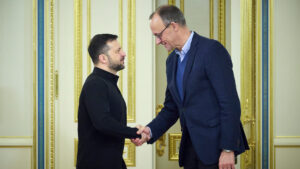
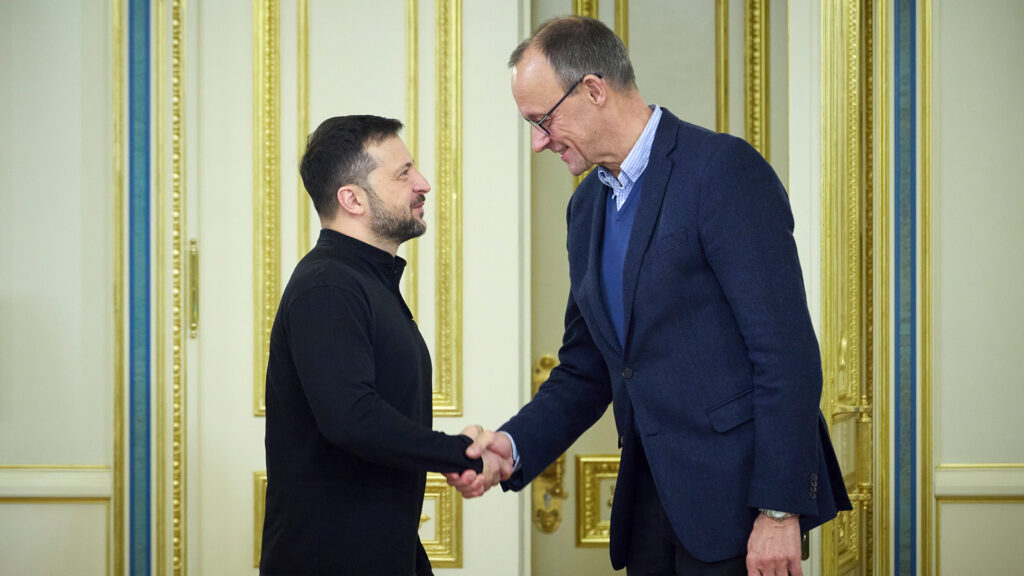
German Chancellor Friedrich Merz arrived in Kyiv on Sunday with a package worth €1.35 billion and plans to deepen joint drone production, as Russia intensifies attacks on Ukrainian cities and energy infrastructure ahead of winter.
German government officials said the measures include the release of €1 billion in military assistance and €350 million for repairs to Ukraine’s battered energy sector. The visit is also expected to advance an agreement covering the joint development and production of drones, missiles and associated software.
Merz travelled with Economy and Energy Minister Katherina Reiche and senior executives from German industrial and defence companies, including Siemens Energy, Hensoldt, Diehl Defence and Quantum Systems. The composition of the delegation underlines how support for Ukraine is increasingly being tied to long-term industrial cooperation rather than the transfer of finished equipment alone.
“I travelled to Kyiv today because Ukraine needs all our support in the coming weeks,” Merz said, citing Russian attacks on towns, residential buildings and heating plants.
He added that President Volodymyr Zelenskyy could continue to count on German assistance and warned that Europe’s wider security would be at risk if Russia were not stopped.
The proposed drone partnership is expected to focus partly on rapidly expanding production of interceptor systems designed to counter high-speed jet-powered attack drones. These weapons have become an increasingly important part of Russia’s aerial campaign against both civilian and military infrastructure.
German defence technology company Quantum Systems and Ukrainian manufacturer WIY Drones created Quantum WIY Industries in April to produce the Strila interceptor drone and related air-defence technology. The latest talks are expected to build on that venture while extending cooperation to other unmanned systems and long-range weapons.
Ukraine said earlier in the week that the two governments were finalising the text of a broader agreement. The proposed arrangement would cover drones, missiles and software while allowing both countries to strengthen their defence industries through shared investment, battlefield experience and production capacity.
The model reflects a wider shift in European support for Kyiv. Ukraine has developed a sophisticated domestic drone industry during the war, frequently adapting systems faster than conventional procurement cycles allow. European partners, meanwhile, offer larger industrial bases, financing and manufacturing sites that are less exposed to Russian attack.
For Germany, the cooperation is also intended to strengthen domestic protection against unmanned aircraft targeting airports, energy facilities and other critical infrastructure. Government officials said the arrangement could bring technology and production activity back to Germany while improving Ukraine’s ability to defend itself.
The energy component of the package carries immediate humanitarian significance. Repeated Russian strikes have damaged power and heating infrastructure, raising fears of difficult conditions for households as colder weather approaches. The €350 million allocation is intended to support repairs and resilience measures before demand peaks.
Merz is also expected to press Ukraine for progress on reforms requested by European Union partners, including stronger anti-corruption safeguards. Kyiv’s EU membership ambitions have made governance reforms an important part of its relationship with European governments, even as military support remains urgent.
The visit comes during a sharp escalation in the conflict. Russia said on Saturday that it would continue what it described as retaliatory strikes on targets in Ukraine and warned foreign nationals and diplomatic staff against travelling to or remaining in the country.
Ukraine, in turn, has said it will intensify attacks on Russian oil refineries in response to what Zelenskyy described as a broader Russian policy of striking cities and civilian infrastructure. Both governments deny deliberately targeting civilians, although attacks have repeatedly caused deaths, injuries and extensive damage far from the front line.
The planned German investment will not, by itself, change the course of the war. Its importance lies in the combination of immediate military aid, energy-system repairs and an industrial partnership designed to produce equipment over a longer period.
That approach may prove especially important as Ukraine faces sustained aerial attacks and uncertainty over the pace of support from some allies. Joint production can shorten supply chains, spread technological knowledge and help manufacturers respond more quickly to changes in drone warfare.
Merz’s Kyiv visit therefore represents more than another diplomatic declaration. It links Europe’s security concerns to Ukraine’s immediate winter needs and to a growing defence industry whose innovations are reshaping modern warfare.
Readers can follow Podium News for verified updates as Germany and Ukraine disclose the final terms of the drone agreement and the timetable for releasing the new assistance.