
The Democratic Republic of the Congo’s Ebola outbreak has reached 7,890 confirmed cases and 3,799 deaths, with the virus now detected across 63 health zones in seven of the country’s 26 provinces, according to the World Health Organization.
WHO’s latest assessment, published on 25 September and based on data through 23 September, shows that the Bundibugyo virus disease outbreak is continuing to expand geographically despite signs of declining transmission in some of the areas hit hardest earlier in the crisis.
The two most recently affected health zones are Bulu in Sud Ubangi province, in the north-west of the country, and Dungu in Haut-Uélé province near the border with South Sudan. The arrival of the virus in Sud Ubangi brought the number of affected provinces to seven and increased concern about transmission across national borders.
The latest totals represent 1,133 additional confirmed cases and 532 deaths since WHO’s previous Disease Outbreak News update on 11 September. The reported case fatality ratio is 48.1 per cent, meaning almost half of confirmed patients have died.
WHO said the continuing high number of deaths occurring outside treatment centres points to delayed detection and difficulty obtaining early, appropriate care. Such delays affect patients’ chances of survival and allow transmission to continue within homes, communities and health facilities.
Ituri remains the outbreak’s epicentre, accounting for 6,032 confirmed cases. North Kivu has recorded 1,480 cases and currently has the outbreak’s highest provincial fatality ratio at 59.7 per cent. Investigations are continuing into the reasons for that exceptionally high mortality.
Although transmission in Ituri has gradually declined from its mid-August peak, it remains elevated. North Kivu recorded a substantial rise before reaching its highest reported incidence in mid-September, followed by an apparent recent decline. Haut-Uélé continues to experience sustained transmission, while Tshopo has recorded renewed activity.
The outbreak is the largest Ebola epidemic ever documented in DR Congo, regardless of the Ebola virus species involved. It is also the country’s second recorded outbreak caused by the Bundibugyo virus, following an outbreak in 2012.
Podium News reported in May that WHO had raised the national risk level to very high. The scale has since changed dramatically. Another earlier Podium News report examined Nigeria’s preparedness and the NCDC’s public guidance.
Bundibugyo virus disease is a severe form of Ebola. It is believed to pass initially from infected wildlife to humans and then between people through direct contact with blood or other bodily fluids, contaminated materials, or unsafe handling of the bodies of people who have died.
People are not infectious before symptoms begin. Early symptoms can include fever, fatigue, muscle pain, headache and sore throat, which can resemble malaria and other common illnesses. Laboratory testing is therefore essential for an accurate diagnosis.
The incubation period ranges from two to 21 days. Early identification, isolation, supportive treatment, contact tracing, safe burials and infection prevention measures remain central to controlling transmission.
Unlike the Zaire Ebola virus, the Bundibugyo species currently has no approved vaccine or specific treatment. WHO says clinical research is under way, but the absence of a licensed vaccine makes rapid detection and reliable infection control particularly important.
The demands on surveillance teams are already immense. Of 32,342 identified contacts requiring follow-up on 23 September, 26,980 were successfully monitored during the preceding 24 hours. That represents 83.4 per cent, leaving thousands who were not reached within the reporting period.
The response is also being complicated by armed conflict, insecurity, displacement and weak access to basic services. These conditions restrict the movement of health teams, interrupt contact tracing and make it harder for sick people to reach treatment facilities promptly.
Overcrowded settlements, informal mining communities and areas with inadequate water and sanitation create additional obstacles. Fear, misinformation and mistrust can also discourage families from reporting symptoms or accepting safe burial procedures.
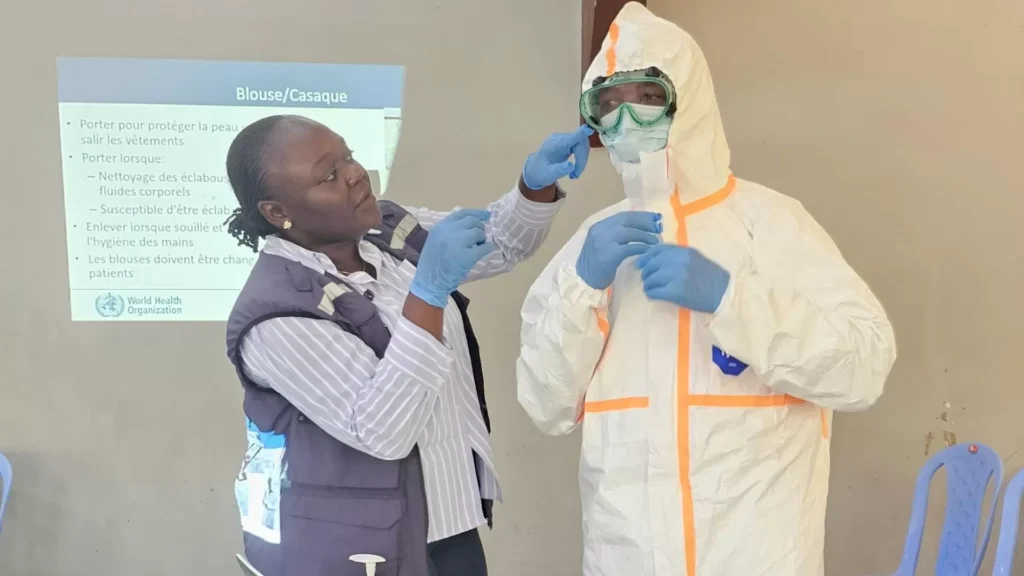
WHO and Congolese health authorities are expanding surveillance, laboratory testing, clinical care, infection prevention, community engagement and logistical support. Frontline teams have reorganised triage areas, installed handwashing facilities and trained health workers to recognise and isolate suspected cases safely.
At Mongbwalu General Reference Hospital in Ituri, infection prevention specialist Nadège Esangowale Yangala has worked with local teams to strengthen patient screening and the safe movement of suspected cases. Her message to colleagues is direct: “These simple actions save lives.”
The geographic spread creates a wider regional concern. Dungu lies close to South Sudan, while Sud Ubangi borders the Central African Republic and the Republic of the Congo. Population movement through formal and informal crossings increases the possibility that an infected person could travel before symptoms are recognised.
WHO assesses the risk within DR Congo as very high and the risk to neighbouring countries as high. The organisation continues to rate the risk to the rest of Africa and globally as low, and it advises against restrictions on travel or trade.
That distinction matters. Preparedness should focus on surveillance, laboratory capacity, protected health workers and clear public information rather than panic or indiscriminate border closures.
For Nigeria and other African countries, the development is a reminder that outbreak readiness must be maintained even when no local case has been recorded. Airports and border posts need working referral systems, while hospitals must be able to recognise relevant symptoms and obtain a patient’s recent travel history without encouraging stigma.
The immediate priority in DR Congo is to reduce the time between illness, diagnosis and treatment. Faster care can improve a patient’s prospects, protect relatives and health workers, and interrupt chains of transmission before the outbreak spreads further.
Podium News invites public health professionals, Congolese residents and members of the African diaspora to share informed perspectives on outbreak preparedness, community trust and the support required by frontline health workers.