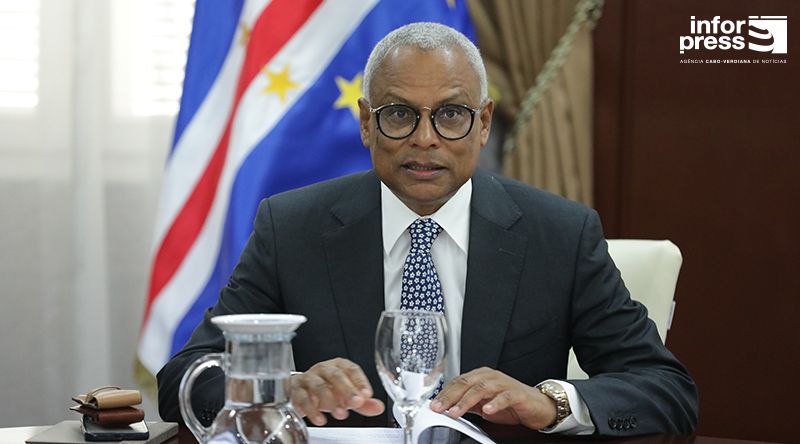
Archive photograph of Cape Verde President José Maria Neves at a meeting, not election night. Photograph: Inforpress. Reuse rights are not stated on the source page and require publisher review.
Cape Verde’s President José Maria Neves has won a second term in the first round of the country’s presidential election, taking 63.8 per cent of the vote according to provisional results released after polling on Sunday, 15 November 2026.
Figures published by the National Electoral Commission and reported by Cape Verde’s Inforpress news agency showed Neves ahead of former justice minister Joana Rosa, who received 31.6 per cent. The figures covered 96.8 per cent of polling stations nationwide and abroad at the time of the agency’s report late on Sunday. Final certified results were still pending.
Neves, who was supported by the African Party for the Independence of Cape Verde (PAICV), had secured 80,018 votes in the provisional count. Rosa, backed by the opposition Movement for Democracy (MpD), had 39,660. With more than half the valid votes, Neves was positioned to avoid a second round that would otherwise have taken place on 29 November.
The provisional figures showed Neves leading in every electoral constituency at home and abroad except the island of Maio, where Rosa was ahead. The election featured six candidates and was conducted across the archipelago and its substantial overseas electorate.
Inforpress reported that 419,448 people were registered to vote, including 343,065 within Cape Verde and 76,383 overseas. The election used 1,302 polling stations, of which 243 were outside the country. Those arrangements underline the role of Cape Verdeans living abroad in the country’s national elections.
Turnout, however, emerged as a significant concern. According to the preliminary figures, abstention was approximately 68 per cent, compared with 52 per cent in the 2021 presidential election. The scale of non-participation presents an immediate question for political parties and institutions even as the incumbent secured a clear electoral lead.
Neves was first elected president in 2021 with 51.75 per cent of the vote. Before becoming head of state, he served as prime minister from 2001 to 2016 and held senior positions within the PAICV. His latest victory follows the party’s success in May’s legislative election, which gave it 37 of the 72 seats in the National Assembly.
Cape Verde operates a semi-presidential political system. The president serves as head of state and a constitutional figure, while the prime minister exercises much of the executive authority. The parliamentary election brought Francisco Carvalho into the premiership, meaning the president’s second term will begin against a changed legislative backdrop.
The campaign took place amid concerns about youth unemployment, the cost of living, emigration and the difficulty of transport between the country’s islands. Neves pledged to convene a youth summit if re-elected, while Rosa campaigned on tackling corruption and political favouritism and on creating opportunities for younger citizens.
Rosa’s candidacy was also notable because she was Cape Verde’s first woman to contest the presidency. Although she did not win, her participation marked a development in the representation of women at the highest level of the country’s electoral politics.
International observers from the Economic Community of West African States, the African Union and the European Union were present during the vote, according to AFP. Their presence reflected regional and international interest in an election held in a country widely regarded for its relatively stable democratic institutions.
The Atlantic island nation, situated off the coast of Senegal, has a population of about half a million people, with a diaspora that is larger than its resident population. Emigration, family remittances and links with Portugal and the United States are therefore important elements of its political and economic life.
Cape Verde’s economy has benefited from tourism, and the World Bank classified it as an upper-middle-income country in July 2026. Yet the headline economic classification does not remove the difficulties of inequality, expensive inter-island transport, exposure to international fuel prices and limited employment opportunities for young people.
For the returning president, the election provides a renewed mandate but also highlights a gap between electoral victory and broad public participation. The final count and the electoral authorities’ certification remain necessary before the complete result can be treated as official.
At the time of this report, the National Electoral Commission’s provisional figures placed Neves comfortably above the threshold for a first-round victory. The decisive numerical lead and the high abstention rate are the two central outcomes awaiting final confirmation.