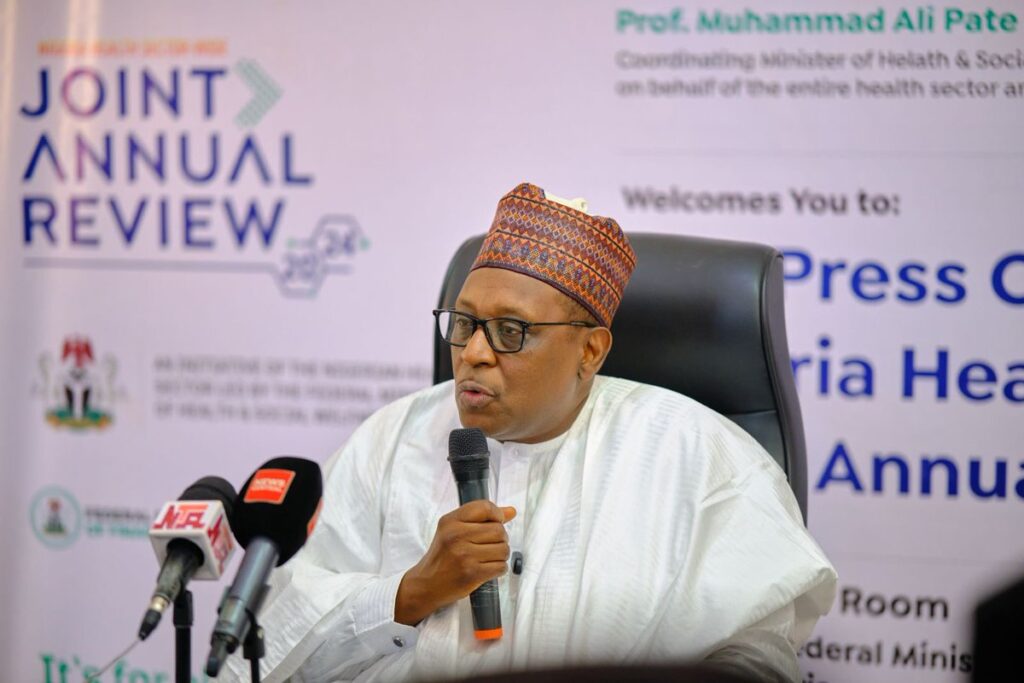
Archive photograph of Professor Muhammad Ali Pate speaking at an earlier Joint Annual Review press conference. Photograph: Federal Ministry of Health.
Nigeria’s Federal Government says maternal case fatality in health facilities supported by the Basic Health Care Provision Fund (BHCPF) has fallen by about 60 per cent in areas covered by the Maternal and Newborn Mortality Reduction Innovation Initiative (MAMII), according to figures presented at the Third Nigeria Health Sector Joint Annual Review in Abuja on 10 November.
Coordinating Minister of Health and Social Welfare, Professor Muhammad Ali Pate, said the reduction was recorded between 2024 and 2026. At the same review, the National Coordinator of the Sector-Wide Approach Coordination Office, Muntaqa Umar-Sadiq, presented a data series showing the maternal case-fatality rate in BHCPF-supported facilities falling from 80.5 in 2024 to 31.9 by September 2026.
Umar-Sadiq said the findings covered 8,309 BHCPF-supported facilities and were drawn from routine health information and facility reports, validated through three rounds of telephone surveys and physical assessments using the Facility Assessment and Supportive Supervision Technical Assistance process. He said the result exceeded the government’s original target of a 30 per cent reduction. The Coordinating Minister’s keynote address also reported a 60 per cent reduction in MAMII areas.
The figures describe case fatality in supported facilities, not a 60 per cent fall in Nigeria’s overall maternal mortality ratio. Umar-Sadiq said facilities outside the BHCPF programme continued to report substantially higher maternal case-fatality ratios.
Pate also told delegates that the administration had achieved all 41 presidential health-sector commitments. The published keynote does not set out a separate, line-by-line scorecard for each commitment, so the claim remains the minister’s assessment in the material reviewed. The speech does, however, detail programme figures covering primary healthcare, maternal and newborn services, health insurance, local manufacturing and health security.
Primary healthcare and emergency referrals
Pate said 3,526 primary healthcare centres had been revitalised, with work continuing at another 900. More than 8,000 facilities were supported through the BHCPF. Cumulative releases under the fund since 2019 had reached about ₦422.3 billion by October 2026. Of ₦323.6 billion disbursed to the fund’s gateways, ₦249.5 billion was disbursed under the current administration, he said. The Ministry has signed a memorandum of understanding with the Independent Corrupt Practices and Other Related Offences Commission to help track the resources.
The maternal and newborn programme has expanded its workforce and referral network. Pate reported that 19,758 skilled birth attendants had been recruited across 22 states, 4,747 community health workers engaged in 10 states and 78,054 frontline health workers trained.
Within MAMII areas, the proportion of BHCPF-supported facilities with at least two midwives or community health extension workers rose from 12 per cent to 91 per cent. The minister said 99 per cent of BHCPF facilities in those areas were connected to the emergency referral system.
Some 750,000 pregnant women had been mapped and linked to functional health facilities. Emergency transport operated in 171 of the initiative’s 172 local government areas and had conveyed 104,566 women and newborns. Across the wider referral network, 1,053 transport assets and 9,050 community drivers had carried 168,571 patients, according to the minister’s address.
Use of several services also increased in BHCPF facilities. Pate said skilled deliveries rose from 4.8 million in 2023 to 7.9 million by the end of the second quarter of 2026. Fourth antenatal-care visits increased from six million to 8.7 million, while outpatient attendance rose from 32.4 million to 43 million.
More than 17 million adolescent girls had received the human papillomavirus vaccine, while measles and rubella vaccination had reached 100 million children, he said. Pate credited Gavi, immunisation partners and health workers for their contributions.
Insurance, treatment costs and local production
The minister said health-insurance coverage had grown from about 16 million to nearly 24 million Nigerians over three years. A total of 5,106 patients had benefited from dialysis cost reductions of up to 80 per cent, while 710 patients had enrolled for an 80 per cent subsidy on selected cancer medicines through the National Health Insurance Authority’s partnership with Roche. The free 48-hour emergency-care programme had benefited more than 15,000 people across 507 participating facilities, with hospitals receiving ₦2.7 billion in reimbursements.
In healthcare manufacturing, Pate reported that ten factories or production lines had been commissioned, six of them in 2026. They cover pharmaceuticals, rapid diagnostic tests, insecticide-treated nets and medical oxygen. The Presidential Executive Order signed in 2024 had supported ₦24 billion in tax waivers for pharmaceutical manufacturers in 2025 and 2026, alongside 12 technology-transfer agreements.
The minister also referred to a prospective investment pipeline exceeding US$5 billion. He stressed that the task was to turn prospective investment into operating businesses producing safe, effective and affordable products. The pipeline should therefore not be treated as capital already committed or factories already operating.
Gaps remain in access and quality
The 2026 Nigeria Health Sector Statistical Book records progress alongside persistent inequalities. Using the 2024 VASA survey, it puts the national maternal mortality ratio at 572 deaths per 100,000 live births, with a heavier rural burden of 656 compared with 444 in urban areas. The national figure remains far above the Sustainable Development Goal target of fewer than 70 deaths per 100,000 live births.
The statistical book’s patient-perception survey covered 2,610 respondents across the 36 states and the Federal Capital Territory in 2026. The proportion rating overall quality of care positively fell from 75 per cent in 2025 to 71 per cent in 2026. The share who felt assured of access to affordable, quality care when ill fell from 48 per cent to 43 per cent. These findings show that expanded services and financing have not yet translated into a better experience for every patient.
The Ministry’s review also reported improvements in 12 of the 13 health indicators assessed, while stunting worsened slightly. Staffing remains another constraint. The statistical book found that 20 of 24 federal tertiary hospitals identified shortages or the departure of health workers as a major problem.
Pate identified uneven workforce distribution, the need for greater domestic health financing, modernisation of federal tertiary hospitals and wider insurance coverage as priorities. He also said the sector must improve the quality of patient experience and strengthen implementation of clinical governance and patient-safety guidelines.
The health-sector compact was signed by the Federal Government, states and development partners in December 2023 and later expanded to include local governments, civil society, traditional and religious institutions and the private sector. The Sector-Wide Approach is intended to align those participants around a common plan, budget, report and review process. The reforms therefore depend on state and local implementation as well as federal policy and funding.
Pate credited governors, state commissioners, local governments, development partners, professional bodies, civil society, private-sector organisations, traditional and religious leaders, and health workers for their contributions. He specifically acknowledged support from the World Bank through HOPE and IMPACT, WHO, UNICEF, Gavi, the Global Fund, the United Kingdom and United States governments, the Gates Foundation and other partners.
The minister said the next phase would require the government and its partners to sustain the staffing, referral and financing arrangements behind the reported gains. The 2026 review identified 2027 as a critical year for consolidating the Health Sector Strategic Blueprint and addressing the remaining gaps in affordability, quality, workforce distribution and access.
“Our responsibility is to deepen implementation and strengthen the institutions and financing arrangements that will sustain it,” Pate said in his closing address.