
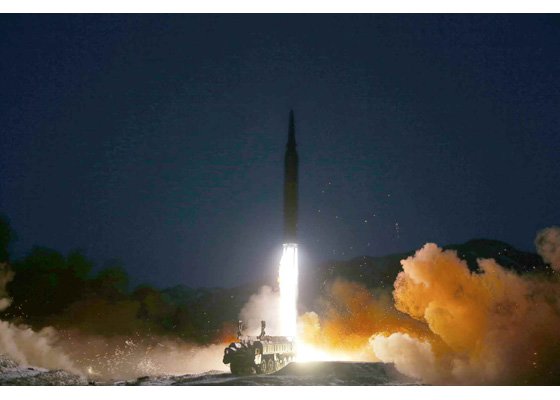
North Korea says it has tested an intermediate-range strategic missile equipped with manoeuvring technology intended to challenge regional missile defences, adding a fresh layer of tension to an already volatile dispute on the Korean Peninsula.
The launch was conducted from eastern North Korea on Saturday and supervised by leader Kim Jong Un, according to the state-run Korean Central News Agency. Pyongyang said the weapon struck a sea target 1,000 kilometres away and described the drill as training for troops operating a hypersonic strategic weapon system.
South Korea’s Joint Chiefs of Staff independently confirmed detecting a ballistic missile launched from the Wonsan area towards the sea east of the peninsula. Seoul assessed that it travelled more than 700 kilometres, a shorter distance than the figure announced by North Korea.
The difference does not necessarily mean one side failed to observe the launch. North Korean officials claimed the weapon followed an unusual, wave-like flight path and could alter its trajectory at low altitude. Independent authorities have not publicly verified all of those technical claims.
Kim links launch to nuclear deterrence
Kim Jong Un said developing strategic weapons remained essential for North Korea’s security and called for continued work to demonstrate the reliability and destructive capability of the country’s offensive systems.
State media presented the missile as part of North Korea’s nuclear deterrent. It also published photographs showing Kim observing the launch with his wife, Ri Sol Ju, and daughter, Ju Ae.
Kim Yo Jong, the leader’s sister and a senior official in the ruling Workers’ Party, disclosed the test less than 12 hours after the launch. She said South Korean and Japanese military systems had failed to follow parts of the missile’s trajectory and claimed artificial intelligence had been incorporated into its guidance.
Those assertions should be treated cautiously. North Korea has not provided independently verifiable flight data, and outside analysts have not confirmed the precise missile model or the sophistication of any artificial-intelligence component.
Some specialists have suggested that the weapon could be the Hwasong-16 Na hypersonic intermediate-range ballistic missile, based on North Korea’s description of low-altitude manoeuvring. That assessment remains a possibility rather than an established identification.
Launch follows dispute over DMZ mine blast
The timing is significant because relations between the two Koreas have deteriorated further following a landmine explosion in the Demilitarized Zone on 21 September. Three South Korean soldiers were injured.
South Korea and the United Nations Command concluded that a North Korean mine caused the blast and said the incident breached the armistice that halted fighting in the 1950 to 1953 Korean War. Seoul demanded an apology and measures to prevent another incident.
Pyongyang denied responsibility. Kim Yo Jong called South Korea’s findings groundless and warned against retaliatory action.
The missile launch therefore took place against a backdrop of military accusation, heightened surveillance and hostile public statements. Even when a test is directed towards open water, such conditions increase the danger of miscalculation because neighbouring governments must decide quickly whether a launch is an exercise, a demonstration or the beginning of an attack.
Why the test matters beyond Korea
Intermediate-range missiles can threaten targets far beyond the immediate border area, depending on their design and flight profile. A system capable of changing course or flying at unusual altitudes may be harder for conventional radar networks to track and for interceptors to engage.
That makes the test relevant to Japan and to United States forces stationed across the region, as well as to South Korea. It also feeds the continuing debate over whether existing sanctions, military exercises and diplomatic pressure have slowed North Korea’s weapons development.
Pyongyang has conducted more than 10 missile tests during 2026. Some followed joint military exercises involving the United States and South Korea, which North Korea describes as rehearsals for invasion. Washington and Seoul say their exercises are defensive.
Diplomatic efforts have remained stalled. North Korea has continued expanding its nuclear and missile programmes while rejecting talks tied to denuclearisation. Its strengthening relationship with Russia has added another strategic concern for governments seeking to contain weapons proliferation.
Claims require independent scrutiny
The latest drill clearly demonstrates that North Korea can organise and publicise an intermediate-range missile launch. It does not, by itself, prove every claim made about artificial intelligence, hypersonic manoeuvring or the inability of regional forces to track the weapon.
The next steps taken by Seoul, Tokyo and Washington will be closely watched. A military show of force could prompt further North Korean testing, while a measured response may leave allies facing pressure to prove that their surveillance and defensive systems remain credible.
The immediate need is for accurate technical assessment and communication that reduces the risk of an accidental escalation. With the DMZ mine dispute unresolved and missile tests continuing, even an exercise intended as deterrence can deepen insecurity across Northeast Asia.
Should governments respond to North Korea’s expanding missile programme with stronger deterrence or renewed diplomacy? Share your view with Podium News.