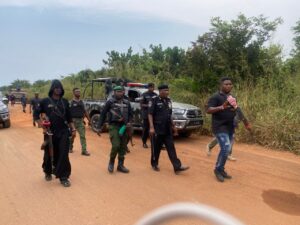
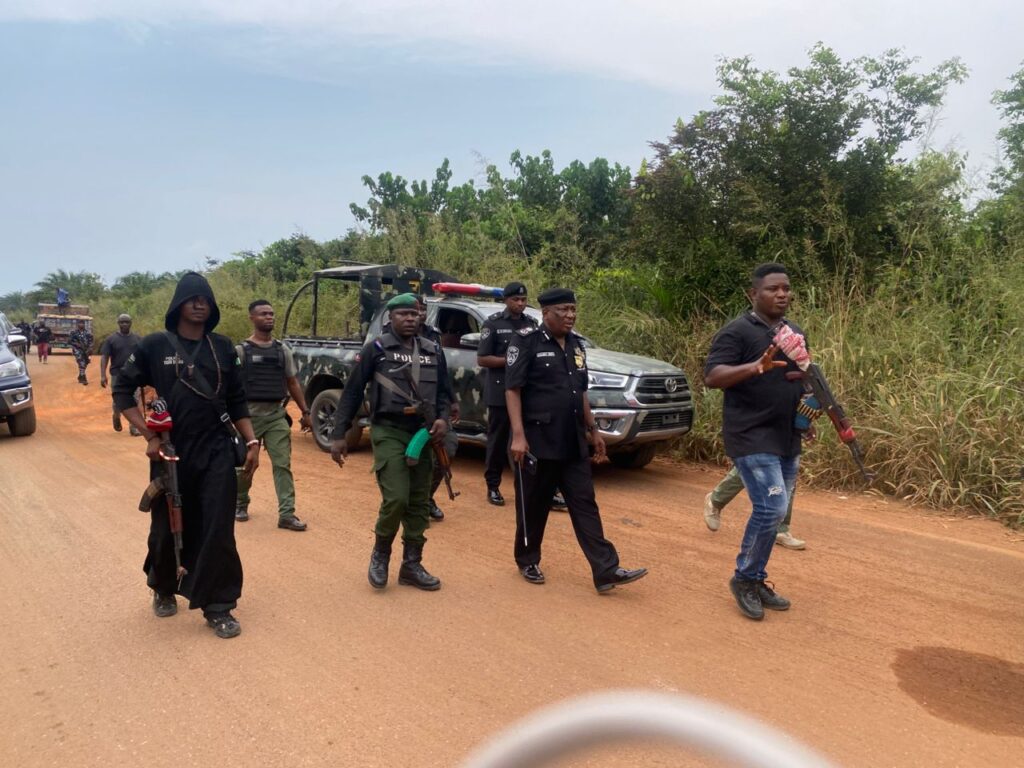
The Nigeria Police Force has deployed a Deputy Inspector-General to Imo State to coordinate the search for 20 people abducted after gunmen attacked two buses carrying prospective National Youth Service Corps members and other passengers on the Owerri to Onitsha road.
DIG Shehu Nadada, who oversees police operations, arrived with two Commissioners of Police to review the rescue effort, inspect the scene and direct additional tactical deployments. Police said intelligence-led operations were continuing in locations considered relevant to the search.
The intervention follows the 1 October attack near Umunoha in Mbaitoli Local Government Area. The buses were travelling from Ibadan, Oyo State, towards Uyo in Akwa Ibom State and Bende in Abia State when armed men intercepted them at about 6.30am.
Imo police spokesperson DSP Okoye Henry said security personnel recovered both vehicles and rescued 10 victims at the scene. Those rescued were taken into safe custody and received medical attention. The command initially said it was verifying how many people remained missing.
A subsequent Force Headquarters statement placed the number still held at 20. Force spokesperson CSP Anietie Iniedu said additional tactical teams and operational resources had been moved into the area, with other security agencies participating in the coordinated search.
Senior officers sent to strengthen rescue effort
Nadada reviewed personnel, operational plans and available resources alongside the Imo State Commissioner of Police, Audu Garba Bosso, the Commissioner of Police for Federal Operations, Akpan Anifiok, the commissioner overseeing the Police Mobile Force and other security commanders.
The police said the deployment was intended to strengthen command and coordination rather than replace the operation already under way. Nadada said the Force was “committed to securing the safe rescue of the 20 abducted persons” and would sustain the mission until it was concluded.
Authorities have not publicly identified all those still missing or released a full breakdown of the number who are prospective corps members. That distinction is important because the buses also carried other passengers. Responsible reporting must therefore avoid describing all 20 abducted people as corps members until the police or NYSC provides a verified list.
The police are working with the NYSC directorate to communicate with affected families. The command has also asked members of the public to avoid speculation and to provide credible information through the nearest police station, assuring informants that their identities will be protected.
An attack on a journey of national service
The presence of prospective corps members gives the incident a particularly painful dimension. Young Nigerians routinely travel long distances after mobilisation to reach orientation camps, often crossing several states on unfamiliar roads and using commercial transport arranged independently.
For families, the journey to camp is supposed to mark the beginning of a year of national service and professional transition. An attack on that journey turns a public programme built around national integration into a source of fear.
The immediate priority remains the safe return of every abducted traveller. The operation also raises wider questions about how prospective corps members are transported, how high-risk routes are assessed and how quickly security agencies can respond when travellers disappear between state jurisdictions.
The affected section of the highway was reopened after the attack, with security personnel deployed to protect commuters. Reopening the road, however, does not by itself settle the safety concerns created by an ambush in daylight on an important regional corridor.
Families need timely, verified communication as the operation continues. Public uncertainty can deepen distress and create an opening for false ransom messages, fabricated casualty claims or social-media posts that compromise the investigation.
What should happen next
Beyond the present rescue mission, the police, the NYSC and transport operators should examine the circumstances of the journey and identify practical lessons. These could include verified passenger manifests, clear emergency contacts, route-risk briefings, coordinated departure information and rapid escalation procedures when a vehicle loses contact.
Such measures cannot eliminate armed crime, and operational details should not be publicised in ways that help attackers. They can, however, reduce confusion and ensure that families and security agencies know quickly who was travelling, where the buses were expected and when intervention is required.
The case also demands careful public communication. The initial statement correctly acknowledged that the number of missing people was still being verified. The later confirmation of 20 abducted persons provides greater clarity, but the authorities should continue issuing updates whenever victims are recovered or the operational picture changes.
For now, the focus must stay on preserving life, supporting the families and bringing the attackers to justice. Security agencies have promised to continue until all the victims are recovered. The public interest requires that promise to be matched by sustained action and transparent updates that do not endanger the rescue.
Do you regularly travel on the Owerri to Onitsha corridor? Share your experience of security conditions with Podium News, but do not post unverified operational information or details that could place the victims at further risk.