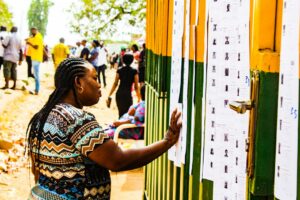

The Economic Community of West African States has said Nigeria will be included in its youth election observer initiative for the 2027 general elections, extending a regional programme designed to give young people a more direct role in monitoring democratic processes.
Serigne Mamadou Ka, head of the ECOWAS Electoral Assistance Division, announced the plan at the fifth Sectoral Reflection Series on elections and democracy, organised by the Peering Advocacy and Advancement Centre in Africa in collaboration with Legis360.
Ka said the regional bloc had already tested the initiative in Côte d’Ivoire and replicated it in Benin, with Nigeria next in line as its election cycle approaches. “Definitely, we are not going to leave Nigeria out in January,” he said.
The proposal would place young observers alongside the wider ECOWAS election observation structure. It is intended to move youth participation beyond campaign messaging and online commentary by giving selected participants practical experience in evidence-based observation, electoral rules and regional democratic standards.
ECOWAS has previously deployed young observers as part of a formal mission. During Côte d’Ivoire’s October 2025 presidential election, the bloc said 22 young observers joined 150 short-term observers and 15 long-term specialists. That pilot was described as the integration of young people into the ECOWAS Election Observation Mission.
The initiative matters in Nigeria because young people make up a large part of the electorate but remain under-represented in many formal political and party structures. Election observation can provide a useful entry point into public service, civic education and democratic accountability, provided participants are properly trained and selected through a transparent process.
Ka said weak access to finance was the biggest obstacle facing young people who want to participate in politics. He also identified limited education and training, gender bias, social and cultural pressures, and poor internal democracy within political parties as continuing barriers.
His comments place responsibility not only on election management bodies and regional organisations, but also on political parties. If younger citizens cannot obtain meaningful roles in party decision-making, nomination processes or campaign leadership, their numbers in the population may not translate into influence over policy and governance.
ECOWAS’ proposed observer initiative does not by itself solve those structural problems. It can, however, create a pathway for young Nigerians to gain a clearer understanding of polling procedures, electoral law, incident reporting and the standards used to judge whether an election is credible.
Ezenwa Nwagwu, executive director of PAACA, said mainstreaming young people into the ECOWAS observation network was important because they had historically not been sufficiently represented in such missions. He also stressed that election observation required knowledge of the laws and regulations governing the process.
That emphasis is crucial. Observers are expected to work impartially, distinguish verified incidents from rumours, document what they see and avoid interfering with voting or collation. Training should therefore cover Nigeria’s legal framework, the role of the Independent National Electoral Commission, voter accreditation, polling-unit procedures, inclusion, security and the responsible use of digital tools.
The announcement also raises practical questions that ECOWAS will need to answer before deployment. These include the number of young observers to be selected, eligibility rules, geographic coverage, training arrangements, safeguards against partisan influence and how their findings will be integrated into the mission’s final assessment.
Nigeria’s elections attract regional and international attention because developments in Africa’s most populous country can affect political stability and democratic confidence across West Africa. A well-run youth observer component could widen the pool of experienced civic actors and help younger citizens see election integrity as a responsibility that continues beyond voting day.
To deliver that value, the youth cohort should reflect Nigeria’s geographic and social diversity rather than become a symbolic group drawn from a narrow circle. Women, persons with disabilities and young people from communities with limited access to formal political networks should have a fair opportunity to take part. Transparent selection would also protect the programme from perceptions that observer positions are rewards for party loyalty.
Election observers do not run polling units or determine official results. Their role is to assess whether procedures are followed, record significant incidents and report findings through established mission channels. Clear public communication about that limited but important mandate will be necessary so voters, political actors and security agencies understand how the youth observers fit into the broader ECOWAS mission.
For the programme to earn public trust, ECOWAS and its partners should publish a clear recruitment and training process, while applicants should rely only on verified official notices and avoid anyone requesting payment for selection. Podium News will continue to track the mission’s timetable, eligibility criteria and eventual deployment plans as further details are released.