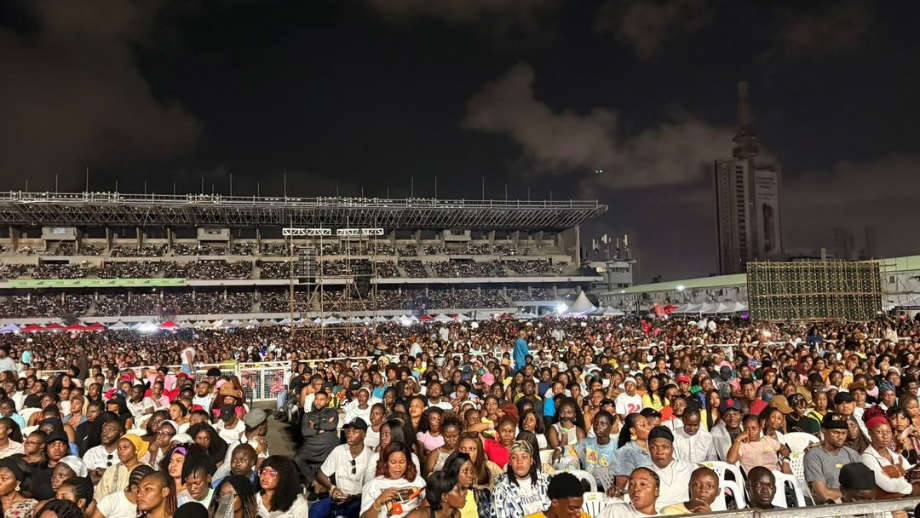
Nollywood has turned a Lagos public square into a record-breaking cinema, drawing 51,258 qualifying viewers to a screening of Black Market at Tafawa Balewa Square and setting a Guinness World Record for the largest attendance at a film screening.
Guinness World Records has formally listed the achievement in the names of Switch Visual Limited, Damilola Osikoya, Rixel Studios and filmmaker Nora Awolowo. The record was set on 26 September 2026, with the official figure counting people who remained for the screening from start to finish.
The total surpassed the previous record by almost 8,000 people. The earlier benchmark of 43,624 was established at the Philippine Arena in 2015 during a screening of Felix Manalo.
That difference matters. Organisers did not merely have to attract a huge crowd to central Lagos. They also had to manage entry, verification and audience retention at a scale more commonly associated with a concert or political rally than a film premiere.
A film screening built as a city event
The screening was organised as a wider public experience, with music, food, games and other entertainment around the film. Lagos State Deputy Governor Obafemi Hamzat said about 64,000 people attended the event, although Guinness accepted 51,258 as the qualifying record total.
For Nigeria’s film industry, the verified number is more significant than the larger attendance claim. It places the achievement on an independently maintained global record and offers a measurable example of Nollywood’s ability to mobilise audiences beyond conventional cinema halls.
Black Market is a crime thriller centred on five market women drawn into cross-border smuggling during a period of fuel scarcity. Their lives are disrupted when the daughter of one of the women is kidnapped.
The film was directed by Fatimah Binta Gimsay, who also co-wrote it with Abdul Tijani-Ahmed. Nora Awolowo and Nicole Ofoegbu are credited as producers, while Omowunmi Dada and Abdul Tijani-Ahmed are co-producers.
Its cast includes Linda Ejiofor-Suleiman, Omowunmi Dada, Scarlet Gomez, Teniola Aladese, Susan Pwajok, Lateef Adedimeji, Ibrahim Yekini, Andrew Yaw Bunting, Kanaga Jnr and Uzor Arukwe.
What the record says about Nollywood
The scale of the gathering offers a useful lesson for a screen industry competing for attention across cinemas, television, YouTube and subscription streaming platforms. The event treated a film not only as a title to watch, but as a shared cultural occasion that audiences could join in person.
That approach can create value beyond ticket sales. A large screening requires event production, security, transport planning, food vendors, technical crews, publicity and sponsorship. When carefully managed, it can connect filmmaking with the wider creative economy and give brands and public institutions a reason to invest in Nigerian stories.
The record also provides a counterpoint to recurring concerns about cinema access. Nigeria’s population is vast, but conventional screens remain concentrated in major urban centres. An open-air or public-square model cannot replace cinemas, yet it shows that producers can experiment with community-scale exhibition and build demand around locally made films.
President Bola Tinubu congratulated the team after the record was set, describing the feat as evidence of Nigerian creativity and enterprise. The Presidency also linked the achievement to the government’s ambition to expand the creative economy, create employment and open new markets for Nigerian talent.
The celebration arrives during a wider Nigerian fascination with Guinness World Records. Associated Press reported that 5,042 Nigerians applied for records between 2022 and September 2026, while 3,346 attempts were made. Those figures placed Nigeria seventh globally for applications and eighth for attempts during the period.
Awolowo told the news agency that the record had changed how people viewed her and had helped her ideas command greater respect. Her experience reflects one attraction of an internationally verified achievement: it can convert a local creative project into a story understood by audiences and potential partners around the world.
A milestone, not a substitute for industry support
A record crowd should not be mistaken for a complete answer to Nollywood’s structural challenges. Filmmakers still need reliable financing, stronger distribution, enforceable intellectual property protections, professional training and more places for audiences to watch films legally.
Nor can every production, or every city, assemble tens of thousands of people for a one-night event. The real test is whether the publicity surrounding Black Market leads to durable opportunities for its creators and encourages investment in the systems that help many more Nigerian films reach viewers.
Still, the achievement is more than a promotional stunt. The Guinness certification confirms that a Nigerian production brought the world’s largest verified film-screening audience together in Lagos. It demonstrates an appetite for collective cinema experiences and gives Nollywood another visible marker of its global cultural reach.
For filmmakers, exhibitors and city authorities, the next opportunity is to turn that visibility into repeatable audience development, safer large-scale events and wider access to Nigerian stories.
What do you think? Could record-scale public screenings help Nigerian filmmakers build new audiences, or should the industry’s priority remain expanding permanent cinemas and digital distribution? Share your view with Podium News.