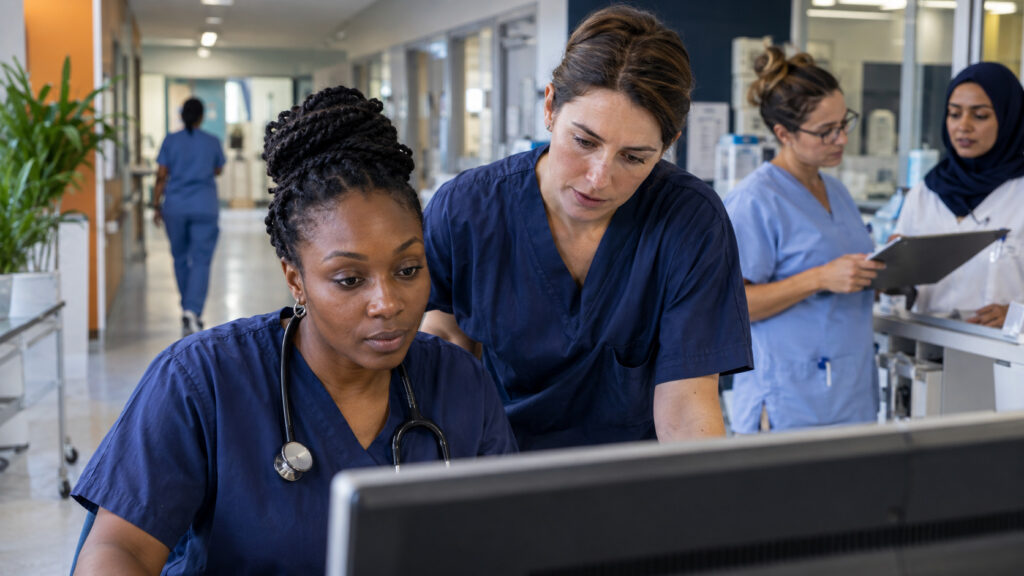
Women make up almost 77 per cent of the health and care workforce across the World Health Organization’s European Region, yet they earn 19 per cent less per hour and 28 per cent less each month than men, according to a new analysis covering 43 countries.
The findings, published by WHO Europe on Friday, expose a persistent divide inside one of the continent’s most essential sectors. The disparity remains even after researchers account for differences in age, education, working hours and whether employees work in the public or private sector.
The evidence brief presents the pay gap as more than a workplace fairness issue. It warns that lower earnings throughout a woman’s career can translate into weaker pension provision, reduced financial security in later life and a greater risk of poverty for people who have spent decades caring for others.
A workforce built on women’s labour
Health and care is the fourth-largest employment sector in the WHO European Region, accounting for about one in every ten jobs. It is also the region’s largest source of paid caring work, ahead of education and domestic employment.
For women, the sector is particularly important. Nearly 17 per cent of all employed women in the region work in health and care, compared with about 5 per cent of employed men. In Belgium, Denmark and Norway, one in four working women is employed in the sector. In France, Germany, Ireland, the Netherlands and Switzerland, the proportion is about one in five.
Women account for close to 90 per cent of health and care workers in Estonia, Lithuania and Poland. Their dominance in the workforce, however, has not translated into equal earnings or equal access to the most highly paid positions.
WHO’s analysis found that the pay divide becomes wider as salaries rise. At the lower end of the earnings scale, women receive about 2 per cent less per hour than men. At the top, the hourly gap approaches 23 per cent.
“Women are being paid less for the same work and passed over for the roles that pay more.”
Dr Natasha Azzopardi Muscat, WHO Europe
The report found that women’s qualifications and experience should, on paper, place them in a position to earn slightly more than men in the best-paid jobs. In practice, they earn less. WHO said this pattern points towards structural undervaluation and bias rather than a simple difference in skills, experience or hours worked.
Most of the disparity remains unexplained
Adjusting the figures for age, education, working hours and employment sector reduces the measured hourly gap from 19 per cent to 6 per cent. The monthly gap falls from 28 per cent to 10 per cent. Even after those adjustments, a substantial difference remains that cannot be explained by the factors recorded in the data.
The unexplained portion is especially pronounced at the top of the pay scale, where it accounts for almost the entire earnings difference between women and men. That finding raises questions about promotion, leadership opportunities and the value placed on work performed predominantly by women.
The analysis also identified a wider pattern: the greater the proportion of women in a particular health or care occupation, the lower its average pay tends to be, even when it is compared with roles elsewhere that require similar skills and responsibilities.
Female managers in health and care earn an average of €22 an hour, according to WHO, compared with €24.70 for comparable managerial work in other sectors. The figures suggest that reaching management does not necessarily protect women from the broader undervaluation of care work.
Why the gap affects everyone
Unequal pay can make it harder for health systems to recruit and retain experienced workers at a time when many countries are already confronting staff shortages, ageing populations and growing demand for care. It can also discourage women from remaining in the profession or pursuing senior roles, weakening the leadership pipeline within hospitals, community services and care organisations.
The consequences therefore extend beyond individual salaries. A workforce that feels undervalued is more difficult to sustain, while the loss of skilled and experienced staff can affect continuity, capacity and the quality of care available to patients.
WHO Europe is urging governments to require gender pay gap reporting, collect more detailed pay data, strengthen equal pay laws and improve enforcement. It also wants action to remove barriers that prevent women from progressing into senior positions, including unequal caring responsibilities and limited access to mentorship.
The organisation has called for health and care work itself to be revalued so that earnings reflect its skills, demands and responsibilities rather than the gender of the people who have traditionally performed it. Its new evidence brief on the gender pay gap builds on earlier work by WHO and the International Labour Organization and argues that closing the divide would support stronger health systems, social protection and inclusive economic growth.
For millions of women, the findings place hard numbers behind an experience long recognised across caring professions: essential work can be publicly praised while remaining financially undervalued. The test for governments and employers will be whether recognition is finally matched by transparent salaries, fair promotion and enforceable action.
Join the conversation: Podium News invites health and care workers, including those in the African diaspora, to share how pay, promotion and recognition affect their working lives.