President Bola Tinubu has removed the requirement for Nigeria’s federal universities to obtain recruitment waivers from the Office of the Head of the Civil Service of the Federation, a policy change intended to ease staffing delays and give institutions greater control over legitimate manpower needs.
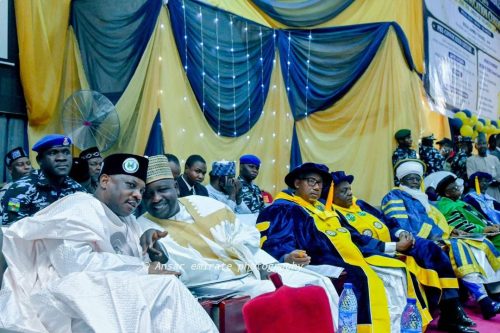
The President announced the reform at the maiden convocation of the Federal University of Health Sciences, Azare, in Bauchi State on Saturday, 17 October. He was represented by the Executive Secretary of the Tertiary Education Trust Fund, Sonny Echono.
Tinubu said the change was reflected in recent agreements reached between the Federal Government and university staff unions. Under the announced arrangement, the Federal Ministry of Education and university governing councils are expected to exercise their respective responsibilities in recruitment without the additional waiver formerly required from the Office of the Head of the Civil Service.
“This measure empowers the Federal Ministry of Education and university Governing Councils to discharge their respective responsibilities in staff recruitment, enabling institutions to respond more effectively to their legitimate manpower needs,” the President said.
What the reform could change
Federal universities have frequently complained about the time required to fill vacant academic, technical and administrative positions. A slow approval chain can leave departments without enough lecturers, laboratories without specialist staff and essential services dependent on temporary arrangements.
Removing one central clearance stage could allow governing councils to respond more quickly when staff retire, resign or move to other institutions. It could also help new and expanding universities recruit the expertise needed for specialised courses.
The announcement does not, however, amount to unrestricted hiring. Universities remain public institutions governed by approved staffing structures, budgets, public-service rules and oversight arrangements. Detailed implementation guidance will be important to establish how vacancies will be approved, funded and monitored, and how the government will prevent unauthorised recruitment or unsustainable payroll growth.
The effectiveness of the reform will therefore depend on more than the removal of the waiver. Governing councils and the Ministry of Education will need transparent procedures, realistic personnel budgets and clear accountability for appointments.
Payroll changes also planned
Tinubu also said the government was working to migrate staff of tertiary institutions from the Integrated Personnel and Payroll Information System to the Government Integrated Financial Management Information System.
According to the President, the proposed change is intended to improve payroll efficiency, transparency and accountability, support timely salary payments and better reflect the operational requirements of universities and other tertiary institutions.
University unions have long argued that a centralised payroll system must recognise academic appointments, sabbaticals, visiting lecturers and other features that distinguish tertiary institutions from conventional civil-service organisations. The government will need to explain the migration timetable, safeguards and responsibilities before institutions and workers can judge whether the new arrangement resolves those concerns.
Funding for health education and research
The announcement came as the Federal University of Health Sciences, Azare celebrated its first graduating class of 50 students. Tinubu said the institution had received an initial ₦8 billion intervention through TETFund to support its establishment.
He linked the investment to weaknesses exposed in Nigeria’s health system during the COVID-19 pandemic and the need to expand the training of health professionals and medical researchers. Further support is expected through TETFund interventions and provisions in the 2026 national budget for roads, lecture halls, laboratories and utility vehicles.
The President also said ₦10 billion had been provided for the National Research Fund in 2026. He urged universities, especially specialised health institutions, to direct research towards Nigeria’s pressing healthcare needs.
On staff welfare, Tinubu said agreements had been signed with academic and non-academic unions covering the Consolidated Academic Tools Allowance and Consolidated Non-Teaching Tools Allowance, effective from 1 January 2026.
He added that 1,798 FUHSA students, representing 43 per cent of the university’s population, had received support from the Nigerian Education Loan Fund for the 2025/2026 academic session.
Why implementation matters
For students, the practical measure of the recruitment reform will be whether it produces adequately staffed departments, better supervision, functioning laboratories and more dependable academic calendars. For lecturers and researchers, the test will be whether vacancies are filled fairly and whether institutions can attract people with scarce skills.
Greater autonomy can improve decision-making, but it also places more responsibility on governing councils. Recruitment must be based on genuine institutional need, competence and open processes rather than patronage.
The government should now publish the operational framework for the exemption, including its effective date, budget controls and reporting requirements. Federal universities should likewise disclose how they intend to identify priority vacancies and protect merit in appointments.
Students, university workers and education stakeholders can follow Podium News for verified updates as the Ministry of Education and governing councils begin implementing the new recruitment arrangement.