France began a vast clean-up on Sunday after nationwide protests over living costs and weakening public services descended into the country’s worst unrest in years, leaving one demonstrator dead, about 1,800 people arrested and more than 500 police officers, gendarmes and firefighters injured.
Peaceful marches give way to violence
More than half a million people joined marches across France on Saturday, 17 October. The Interior Ministry estimated turnout at about 550,000, while organisers put the figure closer to 800,000. In Paris alone, the authorities counted roughly 110,000 participants.
The demonstrations brought together high school and university students, trade unions, Yellow Vest activists and other groups angered by rising prices, pressure on household budgets, teacher shortages and deteriorating public services. The movement had grown from student protests that began in working-class suburbs in September before widening into a broader national expression of discontent.
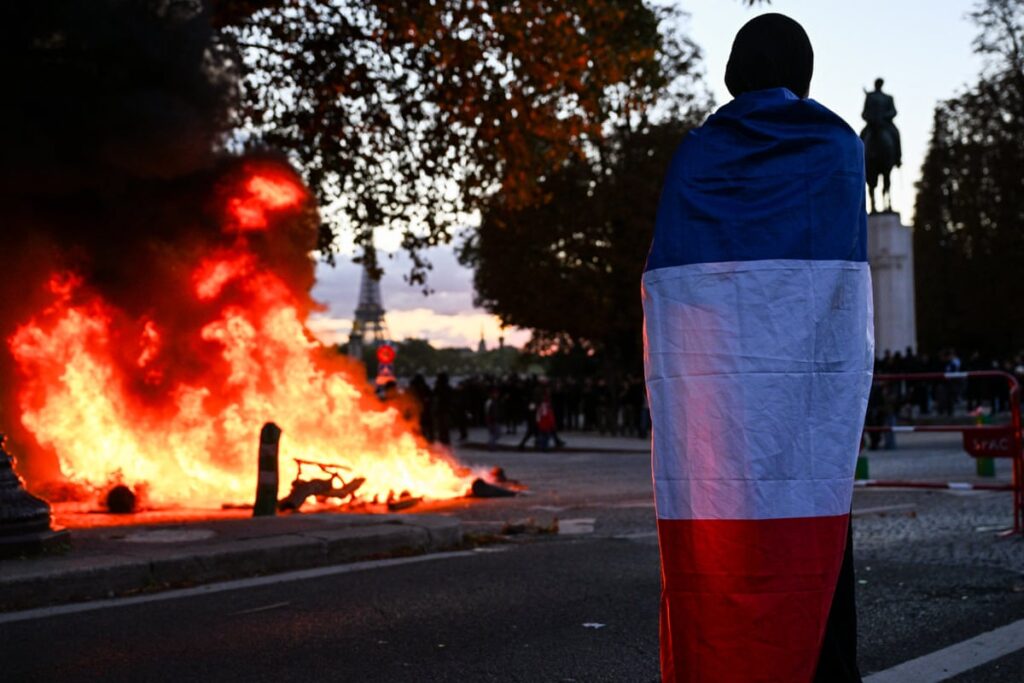
Most of the hundreds of thousands who took part marched peacefully. The day changed sharply, however, when masked groups broke away from official processions, fought police, set fires and looted shops. Public buildings, police vehicles, supermarkets and luxury retailers were among the targets.
Interior Minister Laurent Nuñez said on Sunday that about 1,800 people had been arrested and that the injury count among police, gendarmes and firefighters had risen above 500. He described the figures as provisional. Paris police separately reported a record 855 arrests in the capital region.
One protester died after suffering a cardiac arrest during the Paris demonstration, police said. No further identifying information had been released at the time of writing.
Damage stretches far beyond Paris
Sunday morning revealed the scale of the destruction. Around Place de la République in Paris, streets were strewn with broken glass, dislodged cobblestones and the remains of burnt vehicles and street furniture. Municipal crews moved through damaged shopping districts as investigations began.
The violence was not confined to the capital. In Limoges, an arson attack gutted much of the city’s 19th-century town hall and caused part of its roof to collapse. In Marseille, a masked group entered the lobby of City Hall and a police station was damaged. A tourist office caught fire in Lyon, while the residence of the regional prefect was attacked in Bordeaux.
Bordeaux Mayor Thomas Cazenave said as many as 100 shops were looted in his city. The mayors of Paris, Marseille and Lyon requested a meeting with Prime Minister Sébastien Lecornu, citing the seriousness of the situation and the extent of the damage.
A French retail trade representative estimated that about 1,500 shops and other businesses were damaged nationwide, with losses potentially running into hundreds of millions of euros. The figure remains an industry assessment rather than a completed official damage audit.
Government promises prosecutions and support
President Emmanuel Macron said those responsible for attacks on public institutions, businesses and town halls would be prosecuted. Lecornu also drew a line between peaceful protest and arson, looting and assaults, saying the government would not be intimidated.
The authorities blamed radical far-left groups and opportunistic criminals for much of the violence. Opposition politicians and some demonstrators, however, criticised police tactics and the handling of unauthorised gatherings. That dispute is likely to intensify scrutiny of both the violence and the state’s response.
Economy Minister Roland Lescure promised support for traders and business owners who suffered losses. Marseille’s mayor announced emergency assistance for affected businesses, while clean-up and damage assessments continued in cities from Lille to Strasbourg, Bordeaux and Marseille.
Macron was due to address the country on Sunday evening, adding urgency to a political crisis that arrives less than a year before France’s 2027 presidential election. The protests have exposed anger that extends beyond a single policy, linking the cost of living with schools, wages, public spending and distrust of political institutions.
Why the unrest matters beyond France
The demonstrations also form part of a wider European strain. Protests over living costs and housing took place in Italy and Portugal during the weekend, although the scale and violence differed. For governments across the continent, France’s experience is a warning about how quickly economic grievances can merge with frustration over public services and political representation.
The immediate priorities are public safety, support for injured people and damaged businesses, and credible investigations into criminal acts. The larger challenge will be to address the peaceful majority’s complaints without allowing violence to erase the underlying debate.
Readers in France should follow official local authority and transport updates before travelling through affected city centres. Podium News will update this report as verified casualty figures, damage assessments and the government’s next steps become available.