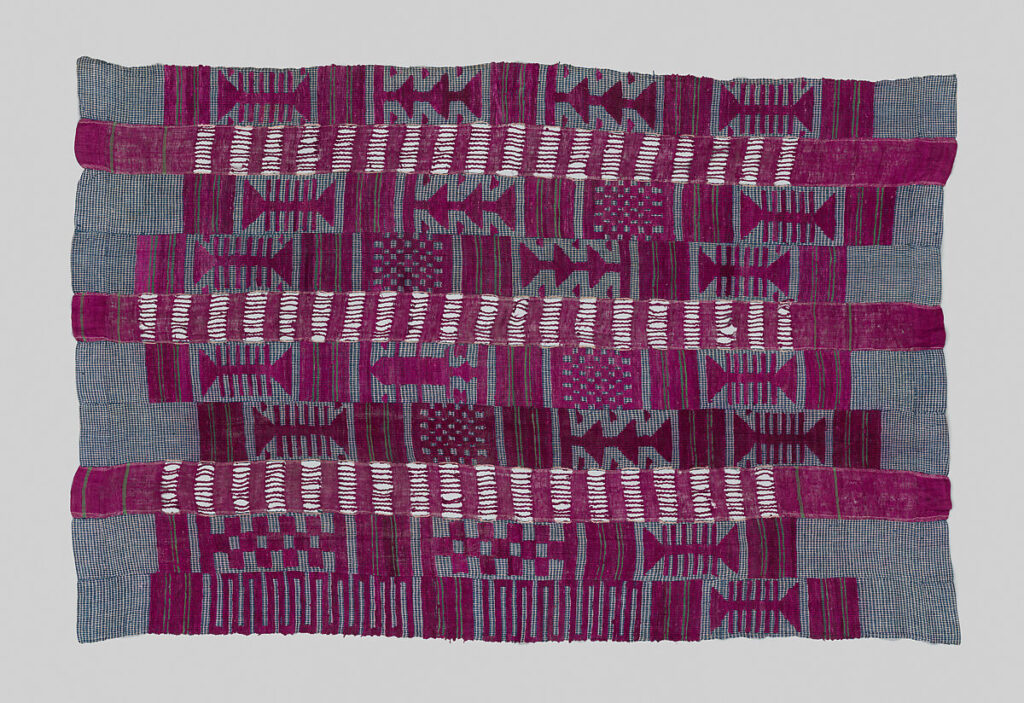
Nigerian-British designer Michelle Adepoju has assembled more than 500 vintage pieces of aṣọ òkè, including cloth dating to the 1940s, as she works to preserve and document a Yoruba textile tradition increasingly attracting international attention.
Adepoju, the founder of the Lagos and London fashion house Kílèntár, began building the collection after searching for weavers in Ondo in 2020. She told the Financial Times that she encountered old pieces among market stalls and immediately recognised their value.
“It was like gold to me,” she said. “I knew it had value.”
The discovery came while Adepoju was seeking fabrics for Kílèntár, the luxury womenswear label she founded in 2020. Her company describes its work as drawing on African heritage and artistic traditions, with collections that have used indigenous dyeing and weaving alongside contemporary silhouettes.
Adepoju initially turned some of the vintage cloth into wide-legged trousers and evening dresses. She later stopped cutting the older material after deciding that the collection had educational and historical importance in its own right.
She now displays vintage examples in Kílèntár’s Lagos space alongside the company’s garments. Large wall hangings made from about 200 patchworked lengths of aṣọ òkè are accompanied by booklets describing their provenance, an attempt to treat the cloth as material culture rather than simply fashion stock.
Aṣọ òkè, sometimes called aṣọ òfì, is a Yoruba narrow-strip woven textile. It has long been used for ceremonial clothing, including wrappers, shawls, head ties, caps and large gowns worn at weddings, naming ceremonies, festivals and other important gatherings.
Museum collections show both the technical range and ceremonial uses of the cloth. The British Museum describes traditional production by male Yoruba weavers using a double-heddle loom to make woven strips. The Metropolitan Museum of Art holds Yoruba wrappers and other aṣọ òkè garments, including cloth connected with Àdàmú Òriṣà performances on Lagos Island.
The three widely recognised historic families of the textile are sanyan, usually associated with beige or brown tones, indigo-coloured etu and the bright magenta alaari. Older examples were made with handspun cotton and silk, while later weavers incorporated rayon, nylon, lurex and a wider range of commercially produced threads.
Adepoju’s collection also records local variation. Her search began in Ondo, where she grew up seeing regional cloth worn by her mother. In a 2025 discussion on preserving African fabric traditions, she said: “My mom used to wear Ondo Aso Oke, so I’ve been collecting vintage Aso Oke from Ondo.”
The work has brought her into contact with dealers and researchers who warn that knowledge attached to older cloth is becoming harder to recover. Textile dealer Alhaji Salami, who has helped Adepoju build the collection, said some weaving techniques were not widely documented outside Nigeria and that many older practitioners had died.
London-based dealer and scholar Duncan Clarke, who researched Yoruba textiles and began trading African cloth in the late 1990s, told the Financial Times that the quality and materials changed over the twentieth century. Earlier cloth could include handspun cotton and silk carried through trans-Saharan trade, while synthetic fibres and metallic thread became increasingly common from the 1960s.
Those changes do not make later cloth culturally unimportant. They reveal how weavers responded to new materials, markets and tastes while retaining the narrow-strip form. Recent work by Nigerian designers has carried aṣọ òkè into ready-to-wear fashion, international exhibitions and art collections, expanding the audience for a textile once seen principally at Yoruba ceremonies.
Adepoju has said that her British and African backgrounds shape how she approaches the work. “The UK background gives me a fresh perspective, while the African background gives me that heritage foundation,” she said during the preservation discussion organised by the fashion platform Ekinken.
The collection also raises a practical question about ownership of cultural records. Historic Yoruba textiles are held by museums in Britain, France, Germany and the United States, while detailed information about particular weavers, towns and family patterns can be difficult to reconstruct. Recording provenance while sellers, collectors and surviving practitioners can still identify pieces may determine how much knowledge accompanies the cloth into the future.
Adepoju’s archive remains tied to a commercial fashion business, but she has separated the rare older pieces from routine production and presented them with documentation. The decision leaves intact a growing body of material through which future viewers can study colour, fibre, technique and changing Yoruba ceremonial taste across decades.
From the Ondo market finds that began the collection to its display in Lagos, the project has placed more than 500 pieces beyond the cutting table and into an emerging private archive of Yoruba textile history.