The Yoruba dùndún is an hourglass-shaped tension drum whose player changes its pitch by squeezing the cords beneath the arm, allowing the instrument to imitate the tones of the Yoruba language. Across south-west Nigeria and beyond, it has carried praise poetry, proverbs and musical rhythms through ceremonies and into contemporary performance.
What is a talking drum?
The dùndún is a family of double-headed drums played by Yoruba musicians, particularly in south-west Nigeria. Its narrow middle and wider ends give it an hourglass shape. Cords run between its two drumheads; when a player squeezes them, the tension on the skins changes and the pitch rises or falls.
The instrument is often called a talking drum because a skilled player can reproduce patterns associated with spoken Yoruba. The name does not mean that the drum uses words in precisely the same way as a voice. Rather, its pitches, rhythm and phrasing can evoke speech and communicate meanings understood through language, context and musical convention.
The dùndún belongs to a much wider family of African and West African musical traditions. Talking drums and speech-surrogate instruments exist in different forms across the region, but their construction, musical roles and languages differ. The Yoruba dùndún is specifically associated with Yoruba culture; it is not a general name for every African talking drum.
The word dùndún refers to the drum family. Gàngan is commonly used for its smaller, higher-pitched member, though people also use “gangan” more loosely as another name for the talking drum. As with many musical traditions, names and ensemble arrangements can vary between communities and performers.
How does the talking drum speak?
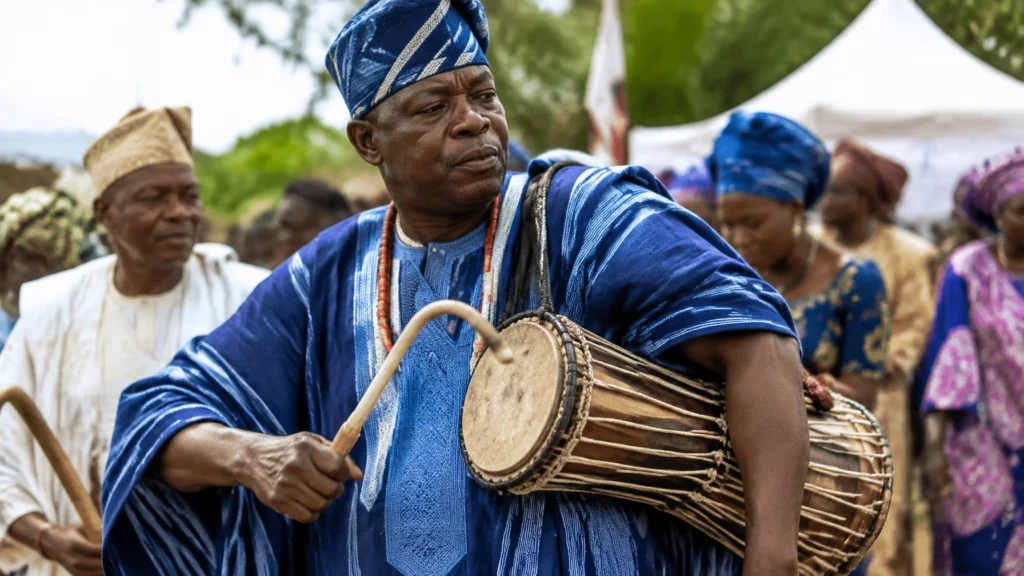
The drum’s two skins are joined by tension cords along the sides of its wooden body. The player typically holds it beneath the arm, often on a shoulder strap, and strikes a drumhead with a curved stick. At the same time, pressure from the fingers, wrist and the bone of the hip squeezes the cords, tightening the skins to raise the pitch or easing the pressure to lower it.
Specific terms vary by community, but players commonly refer to the tension cords as ọ̀sán and the curved stick as ọ̀pá.

That ability to move between pitches matters because Yoruba is a tonal language: the pitch pattern used when saying a syllable can help distinguish one word or meaning from another. A dùndún player can shape a note to echo those changes in pitch. The instrument can also vary the timing and length of strokes, giving a phrase a recognisable rhythm and contour.
A published acoustic study, “When Music Speaks”, examined the relationship between Yoruba speech and dùndún performance. Its authors, led by Cecilia Durojaye of Arizona State University, recorded three Yoruba speakers and three professional drummers and compared pitch, timing and intensity across speech, song and drummed versions of the same phrases. They found the drum can reproduce those patterns closely when imitating speech directly, and that the match weakens as the drummer adds more musical context.
The study also sets out why tone matters so much. Yoruba uses three relative tones, high, mid and low, and the drum produces three corresponding pitches, with the highest tone struck under the firmest pressure on the cords. Because the tone pattern is part of what distinguishes one word from another, a small change in pitch can change meaning entirely. The researchers note that more than one word can be formed from the same set of letters, but only some tonal combinations are meaningful in the language.
The study adds a detail that surprises many listeners: the dùndún imitates the Ọ̀yọ́ dialect in particular, rather than every variety of Yoruba. What listeners understand also depends on the drummer’s phrasing and their own knowledge of Yoruba speech and convention.
The drum does not produce consonants and vowels in the same way as a human voice. Instead, the player works with pitch, rhythm and sound quality to create a speech-like musical phrase. That makes listening an active process: knowledge of a person’s praise name, a proverb or the setting can help the audience recognise what is being conveyed.
Who is in a dùndún ensemble?
The lead drum is the ìyá ìlù, often translated as “mother drum”. It leads the ensemble and can carry speech-like phrases, including oríkì: praise poetry or praise names that recall a person’s qualities, family or history. The player’s part may move between leading the music and addressing a person or audience through the drum.
Smaller drums known as omele support the lead. Their roles and names vary with the ensemble; terms include omele ìṣẹ, omele àkọ and omele mẹ́ta. The supporting parts help establish the rhythmic structure around which the lead drum can speak and improvise.
The gàngan is the small, high-pitched drum in the family. Depending on the musical group, other instruments may join the drums, including the ṣẹ̀kẹ̀rẹ̀, a gourd shaker covered with a net of beads, and the agogo, a metal bell. Not every ensemble uses the same combination: the instruments and their parts depend on the occasion, local practice and the musicians involved.
The relationship between the lead and supporting instruments is central to the sound. The omele drums provide a pattern for listeners and performers to follow; the ìyá ìlù can then bend its pitches and vary its phrases without losing its place in the music. The result is not a single drum playing alone, but a conversation between musical roles.
What is the drum used for?
Dùndún performance has been associated with weddings, naming ceremonies, chieftaincy events, festivals, royal courts and wrestling. At such gatherings, the drum can mark an occasion, accompany dancing or draw attention to a person being honoured. It can also carry proverbs and messages over distance, where the listener recognises the patterns being played.
A prominent use is the performance of oríkì. A praise drummer may call attention to a person’s lineage, achievements or attributes, drawing on words and musical phrases familiar to the community. The practice connects the event in front of the audience with a wider store of family and community memory. It is a form of performance, but also a way of acknowledging relationships and status.
Drumming is historically linked to Ayan Agalu, honoured by many Yoruba drummers as a deity or ancestral figure associated with drumming. Accounts of the tradition describe hereditary drumming families known as Ayan, within which knowledge and skill were passed from one generation to the next. Details of these histories and beliefs are rooted in particular lineages and should not be treated as identical across all Yoruba communities.
Transmission within families has helped preserve specialised knowledge: how to hold the drum, control the cords, memorise phrases and perform appropriately for different occasions. A player’s work draws on technique, musical judgement and cultural understanding. The skill is learned over time, not simply by knowing how to make the pitch rise and fall.
From courtyard to concert hall
The dùndún is heard in both traditional settings and contemporary music. It features in Yoruba popular genres such as juju, fuji and apala, as well as in gospel and Afrobeats performances. Its sound can provide a rhythmic foundation, answer a singer or introduce speech-like phrases into a larger arrangement.
The instrument’s movement between settings is not a break from tradition. Musicians adapt the drum to different ensembles and audiences, while retaining techniques and musical ideas that connect it to Yoruba practice. Scholars studying the tradition describe it as both locally rooted and shaped by wider cultural exchange. Jesse D. Ruskin’s research on the Yoruba dùndún, for example, considers its local and transnational contexts in a University of California dissertation.

Illustrative image generated for this feature; it does not show a specific named ceremony.
The instrument also travels through recordings, performances and teaching beyond Nigeria. In diaspora communities, musicians and educators can introduce younger learners to its sound and cultural context. That work may involve more than demonstrating technique: it can include explaining Yoruba tones, praise poetry, the roles of different drums and the social settings in which the music has been played.
This kind of cultural transmission has parallels in other Yoruba practices. Podium News has also explored how a traditional board game carries strategy and social knowledge in its feature on Ayò Ọlọ́pọ́n. In both cases, cultural knowledge lives through people practising, teaching and adapting a tradition, not only through written records.
What happens next?
The dùndún remains a living tradition, not a museum piece. Its future depends in part on whether experienced players can pass on their knowledge, whether younger musicians have ways to learn, and whether recordings and archives document both the sound and the context in which it is made.
Documentation can preserve performances for future study, but recordings alone cannot teach everything a player needs to know. Learning the instrument also involves listening, practice, relationships with teachers and an understanding of the meanings attached to particular performances. Research on documenting dùndún music as a complete Yoruba art tradition highlights the importance of recording more than isolated rhythms or instrument sounds.

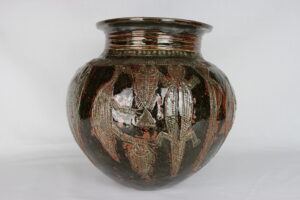
Illustrative image generated for this feature; it does not depict a named workshop or drum maker.
Interest from audiences abroad can bring new opportunities for performance and teaching. It also raises a question familiar to many heritage traditions: how can a practice be shared widely without losing the knowledge and community relationships that give it meaning? The answer rests with musicians, families, teachers and cultural organisations working to keep the tradition audible and understood.
Talking drum: frequently asked questions
What is a talking drum made of?
A Yoruba dùndún has an hourglass-shaped body, two drumheads and tension cords connecting the skins. The player squeezes the cords to change the tension and pitch while striking a head with a curved stick. Materials and construction details can vary.
Can a talking drum actually talk?
It can imitate important pitch and rhythmic features of Yoruba speech, and skilled players use it to perform praise poetry, proverbs and other speech-like phrases. It does not reproduce every sound of spoken language exactly; listeners interpret what they hear through their knowledge of the language and the context.
Is the dùndún the same as the gangan?
Not exactly. Dùndún names the wider Yoruba family of hourglass-shaped tension drums. Gàngan usually refers to its smaller, higher-pitched member, although the term is also sometimes used more broadly for a talking drum.
Which Nigerian ethnic groups use talking drums?
Talking drums are found in different forms among communities across Nigeria and West Africa. The dùndún discussed here is specifically Yoruba. Other communities have their own instruments, names, languages and performance traditions.
How is the talking drum played?
The player holds the drum under the arm, strikes a head with a curved stick and squeezes the cords to change the tension on the skins. That movement raises or lowers the pitch, allowing the drummer to shape musical and speech-like phrases.