The National Assembly says 28 state Houses of Assembly have approved a proposed constitutional amendment to permit the establishment of state police services in Nigeria, exceeding the 24-state threshold required for state-level ratification.
The Clerk to the National Assembly, Kamoru Ogunlana, disclosed the figure in a statement issued on Tuesday, 3 November 2026. He said his office had verified the reports submitted by the state legislatures against their votes and proceedings.
The proposal, identified as the Constitution of the Federal Republic of Nigeria, 1999 (Sixth Alteration) Bill, seeks to provide a constitutional basis for state police services and related matters. It was sent to all 36 state Houses of Assembly on 16 September for consideration.
Under Section 9 of the Constitution, an amendment of this kind requires approval by at least two-thirds of the state legislatures, equivalent to 24 states. The 28 approvals reported by the clerk therefore exceed the required number by four.
The development is an important procedural advance, but it does not mean that state police forces have already been established. The amendment must still complete the remaining constitutional process, including transmission for presidential assent. No state police service becomes operational simply because a state assembly has approved the proposal.
Ogunlana said the National Assembly had initially given state legislatures 30 days to respond, with the period ending on 15 October. His office would nevertheless continue receiving their reports until the bill was transmitted for presidential assent.
The clerk also addressed the legislative procedure for constitutional alterations. He noted that Section 9 does not expressly prescribe a third reading for a constitutional alteration bill in the same way that the procedure for ordinary bills does.
The verification of the 28 submissions matters because state-level ratification is not established by informal endorsements or announcements alone. The National Assembly must be able to establish that each participating legislature considered and approved the text through its own proceedings.
The move comes amid a longstanding debate over how policing should be organised in a federation where security threats and local conditions differ sharply across states. Advocates of state police argue that locally accountable services could respond more closely to community needs, while critics have raised concerns about political interference, financing and the safeguards needed to prevent abuse.
Those questions will remain relevant even if the amendment receives assent. A constitutional permission to create state police would be different from the legislation, budgets, recruitment systems, training arrangements and oversight mechanisms required to establish functioning services.
Any eventual state police framework would also have to clarify the relationship between state-level services and the existing Nigeria Police Force. Questions about command, jurisdiction, investigations across state boundaries and complaints against officers would need clear legal and administrative answers.
The reported approval figure is a national aggregate. The clerk’s statement, as reported on Tuesday, did not identify all 28 approving states in the material available for this report. Podium News has therefore not attributed approval to individual states without a verified list.
President Bola Tinubu has not yet assented to the proposed amendment on the evidence available at the time of this report. The immediate development is the National Assembly’s confirmation that the required number of state legislatures has voted in favour.
The next formal milestone is transmission of the constitutional alteration bill for presidential consideration. Until that stage is completed, the proposal remains a constitutional reform in progress rather than an implemented change to policing.
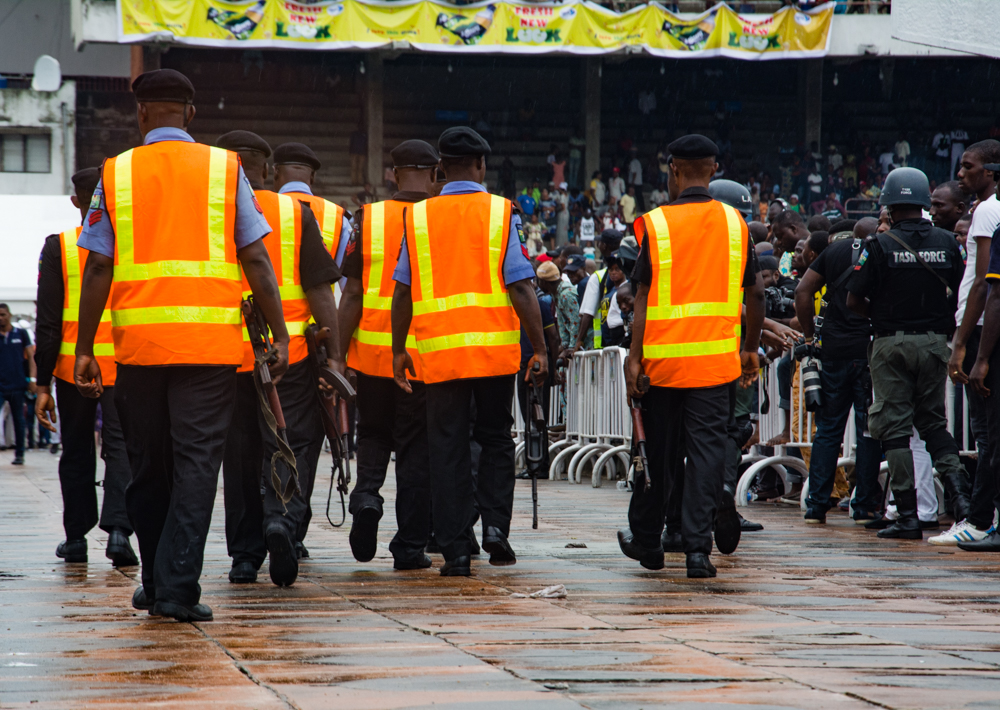
Archival photograph: Nigerian police at the Eyo festival, Lagos, 14 May 2016. Photograph by Olasunkanmiariyo, Wikimedia Commons, CC BY-SA 4.0. Used for illustration; the photograph does not depict the November 2026 legislative proceedings.