Switzerland has said the Ebola patient being treated in Nigeria did not travel to the Democratic Republic of Congo, disputing an account of her movements given by Ugandan authorities. The clarification came on Friday, 23 October.
The Swiss Federal Department of Foreign Affairs told Reuters that the patient, a Ugandan-born Swiss national married to a Swiss diplomat based in Abuja, had not visited Congo. It had said a day earlier that she was believed to have contracted the virus while travelling with her husband in Uganda. The source of infection remains under investigation.
Uganda’s health ministry had said the woman travelled to eastern Congo before passing through Uganda. The European Centre for Disease Prevention and Control recorded that claim in its outbreak update, attributing it to the Ugandan minister’s statement of 20 October.
WHO representative in Nigeria Pavel Ursu said on Thursday that the information supplied to the organisation did not include travel outside Uganda. He said she returned to Abuja on 3 October after being in Uganda from 16 September, according to Reuters’ account of the briefing.
Africa CDC official Wessam Mankoula said investigators were examining whether the Nigerian patient and Kenya’s first Ebola patient might have encountered each other. Both travelled from Uganda’s Entebbe airport on the same day. He described transmission between them as one possible scenario under examination, rather than an established link.
WHO emergency response manager Patrick Otim said the source of the woman’s infection remained unknown. Investigators were also examining the healthcare facilities she visited in Abuja after developing symptoms and before hospitalisation.
WHO’s written account of 20 October put the onset of her symptoms on 7 October. It said she sought care at a private facility in Abuja on 11 October and laboratory tests confirmed Bundibugyo virus on 20 October. She was isolated and receiving medical care.
The organisation said Nigeria had activated its incident management system and was tracing contacts. WHO and its partners were supporting case investigation, infection prevention and the provision of protective equipment for health workers. Its initial statement recorded 44 contacts under monitoring while teams sought others who might have been exposed.
WHO also asked countries in the region to keep laboratories, clinical teams and rapid-response personnel ready, strengthen surveillance and maintain infection-prevention measures in public and private facilities.
The wider outbreak remains concentrated in Congo. In its update dated 22 October, ECDC recorded 9,704 confirmed cases and 4,687 deaths there, using data through 20 October. Eight provinces had been affected. The agency cautioned that case and death figures remained subject to review and reconciliation.
Kenya had reported nine confirmed cases, including one death, by 22 October, all linked to its first case. ECDC said the first patient travelled from Congo to Kenya through Uganda on 3 October and subsequently died.
Uganda experienced an earlier outbreak of Bundibugyo virus this year. WHO declared that outbreak over on 27 August after 42 days without a new confirmed case. ECDC says no licensed vaccine or specific treatment is currently available for Bundibugyo virus disease.
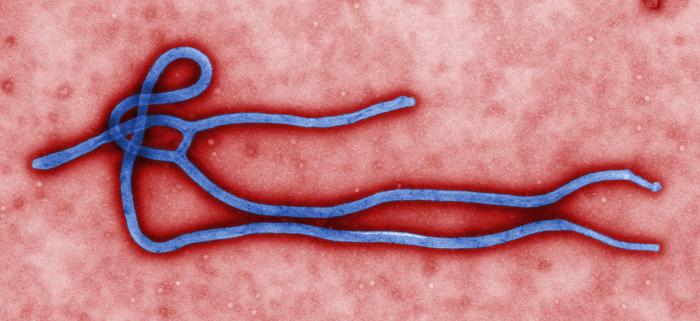
Scientific illustration: CDC/Cynthia Goldsmith, CDC Public Health Image Library image 10816, public domain, free source CDC PHIL. Colourised electron micrograph of an Ebola virus particle, not a sample from the Abuja patient and not identified here as Bundibugyo virus.