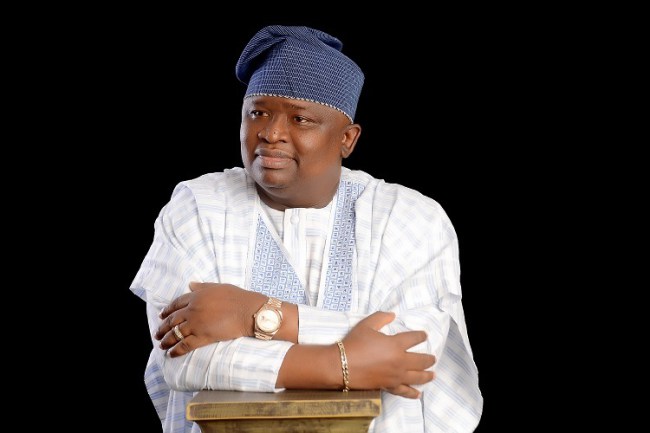
Archival portrait of Senator Solomon Olamilekan Adeola (YAYI), photographed on 13 July 2016. Photo: Kaizenify, Wikimedia Commons, CC BY-SA 4.0. This is not a photograph of the 20 November 2026 manifesto launch.
Senator Solomon Olamilekan Adeola, the All Progressives Congress governorship candidate in Ogun State, has unveiled his ITESIWAJU manifesto, setting out pledges to create 50,000 formal jobs annually, add 200 megawatts of electricity capacity and construct or rehabilitate 2,500 kilometres of roads by 2031 if elected.
Adeola, popularly known as YAYI, presented the development blueprint at the June 12 Cultural Centre in Kuto, Abeokuta, on Friday, 20 November. Titled “Governance That Works for Everyone: My Economic and Social Development Covenant with the People of Ogun State”, the ITESIWAJU manifesto is organised around nine policy pillars covering infrastructure, tourism and creative arts, education and human capital development, security and law enforcement, inclusive health and wellbeing, women and youth empowerment, agricultural transformation, job creation and industrialisation, and urban and environmental sustainability. Sports development is included within the women and youth empowerment pillar.
The candidate said the document followed consultations across Ogun State’s 20 local government areas. He described it as a social contract and urged residents to examine the proposals and hold him accountable if he wins the 2027 election.
“This agenda is a plan, not a performance. Read it as you would read a contract,” Adeola said.
Jobs, enterprise and skills
Employment and business support feature prominently in the blueprint. Adeola proposed a ₦10 billion Enterprise and Empowerment Fund intended to support 60,000 businesses owned by women and young people. He also pledged to train 100,000 young people in digital skills, including coding, data analysis, graphic design and digital marketing, and a further 100,000 women in practical and entrepreneurial skills.
The manifesto proposes that women should occupy at least 30 per cent of senior government appointments. It also sets out 12,000 apprenticeship and internship opportunities by the candidate’s fourth year in office, including placements in energy, minerals and petroleum supply chains.
Adeola said a future administration would establish a Governor’s Delivery Unit within 30 days of taking office. Commissioners and agency heads would sign performance agreements, while a public dashboard would track selected indicators every quarter. He also proposed twice-yearly independent performance assessments and an annual State of Ogun report.
The launch reports describe the employment pledge as 50,000 formal jobs each year. In September, Adeola had also been reported as setting a broader target of more than 500,000 jobs by 2031. The campaign has not publicly explained in the material reviewed how the annual formal-jobs figure relates to the earlier target.
Infrastructure, power and transport
The candidate pledged to construct or rehabilitate 2,500 kilometres of rural, urban and border-community roads by 2031. He said the programme would improve links between farming communities, markets and essential services across Ogun’s three senatorial districts.
He identified an estimated 600-megawatt electricity deficit in the state and proposed adding 200 megawatts through embedded and renewable generation. The ideas listed include an independent power project at Oke-Mosan, renewable energy around Oyan Dam, power development around Ewekoro and solar mini-grids for underserved communities.
For public transport, Adeola proposed introducing between 50 and 100 compressed natural gas buses within 12 months of assuming office. He identified routes linking Abeokuta, Sango-Ota, Lagos, Mowe-Ibafo, Berger and Sagamu. He also proposed a Gateway Metropolitan Area Transport Authority and a regulated OgunRide service for cars, tricycles and licensed motorcycles.
Education, health and agriculture
The manifesto proposes rehabilitating 2,000 classrooms, building 500 new educational facilities and training more than 35,000 public-school teachers. Adeola also set a target of 95 per cent primary-school completion, linked to improvements in facilities, technology, curriculum and teacher welfare.
In healthcare, he pledged to equip primary healthcare centres across the state’s wards and establish a Centre of Medical Excellence in each senatorial district. He proposed expanding the Ilera D’ero health insurance programme to cover two million residents by 2031 and reducing maternal mortality to below 200 deaths per 100,000 live births.
For agriculture, Adeola said about 30 per cent of Ogun’s estimated 1.2 million hectares of arable land was being cultivated. He proposed raising that proportion to 60 per cent through mechanisation, irrigation, extension services, agricultural finance and improved market access. The plan includes cocoa hubs in Ogun East, cashew hubs in Ogun West and oil-palm hubs in Ogun Central.
Tourism, industry and continuity
Adeola proposed developing 12 tourism destinations, with a target of attracting 500,000 visitors annually and generating a projected ₦15 billion in revenue by 2031. The sites he identified include Olumo Rock, Bilikisu Sungbo Grove, the Ojude Oba Festival, Lisabi Festival and coastal attractions in Ogun Waterside. He also proposed an Ogun Film Village to support film, fashion, music and the state’s Adire textile industry.
The candidate said he would continue and expand projects begun by Governor Dapo Abiodun, specifically acknowledging the ISEYA Development Agenda and investments linked to the Gateway International Agro-Cargo Airport, proposed dry ports, the planned Gateway Deep Sea Port, road construction and housing. He also credited earlier administrations led by Olabisi Onabanjo, Olusegun Osoba, Gbenga Daniel and Ibikunle Amosun.
Adeola acknowledged that economic growth had not yet reached many households, pointing to unemployment, unreliable electricity, inadequate agricultural storage and pressure on healthcare services. He also said proposals involving state policing, rail extensions into Ogun and oil derivation would require cooperation with the Federal Government.
The manifesto includes targets for higher per-capita income, faster annual growth and lower multidimensional poverty by 2031. However, the launch reports do not provide a full project-by-project costing, identified funding sources or a delivery timetable for every proposal. Several commitments will also depend on federal approvals, private investment and the capacity of state institutions.
Adeola urged residents to scrutinise the blueprint and judge it against measurable results if he is elected. The proposals now enter the public debate ahead of the 2027 poll, with their credibility depending on clearer costing, financing, sequencing and accountability.