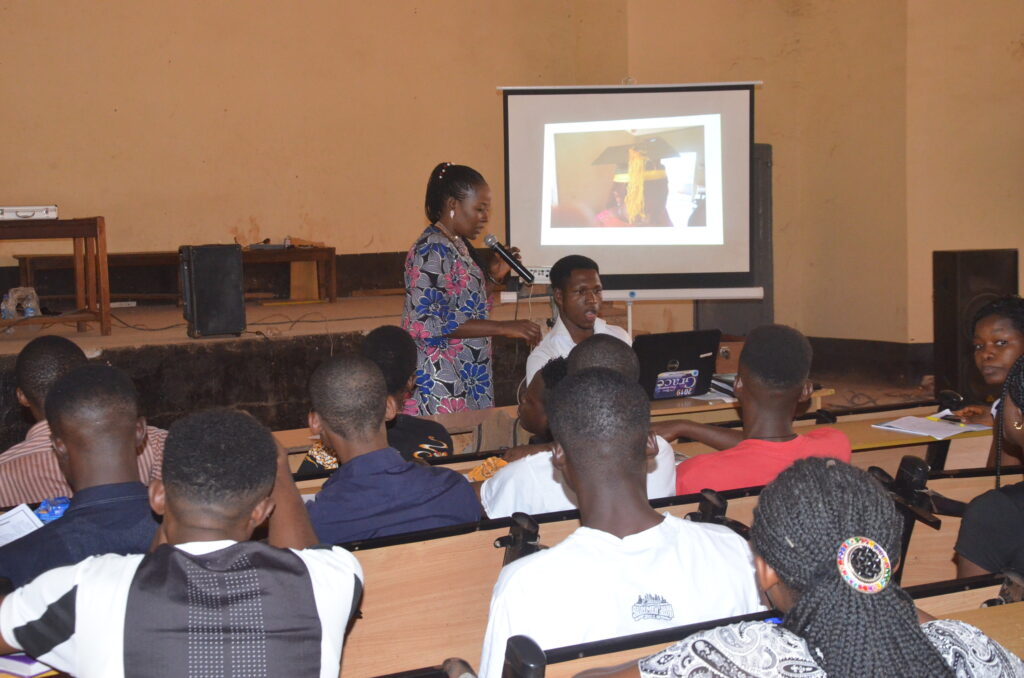
File photograph of a teaching session at the University of Nigeria, Nsukka. It does not depict the ASUP strike or the student protest in Ogun State. Photo: Ngozi Stella Udechukwu / Wikimedia Commons, CC BY-SA 4.0.
Students in Ogun State took their protest to the Governor’s Office at Oke-Mosan, Abeokuta, on Thursday, 19 November, as an industrial action by the Academic Staff Union of Polytechnics continued to disrupt academic activities in state-owned institutions across four South-West states.
ASUP Zone C said its strike covers state-owned polytechnics, colleges of technology and monotechnics in Ogun, Oyo, Osun and Ekiti. The union said the action began on Monday, 16 November, after a 15-day ultimatum to the affected state governments expired without the implementation of two allowances agreed for academic staff.
The protest in Abeokuta brought students directly into a dispute that has so far centred on the welfare and remuneration of lecturers. Reports from the demonstration said students took their grievances over the disruption of academic activities to the Ogun State Government’s offices. The reports did not establish how many students took part or identify the institutions represented.
Strike follows months of appeals
The union’s Zone C leadership announced the action at a press conference held at its secretariat in The Polytechnic, Ibadan, on Thursday. A statement signed by the zonal executive council set out the reasons for the strike and the steps the union said it had taken before withdrawing members’ services.
According to the statement, ASUP wrote to the governors of the affected states on 10 August 2026, requesting implementation of the allowances. It said a reminder was sent on 21 September. The union’s National Executive Council then met in Abuja on 23 and 24 October and resolved to issue a 15-day ultimatum to governments that had not acted. That ultimatum expired on 10 November.
The union said the industrial action was prompted by the failure of Ogun, Oyo, Osun and Ekiti to implement the Consolidated Academic Tools Allowance, known as CATA, and the Earned Academic Allowance, or EAA, for lecturers in their state-owned institutions. It is also seeking payment of outstanding allowances dating back to 1 January 2026.
ASUP said the Federal Government had started implementing the allowances for academic staff in federal institutions on the relevant polytechnic salary structure, while lecturers in state-owned institutions in the four states had not received the same treatment. The union argued that staff performing comparable duties should not be treated differently because their institutions are funded by different levels of government.
“State governments should endeavour to treat our members in state-owned institutions appropriately, not as second-class citizens within the same national economy,” the union said in its statement.
Federal agreement provides the background
The dispute follows a renegotiated agreement signed by ASUP and the Federal Government on 8 April 2026. The union’s president, Shammah S. Kpanja, signed on behalf of ASUP, while Dr Mamud Yayale Ahmed, chairman of the government’s renegotiation committee, signed for the Federal Government. The agreement took effect from 1 January 2026 and addressed welfare and conditions of service in the polytechnic sector.
The Federal Ministry of Education said in October that the 2026 agreements with academic and non-academic staff unions, including ASUP, had been unveiled and that implementation of approved allowances had commenced. The ministry identified CATA for eligible ASUP and Colleges of Education Academic Staff Union members, and a separate non-teaching tools allowance for eligible non-academic staff. It also said an expanded implementation and monitoring committee would track progress and identify problems affecting delivery.
That federal framework forms part of the background to the present dispute, but the current strike concerns state-owned institutions and the decisions of their respective state governments. The Federal Government’s agreement and payments to federal institutions do not establish that the four states have adopted or implemented the same provisions for their own employees. ASUP is asking them to do so and to clear the arrears it says have accumulated.
Ondo cited as the exception
ASUP Zone C commended the Ondo State Government, which it described as the first and only government in the zone to implement the 2025/2026 agreement. The union criticised Ogun, Oyo, Osun and Ekiti for failing to follow suit.
Ogun State has since responded to the protest. Dolamu Idowu-Agida, the Permanent Secretary of the Bureau of Cabinet and Special Services, told the students on Thursday, 19 November, that the government had held two meetings with relevant stakeholders and that approval had been granted for an increase in monthly subvention to all state-owned polytechnics. He said the state hoped lecturers would return to classrooms within 48 hours.
The official did not state the revised subvention amount or when the increase would take effect. His assurance was not confirmation that the additional funding had been released or that ASUP had suspended the strike. The reports reviewed did not establish whether Oyo, Osun or Ekiti had announced comparable steps.
The strike is limited to the state-owned polytechnics, colleges of technology and monotechnics covered by the Zone C directive. It should not be read as a shutdown of every university or tertiary institution in the South-West, nor as an action by staff of all federal polytechnics.
ASUP has called for immediate implementation of CATA and EAA and payment of the outstanding sums from January 2026. It has not announced a settlement timetable or a date for resuming academic activities. The student protest in Abeokuta adds pressure for a resolution, but the next step rests on whether the affected state governments and the union can agree on implementation and payment.