Tunde Kelani built Mainframe Film and Television Productions around Yoruba stories, drawing on a career in photography and cinematography to make films rooted in literature, language and performance.
His catalogue includes Ti Oluwa Ni Ile, Saworoide, Oleku and Maami. Alongside directing, he has worked as a cameraman, producer and teacher, taking stories from the printed page to screens and community audiences.
Born in Lagos, Kelani grew up with his grandparents in Abeokuta. The Federal University of Agriculture, Abeokuta records that he attended Oke-Ona Primary School and Abeokuta Grammar School, in a community where he encountered Yoruba literature and theatre.
Photography became an early interest. In a 2012 interview with Netng, he recalled using four cameras before finishing secondary school. He then chose an apprenticeship in photography, rather than beginning his working life as a film director.
Television provided his next stage of technical training. He trained as a film cameraman at Western Nigeria Television and later attended the London Film School, obtaining a diploma in the art and technique of filmmaking.
The work took him beyond the studio. In a 2014 interview published by African Film Festival, Kelani described his work for Reuters, including covering drought in Ethiopia and travelling to Zimbabwe around its independence. He also worked in Nigerian television and for the BBC.
Mainframe gave him a base for making his own productions after years of supplying technical expertise to other filmmakers. The company emerged during the early 1990s, when economic pressures and video technology were changing how Nigerian films were made and circulated.
His films repeatedly returned to Nigerian writing. African Film Festival identifies Koseegbe, Oleku, Thunderbolt: Magun, The White Handkerchief, The Narrow Path and Dazzling Mirage among his literary adaptations. Adaptation became a recurring production method.
The festival’s filmography lists Ti Oluwa Ni Ile in 1993, Saworoide in 1999 and Agogo Eewo in 2002. Its programme places Yoruba alongside English and other Nigerian languages across his work, including English, Igbo and Yoruba in Thunderbolt: Magun.
Kelani has described casting as a decision driven by the story. Discussing Maami with Netng, he said Funke Akindele had previously appeared in smaller roles in Abeni and The Narrow Path. For Maami, he considered her the right performer for the character.
Building audience trust was also part of the work. He told Netng that Mainframe sought to sustain viewers’ loyalty through consistent production values. The recognition, he said, belonged to the producer and company behind the film as well as the people appearing on screen.
That approach did not remove the difficulty of financing productions. In the same 2012 interview, he explained that filming could stop when money ran out and resume when more became available. He wanted dependable funding that would allow him to produce more regularly.
His work has also involved taking films outside conventional cinemas. FUNAAB’s account of his career identifies the Mobile Cinema Project as a means of bringing information and entertainment to communities.
In October 2019, the university appointed him a visiting fellow in its Centre for Entrepreneurial Studies. The role was to help teach and coordinate short courses developing students’ filmmaking knowledge and entrepreneurial skills.
His cultural starting point remains explicit. Speaking to Punch in September 2026 about Yoruba language and identity, he said: “That is my whole being. It is my essence.” He described reading during childhood as both comfort and escape.
Kelani also discussed Cordelia, adapted from Femi Osofisan’s novel, as a project he had wanted to make for years. His account connected the film’s development to conversations about a musical collaboration with the University of Delaware.
Technology continues to feature in his production experiments. In the September interview, he described a studio laboratory combining physical sets, green screen, traditional props, digital cinema cameras and artificial intelligence. He said the tools should support filmmakers’ stories without displacing their languages or cultures.
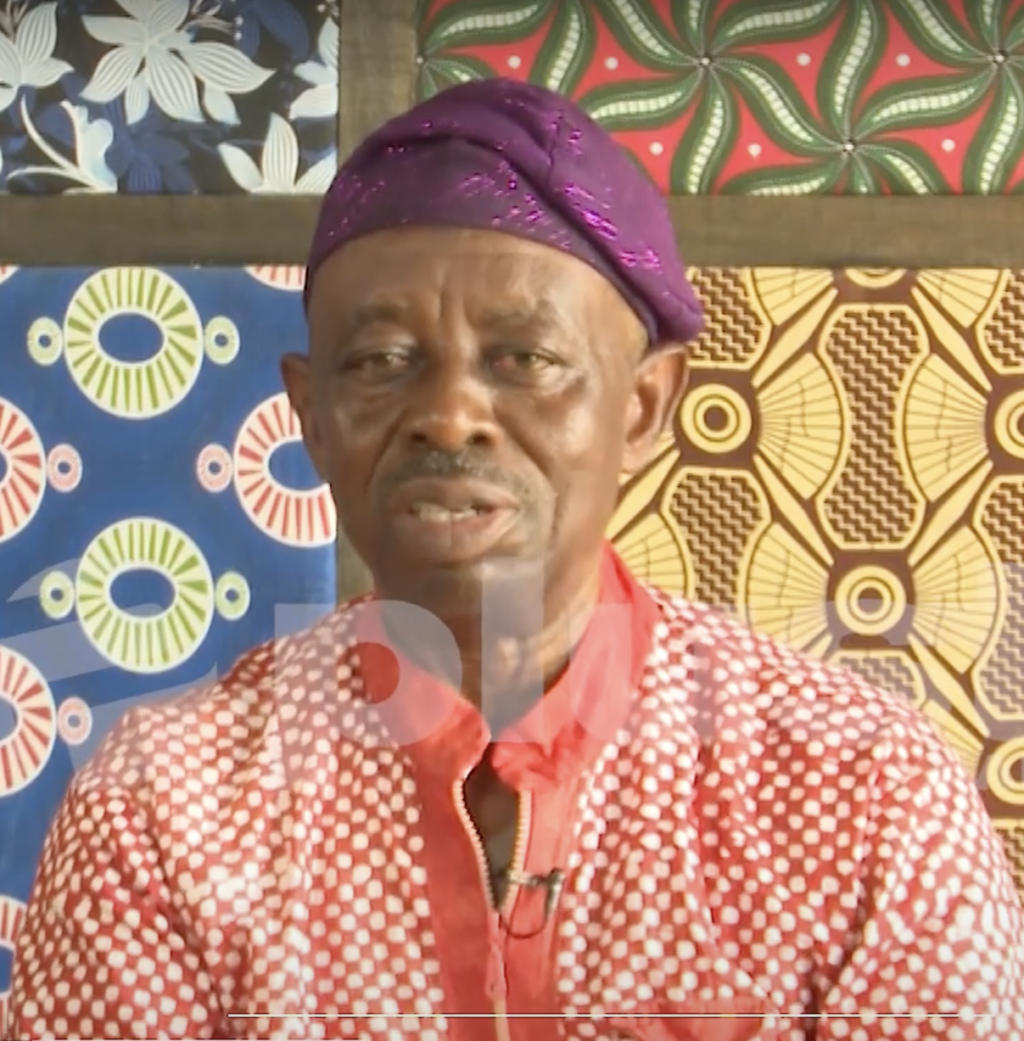
Archival portrait: Tunde Kelani in a Plus TV Africa interview, October 2019. Plus TV Africa / Wikimedia Commons, CC BY-SA 4.0. Display resized.