Qudus Onikeku built his international dance career in France, then returned to Lagos to create an organisation that could support other artists. The QDance Center, which he co-founded with his partner Hajarat in 2014, combines performance, talent development and community work with research into technology and movement.
His route into cultural enterprise began in Surulere. In a personal account published in 2021, Onikeku wrote: “I was born in Surulere, Lagos to a working-class Yoruba family.” He described a career shaped by migration, the difficulty of returning home and a determination to establish a lasting artistic practice in Nigeria.
After secondary school, he worked with the Lagos State dance troupe and received mentoring from practitioners including Victor Uwagba, Isioma Williams and Christopher Abdul. His official biography records a French embassy scholarship between 2006 and 2009 to study dance and acrobatics in France.
On graduating, he established YK Projects in Paris as a production and touring company. It developed around the migrant experience. His solo My Exile Is in My Head, created in 2010, grew out of the disappointment of an earlier attempted return to Nigeria.
His career gained international recognition, but success abroad did not settle the question of where to build. In his 2021 account, he recalled deciding with Hajarat to wind down their activities in France and return to Lagos. They arrived in January 2014 and spent several months reconnecting with the city before starting QDance.
The organisation gave the pair a structure beyond producing individual shows. Onikeku described four connected strands: making art, community development, talent development and services. He presented it as a social enterprise, bringing artistic work into contact with the practical demands of running an organisation.
The University of Florida identifies QDance as an incubator operating since 2014. Its work involves young artists, technology creatives, local communities and researchers, with interests extending across Africa and the diaspora. That institutional account corroborates the centre’s continuing role beyond its founder’s performances.
Yoruba thought remains central to the work. Re:INCARNATION, which premiered in 2021, brings Nigerian youth culture and Afrobeats into a structure concerned with birth, death and rebirth. The production developed through years of movement research with young dancers in Nigeria following Onikeku’s return.
Taipei Performing Arts Center programmed the work for 2 and 3 May 2026. Its production record credits a wider team of dancers, musicians, designers and managers. Hajarat Alli is credited as producer, alongside a music director, live musicians, costume and lighting designers, mask makers and a tour manager.
The same programme identifies Onikeku as chief executive and centre director of the John Randle Centre for Yoruba Culture and History in Lagos. His work therefore extends from creating productions to leading a cultural institution, alongside the organisation he helped establish.
His collaborations have also reached animation. The University of Florida records that he choreographed dance sequences for Iwájú, the 2024 animated miniseries made through Disney’s collaboration with the pan-African studio Kugali Media. The series is set in a futuristic Lagos.
Technology has become another strand of his practice. Atunda, his research project with collaborators at the University of Florida, examines whether artificial intelligence can help protect dancers’ intellectual property and create economic opportunities. The university says the project received a Robert Wood Johnson Foundation grant. It remains research, rather than evidence of a finished system delivering royalties to performers.
For Out of this World, presented at the Centre Pompidou in June 2023, Onikeku combined performance and installation. The university describes software called Oraqu whose framework drew on the Ifá divination system. It placed Yoruba knowledge within an interactive work using contemporary technology.
Across these projects, the enterprise has relied on collaboration as well as choreography. The QDance production record brings touring, music, design and management into the same working structure. Onikeku’s public contact page continues to direct enquiries to QDance Center, the Lagos organisation that followed his return from France.
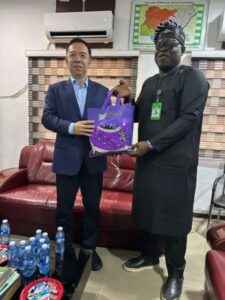
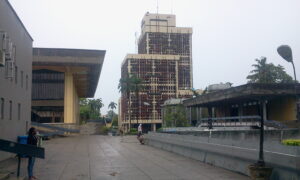
Archive location photograph: John Randle Centre for Yoruba Culture and History, Lagos, 15 November 2024. Isaacayodele32 / Wikimedia Commons, CC BY-SA 4.0. Resized for display. This is not a portrait of Onikeku or a QDance performance. Source; licence.