The Nigerian Union of Allied Health Professionals has directed health workers to prepare for possible nationwide industrial action over delayed salary adjustments and outstanding allowances. The mobilisation follows its National Executive Council meeting in Enugu on 21 and 22 October.
The directive raises the prospect of renewed industrial action by members of the Joint Health Sector Unions, known as JOHESU. It does not establish that a nationwide walkout has begun, and the communiqué sets no definite starting date for one.
NUAHP’s national president, Kamal Ibrahim, and general secretary, Martin Egbanubi, signed the communiqué, which was reported by Punch, TheCable and Nigerian Pilot. The union asked the Federal Government to implement its commitments under the terms of settlement reached with JOHESU on 5 February 2026.
Central to the dispute is the adjustment of the Consolidated Health Salary Structure, or CONHESS. The union said the government had not implemented the adjustment despite the previous prolonged JOHESU strike and the settlement intended to resolve the dispute.
NUAHP represents several professions involved in hospital treatment, diagnosis and rehabilitation. Its membership includes pharmacists, physiotherapists, medical laboratory scientists, imaging scientists, occupational therapists, dental technologists, dental therapists, dietitians and health information management practitioners.
The union’s communiqué referred to a labour ultimatum expiring on 23 October. However, the Nigeria Labour Congress announced an extension until Tuesday, 27 October, following talks with government representatives in Abuja on 22 October. That later deadline is material to the timetable for any wider labour action.
Benson Upah, the NLC’s acting general secretary, said the meeting ended without concrete commitments. He said the labour minister requested an adjournment so that relevant ministers and heads of agencies could attend the next round of discussions.
The congress’s demands include implementation of the JOHESU settlement, alongside petrol price reductions, renegotiation of the national minimum wage and agreed tax relief measures. Upah said the NLC’s appropriate organs would determine its next steps if the resumed talks failed to produce meaningful progress.
The NLC also clarified on 23 October that the Trade Union Congress itself had not participated in the 22 October dialogue or issued the ultimatum. It distinguished the TUC from representatives linked to JOHESU and the public-sector negotiating council who attended the meeting.
Separately, NUAHP demanded payment of what it described as 19 months of arrears arising from reviewed professional allowances. It also sought promotion of eligible professionals from CONHESS 14 to CONHESS 15, alleging that some institutional chief executives had disregarded career-progression guidelines.
The union acknowledged payment of call-duty allowances to eligible professional groups, while pressing for outstanding entitlements to be settled. Its demands therefore cover both salary-structure adjustments and the implementation of specific allowances and promotion provisions.
Beyond pay, the council called for stronger hospital security and enforcement of existing guidelines against assaults on healthcare professionals. It cited physical attacks, verbal abuse, intimidation and harassment among its concerns.
It also urged the government to supply protective equipment, diagnostic resources, training and funding for public-health preparedness against Ebola. NUAHP’s request accompanied its call for outstanding agreements and approved entitlements to be implemented to avert further industrial action.
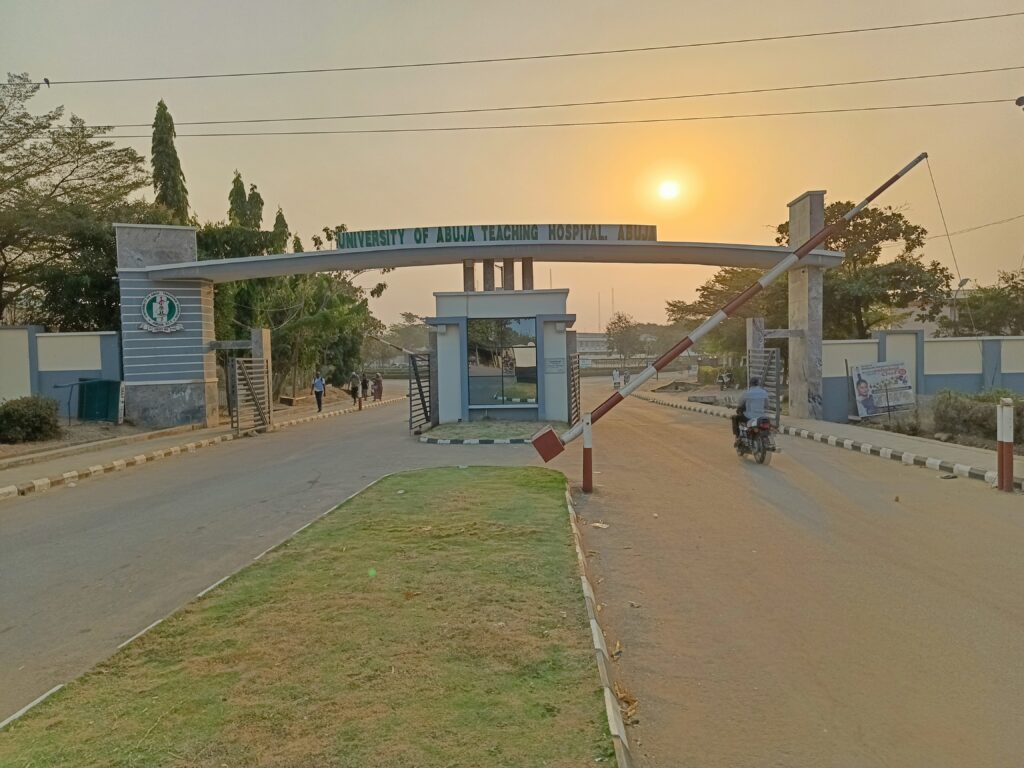
Image: University of Abuja Teaching Hospital entrance, Gwagwalada, photographed on 20 January 2024 by Marvelousola01. Archive location illustration, not a photograph of the union meeting or a current hospital closure. Wikimedia Commons, CC0 1.0. Cropped and resized.