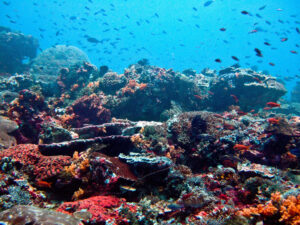
Most of the world’s shallow-water coral reef ecosystems face an extremely high risk of collapse by 2075, according to a global assessment released by the International Union for Conservation of Nature on 22 October.
The study classifies 122 of 127 assessed reef ecoregions, or 96 per cent, as Critically Endangered. It covers warm, shallow-water reefs across more than 80 countries and territories, including the Red Sea, the Great Barrier Reef and the Coral Triangle.
The finding measures the risk of losing functioning reef ecosystems. It does not mean that 96 per cent of reefs have already disappeared. Most still contain living coral, and the assessment identifies opportunities to improve their chances of survival.
The result combines records of past damage, present conditions and projections of future ocean warming. Without the future climate projections, 30 assessed ecosystems, or 24 per cent, would fall within the Critically Endangered category on the basis of observed changes alone.
Projected heat stress accounts for much of the increase. The researchers used the Intergovernmental Panel on Climate Change’s SSP2-4.5 scenario, described by IUCN as a middle-of-the-road pathway. Under that scenario, increasingly frequent marine heatwaves leave reefs with less time to recover between damaging events.
The assessment was coordinated by IUCN, the University of Melbourne and CORDIO East Africa, alongside regional networks of the Global Coral Reef Monitoring Network. More than 250 experts contributed through ten regional teams.
One assessed ecosystem, the Western Galápagos Islands, was classified as Collapsed following the 1982-83 El Niño event. Four others were listed as Data Deficient, meaning there was insufficient information for a full assessment. They include three Brazilian ecoregions and the Northern Monsoon Current in the western Indian Ocean.
Coral reefs support fishing, coastal tourism and protection against waves, flooding and erosion. Their loss therefore affects food supplies, employment and coastal settlements as well as marine biodiversity.
IUCN director general Grethel Aguilar said declining reefs threatened the food, shelter and breeding grounds used by marine life. She called for emissions reductions, protection and restoration alongside investment in coastal ecosystems and the communities depending on them.
Heat is not the only pressure. The assessment also identifies overfishing, pollution and sediment as factors that can disrupt the balance between corals, algae and fish. Removing fish that control algae can make it harder for corals to recover.
IUCN said local conservation measures could reduce those additional pressures, although they could not prevent marine heatwaves. Its recommendations include rebuilding fish populations, limiting pollution and protecting reefs that have retained living coral despite repeated exposure to heat.
Mishal Gudka, research director at CORDIO East Africa and scientific lead of the assessment, said reefs had demonstrated an ability to recover after severe bleaching. He urged national and local authorities to keep coastal waters clean and ensure fishing remained sustainable.
The assessment also identifies gaps in monitoring, including in the Gulf of Aden, the western Arabian Sea and parts of northern Brazil. Its findings provide a baseline for national assessments and reporting under the Kunming-Montreal Global Biodiversity Framework.
Image: Ilse Reijs and Jan-Noud Hutten, 26 July 2009, CC BY 2.0. Archive reef off Nusa Lembongan, Bali; not a current condition survey. Source, CC BY 2.0. Cropped and resized; faded at the lower edge on the social artwork.