
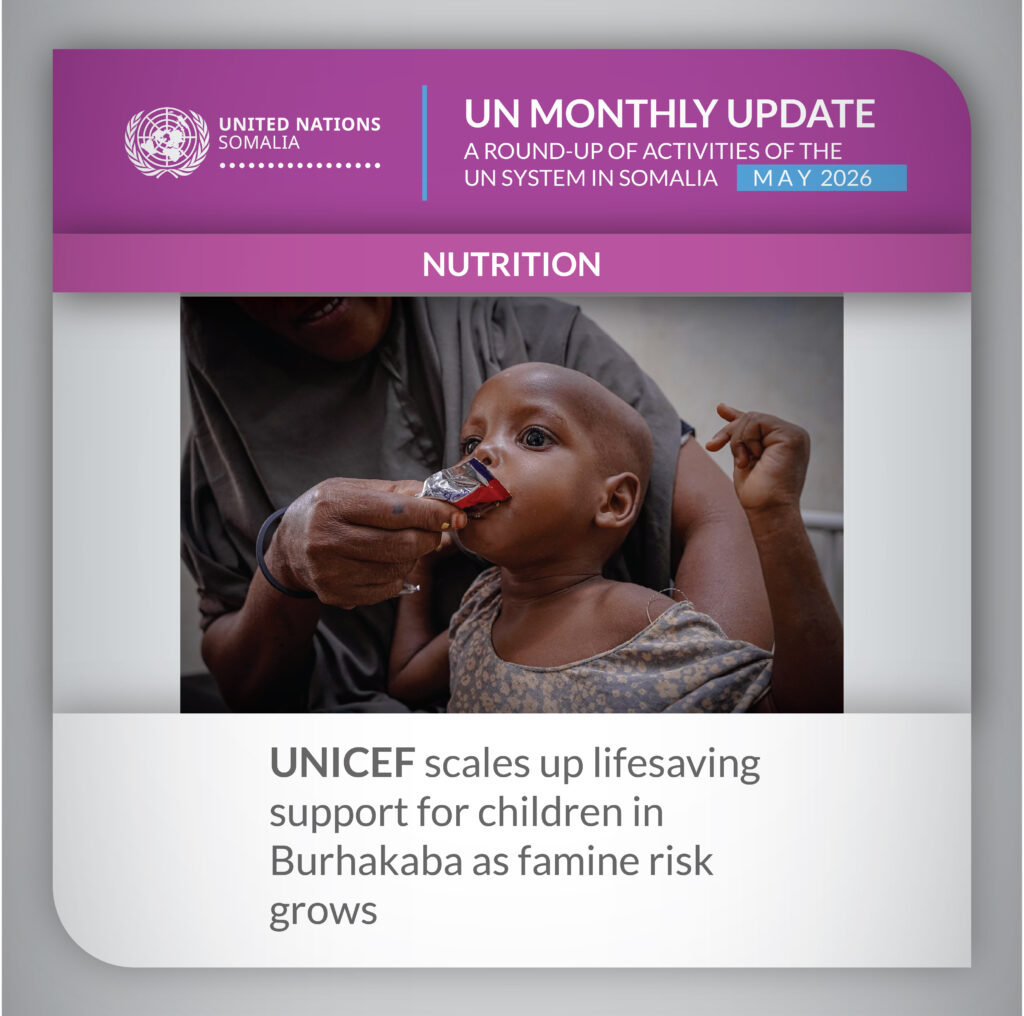
A Somali mother’s three-day journey carrying her dangerously ill daughter to hospital has exposed the distance between millions of vulnerable children and the treatment that could save their lives.
Halima Abdullahi Ibrahim walked nearly 90 kilometres from her village to Kismayo Referral Hospital with her three-year-old daughter, Asho Hassan Abdi. The child’s body was swelling and medical help was not available closer to home.
At the hospital’s stabilisation centre, health workers diagnosed Asho with oedema, a sign of severe acute malnutrition. Her case reflects a national emergency in which an estimated 1.92 million Somali children aged between six months and almost five years are suffering, or are expected to suffer, from acute malnutrition during the year ending in June 2027.
The estimate comes from the Integrated Food Security Phase Classification, the internationally recognised system used by governments and humanitarian agencies to measure hunger. Almost half a million Somali children are expected to experience severe acute malnutrition, its most life-threatening form.
Sandra Lattouf, UNICEF’s representative in Somalia, said children were dying from malnutrition while illnesses including measles intensified the danger. “We need to do more for them,” she said during a visit to Kismayo.
Long journeys and shrinking services
Kismayo Referral Hospital admitted 152 children with severe acute malnutrition in August alone, according to figures gathered at the facility. Four died. Each number represents a family that managed to reach treatment, while many others remain in settlements and rural communities without the money or transport to travel.
The crisis has worsened as health and nutrition services close because of funding shortages. UNICEF said in August that 205 facilities had already shut and as many as 618 could close nationwide. Fewer clinics force families to travel farther, delaying treatment until a child’s condition becomes more complicated and expensive to manage.
The International Committee of the Red Cross previously reported record admissions at the stabilisation centre in Kismayo. It recorded 277 critically ill children in May 2025, the highest monthly total since 2023, and 863 admissions during the first five months of that year.
ICRC officials said conflict, displacement, floods and drought were combining to push communities towards hunger. Nutrition clinics that once treated children before their condition became critical have been among the services lost to funding cuts.
Displacement compounds the emergency
The consequences are visible at Luglow, a settlement for displaced people outside Kismayo. Families live in shelters made from branches and patched plastic sheeting, often near stagnant and contaminated water.
Ali Adan Ali, Jubbaland’s commissioner for refugees and internally displaced people, said many displaced families had received no humanitarian assistance since 2023 because aid organisations lacked funding.
Somalia’s hunger emergency is driven by overlapping pressures. Repeated droughts have destroyed crops and livestock, while floods have displaced communities and damaged farms and roads. Conflict restricts access to some areas and forces families from their homes. Poor sanitation and infectious diseases then increase the risk that an undernourished child will deteriorate rapidly.
The World Food Programme has estimated that about six million people, close to one-third of Somalia’s population, face acute food insecurity. The agency has said its available resources are only a fraction of what it had during the 2022 response, when expanded assistance helped avert famine.
Humanitarian agencies must therefore make difficult choices about who receives food, therapeutic nutrition and medical care. Children with the most severe conditions are prioritised, but prevention programmes and early treatment can disappear as budgets contract.
Why early treatment matters
Acute malnutrition weakens a child’s immune system and makes common illnesses far more dangerous. Severe cases can produce wasting, swelling and medical complications that require specialised food, medicines and careful monitoring.
Community screening can identify malnutrition before a child needs admission to hospital. That depends on trained health workers, reliable supplies and clinics within reach of families. When those services close, cases that could have been treated locally arrive at stabilisation centres in critical condition.
Halima and Asho’s journey shows why humanitarian funding is not an abstract budget issue. It determines whether a mother can find treatment near her home or must carry a sick child for days in the hope that a distant hospital still has a bed, medicine and therapeutic food.
International donors, Somali authorities and aid agencies now face an urgent choice: restore frontline nutrition and health services, or accept that more children will reach care too late.
Podium News will continue to monitor humanitarian funding, clinic closures and child-malnutrition figures across Somalia and the wider Horn of Africa.





