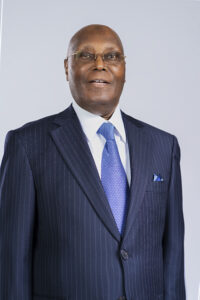
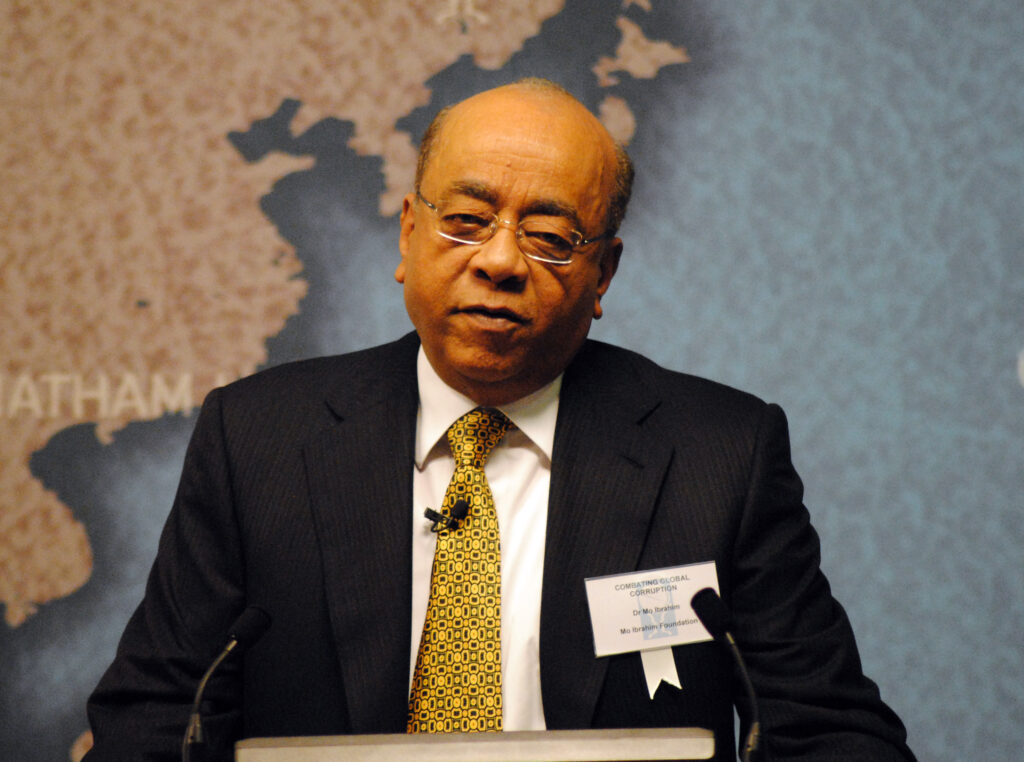
Dr Mo Ibrahim at a Chatham House event in London, 3 February 2014. Photograph: Chatham House, CC BY 2.0.
Mo Ibrahim has urged African governments to reduce their dependence on foreign aid and take greater responsibility for financing healthcare, education and development after official development assistance recorded its largest annual fall on record in 2025.
The Sudanese-born British entrepreneur and philanthropist, founder and chair of the Mo Ibrahim Foundation, made the call in an interview on Wednesday, 18 November. He argued that the reduction in aid should prompt governments to strengthen domestic revenue, tackle illicit financial flows and make better use of resources already generated across the continent.
“Africa needs to own its own future and its own economy,” Ibrahim said, adding that responsibility for essential services such as healthcare and education rests primarily with governments. He warned that sudden reductions in assistance can interrupt programmes on which vulnerable people depend.
Preliminary figures published by the Organisation for Economic Co-operation and Development show that official development assistance from Development Assistance Committee members and associates fell by 23.1 per cent in real terms in 2025, to 174.3 billion US dollars from 215.1 billion dollars in 2024. The OECD described it as the largest annual contraction in the history of the aid measure.
The five largest providers, Germany, the United States, the United Kingdom, Japan and France, accounted for 95.7 per cent of the overall decline. US official development assistance fell by 56.9 per cent. The figures are preliminary, with final activity-level data due in December 2026.
The OECD’s June outlook also projected a further 6.9 per cent fall in net official development assistance in 2026. Bilateral aid to sub-Saharan Africa was projected to decline by 11.6 per cent that year. Those figures are forecasts rather than confirmed final outcomes, but they point to continued pressure on development financing.
Ibrahim’s comments follow the release of the foundation’s 2026 Ibrahim Index of African Governance on 31 October. The index assesses governance performance in all 54 African countries over the decade from 2016 to 2025, using data from 51 sources. Its 319 underlying variables are organised into 96 indicators covering security and the rule of law, participation and rights, economic opportunity and human development.
The continental picture is mixed. Africa’s average overall governance score rose by 0.8 points between 2016 and 2025, reaching 50.1 out of 100. Thirty countries improved, 23 deteriorated and one recorded no change. Gains in economic opportunity and human development, including infrastructure, health and education, helped lift the average, while security, the rule of law, participation and rights weakened.
Nigeria recorded one of the sharpest declines. It ranked 38th out of 54 countries in 2025, with an overall score of 44.2, down 5.2 points over the decade. Only Burkina Faso recorded a larger fall. Nigeria was the only country in the index to deteriorate across all four main governance dimensions.
The foundation identified security and the rule of law as Nigeria’s weakest dimension over the period, with a decline of 11.2 points. Foundations for economic opportunity fell by 4.2 points, driven particularly by a 12.1-point drop in the rural economy measure. The index also recorded deterioration in public perceptions of economic opportunity.
There were areas of improvement in Nigeria’s results. The foundation recorded progress in health, education, inclusion and equality, and the sustainable environment sub-categories. The national score covers 2016 to 2025, a period spanning more than one administration, and should not be treated as a measure of the performance of a single government.
Ibrahim told Reuters that the latest index showed deterioration across all four of its main categories in Nigeria, while South Africa had continued to slide. He said the wider continent had resources to respond to the aid reduction, but that governments needed to take a more active role in financing public services and strengthening their economies.
One of the resources he highlighted was the money lost through capital flight and illicit financial flows. A 2025 Mo Ibrahim Foundation report cited a 2020 United Nations Conference on Trade and Development estimate that Africa loses about 90 billion dollars a year through capital flight, more than it receives in official development assistance. The foundation said almost half of that estimated outflow was linked to extractive industries. The figure is an estimate based on earlier research, not a new measurement for 2026.
Ibrahim called for stronger tax collection, action against profit shifting by multinational companies and a review of incentives such as tax holidays. He also argued that African pension funds and sovereign wealth funds could play a greater role in financing investment on the continent, provided governments create conditions that encourage confidence in domestic economies.
The proposals place responsibility on African governments to improve revenue administration and retain more value from their economies, while recognising that the loss of external assistance can put existing health, education and humanitarian programmes under pressure. The OECD’s preliminary figures show that the contraction was concentrated among the largest donors, while the foundation’s index highlights the institutional weaknesses that can limit the impact of domestic investment.
The Mo Ibrahim Foundation has cautioned that economic and human development gains will remain fragile without progress in security, the rule of law and public participation. Its 2026 index therefore presents a challenge beyond replacing lost aid: governments must also strengthen the institutions needed to turn available resources into reliable public services and lasting improvements in people’s lives.