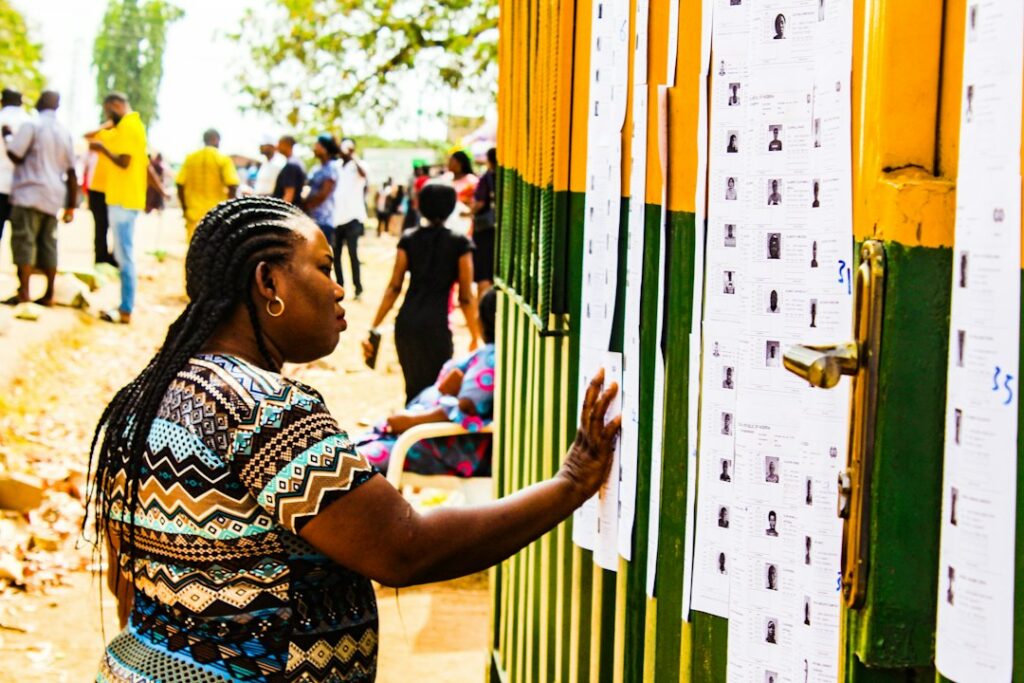
Illustrative photograph of a voter checking the register during Nigeria's 2019 general election. Photo: Nnaemeka Ugochukwu / Unsplash.
The INEC BVAS mock test will take place nationwide on Saturday, 28 November 2026, as the Independent National Electoral Commission prepares for Nigeria’s 2027 general elections. The exercise will test voter accreditation and the uploading of election results.
The exercise is scheduled to run from 8:30am to 2:30pm and will test the Bimodal Voter Accreditation System (BVAS), other election technologies and the procedures for transmitting results to the commission’s viewing portal.
17,676 polling units selected
According to details published by The PUNCH on Friday, the exercise will take place in 17,676 polling units across the country. That represents two polling units in each of Nigeria’s 8,838 Registration Areas.
INEC has urged registered voters assigned to the selected polling units to take part. The commission says their participation will help it assess the performance of the equipment and the practical procedures that will be used during the elections.
INEC BVAS mock test: what the exercise will cover
The mock exercise is designed to test voter accreditation using BVAS, the functionality of election devices and the process of uploading simulated results. INEC will also test how those results appear on its INEC Result Viewing Portal, known as IReV.
The exercise is a technical and operational rehearsal. It is not an election, and the results uploaded will be simulated rather than votes cast in a political contest.
How voters can check their polling units
Registered voters have been advised to confirm whether their polling units are among those selected. INEC has published a list of participating locations through its official website and provided contact channels for enquiries.
Voters can contact the commission on its toll-free line, 0700-2255-4632, or use the numbers 09050858629, 09050858675 and 09084444333. The short code 4632 and the commission’s published email contact are also available for enquiries.
The IReV portal, at irev.inecnigeria.org, is expected to allow members of the public to monitor the simulated results-upload process.
A test of public confidence
The exercise comes as political activity gathers pace ahead of the 2027 polls and concerns about election security and public confidence remain prominent. INEC and security agencies have separately called for stronger coordination to prevent political violence and protect electoral personnel and materials.
A successful technology test will not, on its own, guarantee a credible election. Voters will also look for transparent procedures, reliable communication, effective security and timely responses when problems arise. The mock exercise therefore provides an opportunity to identify weaknesses before election day rather than during it.
INEC’s preparations will be closely watched by political parties, civil society organisations and voters, particularly in communities where confidence in the electoral process has been affected by previous disputes.
For wider context, read Podium’s report on Atiku’s call for an independent audit of INEC’s proposed AI result checks ahead of the 2027 polls.