Ile-Ife glass beads carry a history of local invention and family knowledge. Archaeological research has established the Yoruba city as an early glassmaking centre, while a digital archive records a later craft sustained through recycled glass and inherited skills.
At Ayibiowu Compound, a beadmaker demonstrated how discarded beer bottles could become objects of adornment and cultural significance. The British Museum’s project record identifies him as Oladipupo Agbogunleri, a descendant of glass-bead makers who retained knowledge of the process.
Researchers documented grinding, washing, moulding, perforating and firing. Their record follows the material through successive stages, alongside interviews with beadmaking families, sellers, contemporary bead workers, priests and priestesses. The collection covers both manufacture and the meanings attached to beads in Yoruba life.
The archive belongs to a project led by archaeologist Abidemi Babatunde Babalola, with Adisa Ogunfolakan, Lesley Lababidi and Ademola Adesiyan. Published in May 2025, the British Museum repository lists Yoruba and English as its languages and the University of Cambridge as host institution.
The Endangered Material Knowledge Programme’s account dates the fieldwork to September 2019 through December 2021. It describes repeated visits to participants, audiovisual recording and the collection of oral histories. Researchers sought verbal consent before interviews and other recorded interactions.
Among the contributors was Iya Pete, who recalled witnessing beadmaking after marrying into a family practising the craft. Although she was not a beadmaker herself, she shared memories of work in the compound and showed her bead collection, according to the project account.
Members of the Ajilesoro family also contributed inherited knowledge about raw materials and production. The account says none of those interviewed remained active practitioners. Tools and unfinished work left by the family’s last beadmaker, Alhaji Ashiru, helped researchers understand the sequence of production.
The ancient industry left a different body of evidence beneath the city. Excavations at Igbo Olokun, on Ile-Ife’s northern edge, recovered beads, crucibles and production waste. A 2017 study in Antiquity placed the main period of glassworking at the site between the eleventh and fifteenth centuries.
Babalola and fellow researchers Susan Keech McIntosh, Laure Dussubieux and Thilo Rehren concluded that production was largely independent of glassmaking traditions documented farther afield. Their findings placed Igbo Olokun among the earliest known glass-production workshops in West Africa.
A subsequent chemical study, published in the Journal of Archaeological Science in 2018, examined 52 beads from an excavated assemblage containing more than 12,000. The analysis confirmed the prevalence of glass with a distinctive high-lime, high-alumina composition. Earlier interpretations had treated the workshop as a place where imported glass was reworked.
The study also identified a low-lime, high-alumina group. The researchers said evidence from crucibles suggested that both varieties were worked together and that the second may also have been made locally. Their conclusions distinguish established findings from possibilities still requiring investigation.
Making glass and making beads are related but separate operations. The former transforms raw ingredients into glass; the latter shapes that material into objects. In a 2023 African Archaeological Review paper, Foreman Bandama and Babalola describe evidence for both activities within Ile-Ife’s ancient industrial space.
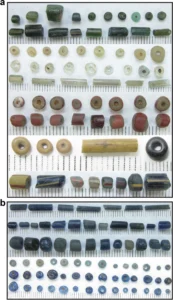
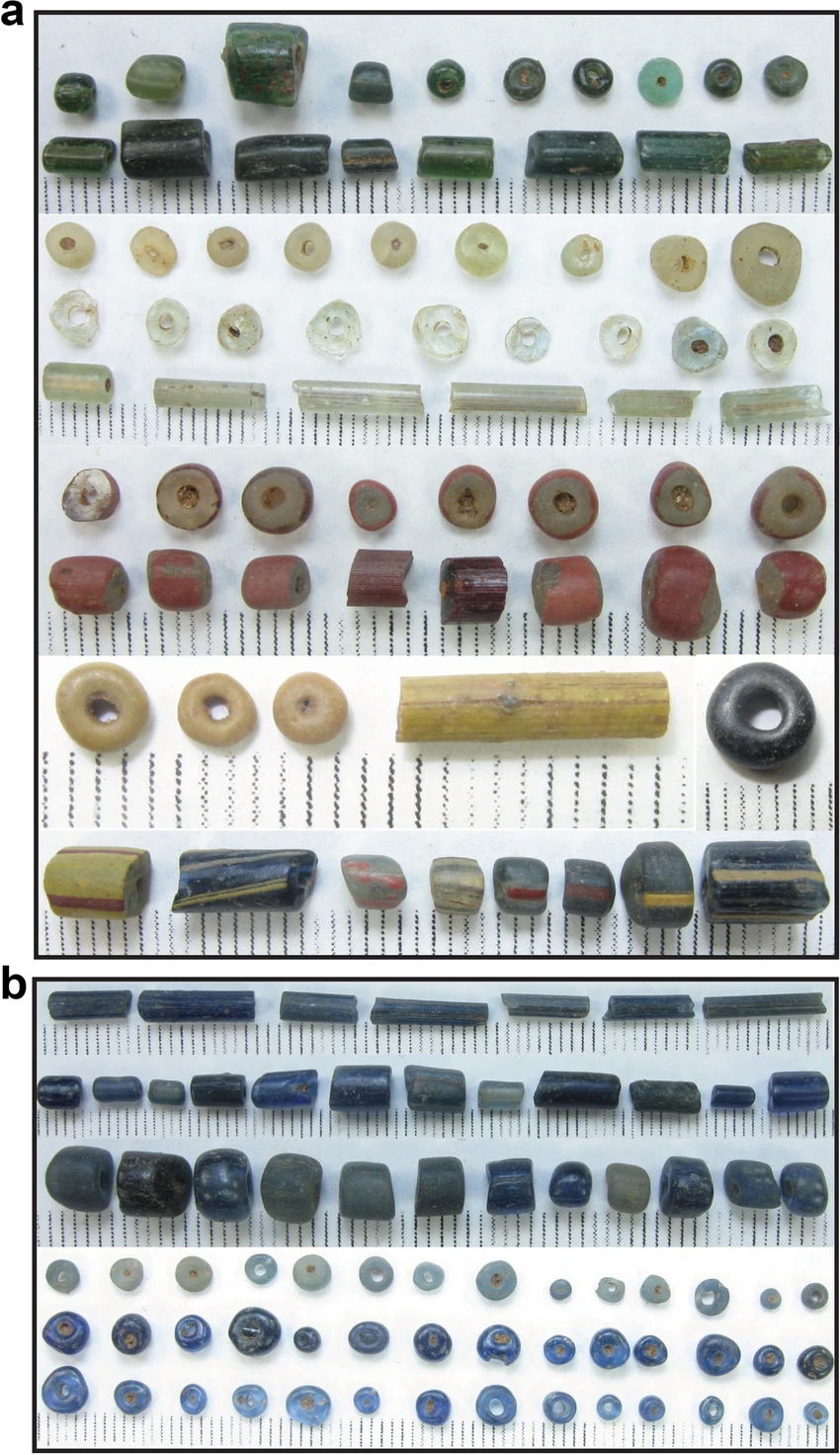
They explain how makers drew molten glass into tubes, maintained a central perforation and cut the tubes into bead lengths. Further treatment smoothed sharp edges. Their illustrated examples include unfinished pieces as well as rounded beads, preserving evidence of work in progress alongside finished objects.
The later bottle-recycling demonstrations document another form of beadmaking. They do not establish that the ancient furnaces remained in continuous operation. The Endangered Material Knowledge Programme distinguishes the earlier glass industry from the beadmaking knowledge that survived into its fieldwork.
Its recorded knowledge-holders also included a bead worker whose products comprised crowns, staffs, bags and badges. Researchers documented the making of a crown over several days, recording how beads were assembled into another object of Yoruba craftsmanship.
Image: Foreman Bandama and Abidemi Babatunde Babalola, Figure 5, African Archaeological Review, 2023, CC BY 4.0. Photograph date unconfirmed. Does not show the later craft demonstration.