Àgéré Ifá vessels hold the sixteen sacred palm nuts used in Yoruba Ifá divination. Carvers made these containers in forms ranging from a kneeling woman supporting a bowl to horses, riders and fish, combining a practical receptacle with carefully chosen figures.
The palm nuts are known as ikin. In its account of Yoruba divination implements, the Smithsonian’s National Museum of African Art distinguishes their container from the other objects used by a babalawo, or diviner. The iroke Ifá is a tapper, while the opon Ifá is the tray on which signs associated with an odu are marked.
The Smithsonian describes consultation with Orunmila as a means of seeking insight into misfortune or advice about an undertaking. The vessel belongs within that religious practice, alongside the handling of the nuts and the interpretation of verses.
A wooden example at the Cleveland Museum of Art places a mother and child beneath its bowl. The woman kneels on a circular base, with the smaller figure secured to her back. Fine lines describe her hair, while geometric patterns run around her waist.
The museum dates this vessel to the middle or later nineteenth century. Made from wood and colorant, it stands 31.7 centimetres high. Its catalogue cautiously identifies the maker as a Yoruba-style carver, possibly from Ekiti State; the accompanying interpretation associates the kneeling devotee with southern Ekiti.
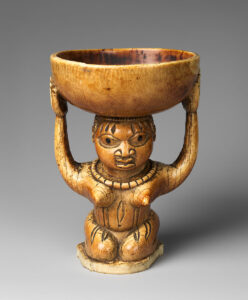
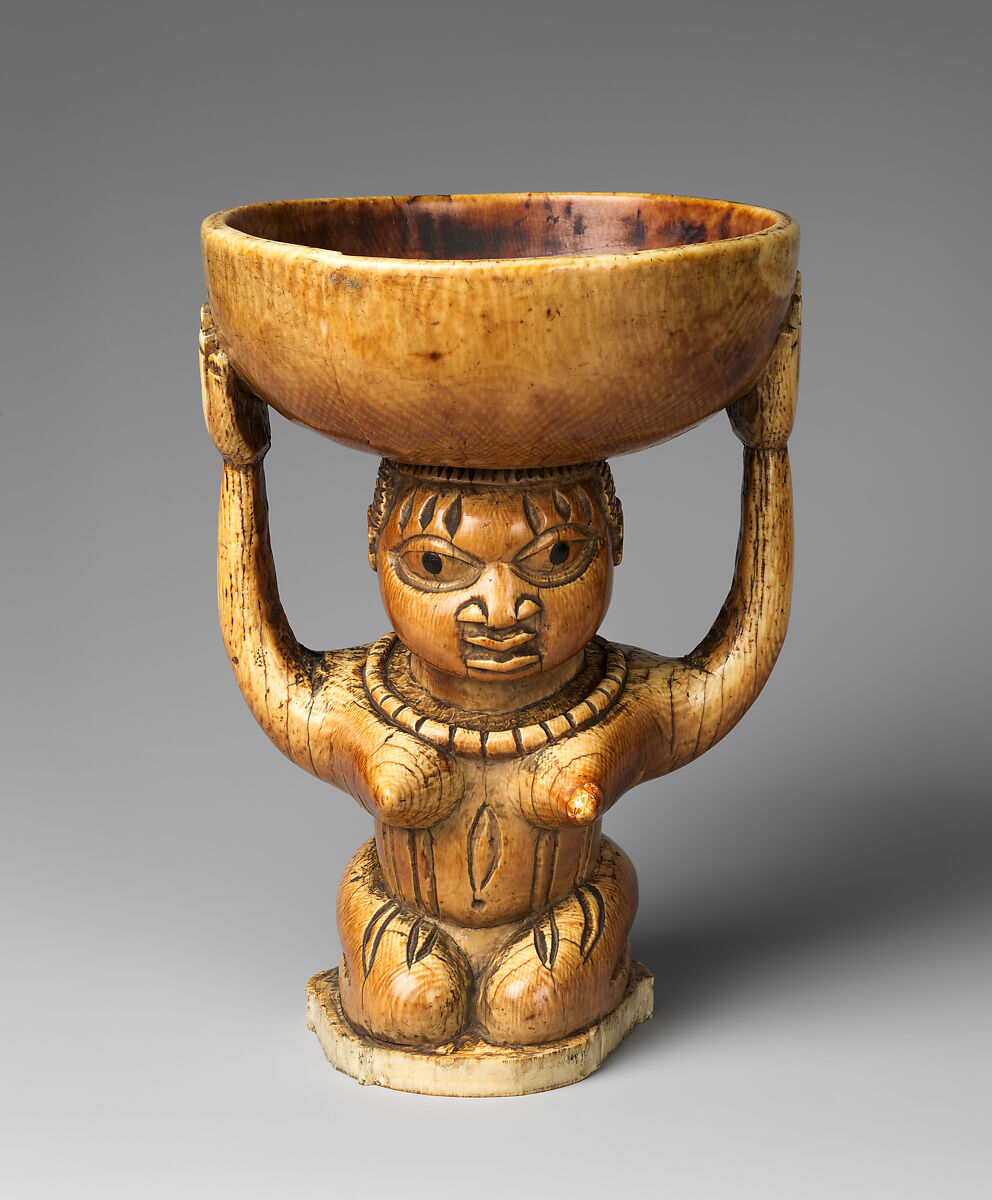
An ivory vessel at the Metropolitan Museum of Art shows another treatment of the kneeling figure. Here, the woman holds up the bowl with raised arms. Her legs fold beneath her body, and a carved necklace rests against her chest. Incised markings appear above her eyes.
The Met attributes the work to Owo on stylistic grounds and dates it between the seventeenth and nineteenth centuries. Its materials include ivory with wood or coconut-shell inlay. At 16.5 centimetres high, it is considerably smaller than the Cleveland vessel.
Most àgéré Ifá were made from wood, according to the Met. The museum suggests that the relative rarity and expense of ivory examples could indicate ownership by senior diviners or use within royal ritual settings. That interpretation concerns the material and status of such works, rather than a documented owner of this particular vessel.
Human figures were only one possibility. A mid-twentieth-century wooden cup in the Smithsonian collection rests on three curved mudfish. Open spaces separate the fish, whose bodies form the support between the bowl and its circular base.
The Smithsonian interprets the mudfish as a significant image of survival, referring to the ability of some species to endure low water or move across land. Sticks passing through the carved fish suggest preparation for smoking, connecting the image with food sold in markets or used as an offering.
A twentieth-century bowl in the Lowe Art Museum at the University of Miami provides a further animal association. Its interpretation identifies the domestic chicken as an offering and a symbol of devotion and communication with the spirit world. The museum records wood and stain as its materials.
The surviving vessels also differ in size and construction. Another wooden àgéré Ifá at the Met measures 16.2 centimetres high and dates from the nineteenth or twentieth century. That work entered the collection as a gift from Dr Jeffrey S. Hammer in 1980, under object number 1980.553.2.
Image: Yoruba artist, Owo, Àgéré Ifá with kneeling woman, 17th to 19th century. The Metropolitan Museum of Art, Gift of Mr. and Mrs. Klaus G. Perls, 1991, 1991.17.127. Public-domain image, The Met. Photograph date unconfirmed; resized for layout.