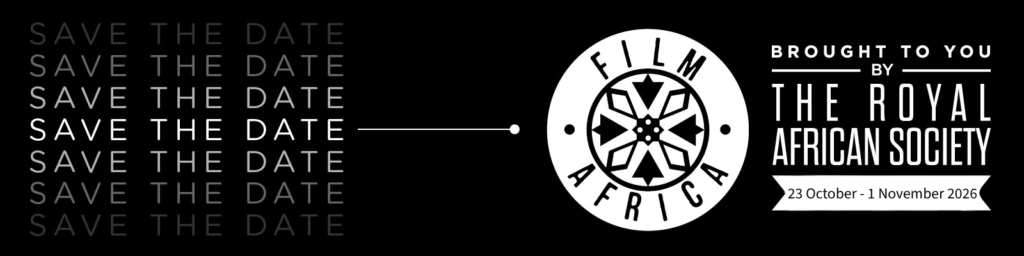
Film Africa 2026 will open in London on Friday, 23 October, launching ten days of screenings, conversations and industry activity devoted to cinema from across Africa and its global diaspora.
Presented by the Royal African Society during its 125th anniversary year, the festival runs until 1 November under the theme “125 Years of African Storytelling and Filmmaking”. Its programme brings contemporary features, documentaries and short films into conversation with the history of African screen culture and the conditions shaping its future.
BFI Southbank will host the opening and closing events, while screenings and discussions will extend to the Rio Cinema, The Lexi Cinema, EbonyLife Place London, Ciné Lumière and Riverside Studios. Partner screenings will also reach audiences outside the capital at Watershed in Bristol and Plymouth Arts Cinema.
African women move to the centre
A defining strand of this edition is the prominence of African women filmmakers. On 24 October, the half-day Twende: African Women and Cinema symposium at BFI Southbank will examine the contribution of women directors to contemporary world cinema.
Organisers say the event will place a new generation of filmmakers within wider historical, cultural and industrial contexts. The accompanying films engage with identity, memory, migration, gender, family, politics, ecology and social transformation, illustrating the breadth of stories being shaped by women across the continent.
The festival’s official promotion identifies Marie-Clémentine Dusabejambo’s Ben’imana as the opening film. The Rwandan-language feature follows Vénéranda, a survivor leading reconciliation dialogues in Rwanda in 2012 while facing a crisis within her own family. The film is a production involving Rwanda, Gabon, France, Norway and Côte d’Ivoire.
The closing film is Lady, written and directed by Nigerian-born, London-based filmmaker Olive Nwosu. Set in Lagos, it follows a cab driver who enters the world of a fearless group of sex workers and discovers sisterhood, danger and freedom. The closing screening is scheduled for 6.15pm on 1 November at BFI Southbank.
That pairing gives the festival a broad geographic and emotional frame. One story examines reconciliation, responsibility and family in Rwanda. The other uses Lagos nightlife and female solidarity to build a heroine rarely placed at the centre of mainstream African cinema.
From cinematic history to emerging voices
Film Africa is also using its anniversary edition to look backwards without turning the programme into a museum piece. A special programme at Ciné Lumière on 31 October celebrates Tunisian filmmaker, critic and historian Férid Boughedir.
His documentaries Caméra d’Afrique and Caméra Arabe trace the efforts of African and Arab filmmakers to reclaim the camera after colonial cinema had frequently reduced the continent to an exotic setting. The screenings will be accompanied by an introduction and conversation with Boughedir, giving audiences a direct route into the intellectual history of African film.
Elsewhere, the feature selection travels widely. The programme includes stories connected to Morocco, Algeria, Tunisia, Sudan, South Africa, Mozambique, Kenya, Nigeria, Rwanda, the Central African Republic, the Democratic Republic of Congo and Guinea-Bissau, alongside international co-productions.
Its short-film strands are organised around subjects including ritual and belonging, social norms and law, memory and religion, migration, folklore, colonialism and social harms. Scheduled SOAS programmes between 26 and 30 October bring together films from several countries in each session, allowing audiences to see connections that are sometimes obscured when African cinema is discussed one country at a time.
Why Film Africa matters
Film Africa was established in 2011 and is presented as London’s biggest festival dedicated to African cinema from the continent and diaspora. Beyond public screenings, it has traditionally combined director question-and-answer sessions, panels, workshops, masterclasses, school screenings and family activities.
That structure matters because festivals do more than place films on screens. They can connect filmmakers with programmers, distributors and new audiences, while giving viewers the context required to engage with work that may receive limited commercial release in Britain.
The 2026 edition arrives at a moment when African stories have greater international visibility but distribution remains uneven. A successful festival appearance can generate reviews, sales conversations and future invitations, yet many African films still struggle to secure sustained cinema runs or reliable access across the continent itself.
By pairing historical reflection with new work, Film Africa makes a useful argument: African cinema is neither a new trend nor a single aesthetic. It is a long, contested and continually evolving body of work, shaped by local languages, political histories, migration and changing technology.
Planning a visit
Dates, times, age classifications and ticket arrangements vary by film and venue. Audiences should therefore use the official calendar rather than assume that every event is taking place at BFI Southbank.
Some screenings are in London, while the Bristol and Plymouth partnerships broaden access outside the capital. Visitors interested in the women filmmakers strand should check the Twende symposium on 24 October, while those drawn to film history can plan for the Boughedir programme at Ciné Lumière on 31 October.
Film Africa 2026 runs from 23 October to 1 November. Readers can explore the full film list, venue information and ticket links through the official Film Africa website.