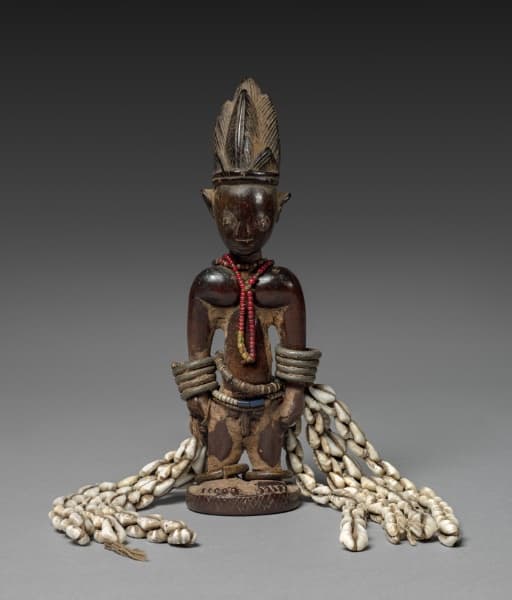
Ere ibeji are Yoruba memorial figures made to honour a twin who has died. Carved with adult features, they can be washed, dressed, decorated and symbolically fed, maintaining a connection between the deceased child and the surviving twin.
The figures belong to a religious and artistic tradition in which twins hold a special place. The Metropolitan Museum of Art associates them with Sango, the deity of thunder. Its account describes the carvings as a point of contact with the departed individual’s spirit.
Care leaves physical traces. Repeated handling changes the surface of the wood, while adornment adds materials that were not part of the original carving. Beads, cowries, cloth and metal ornaments can become part of a figure’s appearance through its use.
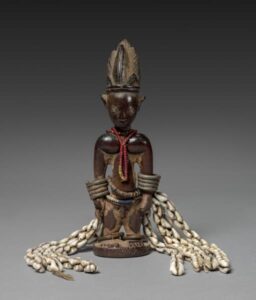
A late nineteenth or early twentieth-century example in the Cleveland Museum of Art carries several of these additions. Catalogued as the work of a Yoruba-style maker, it combines wood with copper alloy, iron alloy, lead, glass beads, cowrie shells, twine and pigment.
The museum describes its worn facial features as evidence of symbolic washing and feeding. Its adornments, in the museum’s interpretation, express parental care. The figure stands 25.6 centimetres high and entered the collection as a gift from Kim Sherwin, accession 2016.9.
Its adult form is deliberate. Cleveland explains that these memorials represent idealised adult individuals, even when they commemorate children who died in infancy. The sculpted body therefore differs from a naturalistic portrait of the child at the time of death.
Another Cleveland group records the work of the Fakeye School. Dated to about the 1940s, the pair consists of figures measuring 28 centimetres each. Their materials include wood, glass beads, natural fibre and organic material identified cautiously as probably bluing.
Cleveland interprets blue colouring in the hair and red camwood on the bodies as signs of the former owners’ devotion. The pair, accession 1972.332, was donated by Katherine C. White. The museum notes that members of the Fakeye family continued carving into the twenty-first century.
Regional attributions also distinguish surviving works. The Met identifies a female figure from the Ilaro region as Yewa-Yoruba. Made from wood, beads and camwood powder, the nineteenth or twentieth-century carving measures 20.3 centimetres high. It entered the collection through a 1979 gift from Dr Jeffrey S. Hammer.
Some records preserve the name of a particular carver. The British Museum attributes a female ere ibeji made in Abeokuta in 1964 to Sarakatu Ayoola. The wooden figure has a high plaited hairstyle and stands on a roughly circular base. A triangular mark is incised underneath the base, according to the museum’s description.
Its donor, Timothy J. H. Chappel, recorded commissioning the work and watching its initial shaping. His account says another member of the workshop completed the final smoothing at Ayoola’s request. That detail documents collaboration within a carving workshop alongside the named artist’s role.
The British Museum records the figure’s height as 28.6 centimetres. Donated by Chappel in 2021, it is registered as 2021,2024.2. The catalogue lists the figure as not on display.
Image: Twin Figure (Ère Ìbejì), late 1800s to early 1900s, Yoruba-style maker. Cleveland Museum of Art, Gift of Kim Sherwin, 2016.9. CC0. Museum object photograph.