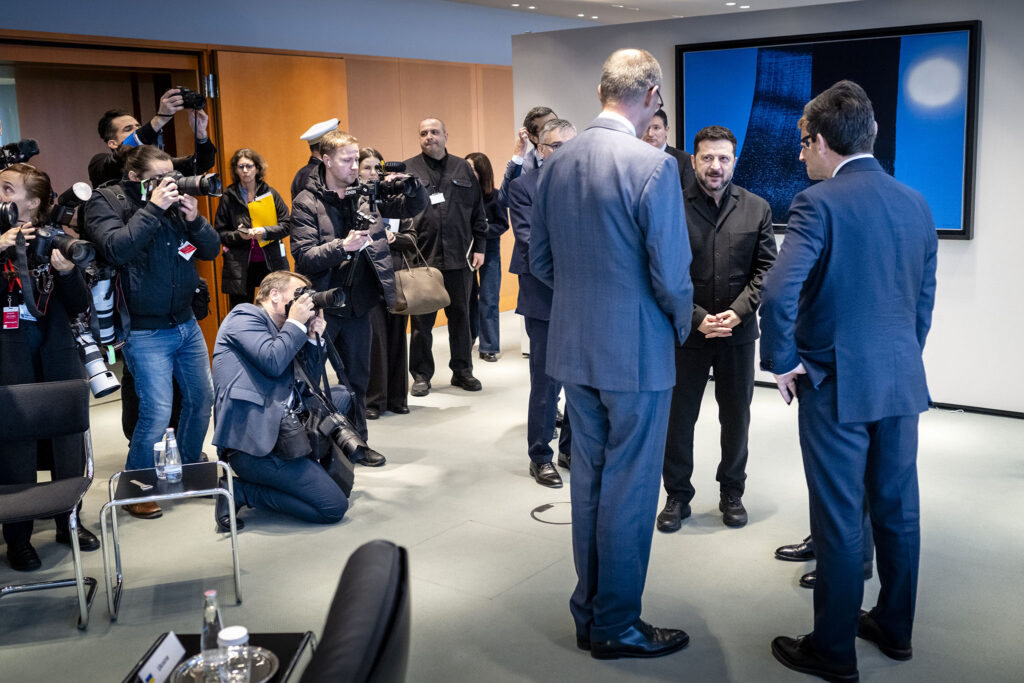
Berlin, 19 November 2026: German Chancellor Friedrich Merz, French President Emmanuel Macron and UK Prime Minister Andy Burnham welcome Ukrainian President Volodymyr Zelenskyy at the Coalition of the Willing summit. Photo: Bundesregierung/Guido Bergmann.
Representatives of 37 countries, alongside the leaders of the European Union and NATO, met in Berlin on Thursday as Ukraine’s allies called on Russia to accept a winter ceasefire covering energy infrastructure and Black Sea food exports, while setting out a proposed framework for postwar security guarantees for Kyiv.
The meeting of the Coalition of the Willing was hosted by German Chancellor Friedrich Merz and co-chaired by France and the United Kingdom. Ukrainian President Volodymyr Zelenskyy attended, while US President Donald Trump’s envoys Steve Witkoff and Jared Kushner took part in the discussions. NATO Secretary General Mark Rutte was also present.
A joint statement issued after the meeting said the leaders wanted additional missile defence for Ukraine before winter, particularly systems capable of intercepting ballistic missiles. It also described possible security arrangements that could take effect if a ceasefire is reached, including a US-led mechanism to monitor and verify the cessation of hostilities and a European-led multinational force supported by Washington.
The proposed force could provide reassurance measures in the air, at sea and on land, while helping to rebuild Ukraine’s armed forces. The statement also referred to a legally binding commitment by participating countries to take measures to restore peace and security if Russia launched another armed attack. Any such commitment would remain subject to each country’s national procedures.
The Berlin statement makes a distinction between the support already pledged to Ukraine and the security arrangements that allies say would be needed after a ceasefire.
Security plan depends on a ceasefire
The proposals are not a deployment decision or a security treaty already in force. The statement places the guarantees after a ceasefire and describes a framework for willing countries to develop with the United States. It does not set out a deployment date, name the countries that would contribute troops or specify the final legal form of the guarantees.
The leaders said Ukraine’s security was inseparable from the wider security of the Euro-Atlantic region. They backed continued military, financial and technical assistance and said Ukraine should retain the sovereign right to choose its security arrangements and alliances. They also maintained that international borders must not be changed by force.
The statement supported direct dialogue between Ukraine and Russia with the participation of the United States and European countries. It said the first objective of negotiations should be to end the fighting. It added that any wider agreement involving the European Union or NATO would require the consent of the relevant member states and allies.
That position reflects European governments’ insistence that they must be involved in decisions affecting the continent’s security. The Berlin meeting followed renewed US diplomatic activity involving Ukraine and Russia. European officials have expressed concern that negotiations conducted without Kyiv or European representatives would not produce a durable settlement.
Winter energy and food-export proposals
For the immediate term, the leaders called on Russia to agree to an energy ceasefire for the duration of the winter. They also said a separate ceasefire was needed to protect safe passage and freedom of navigation in the Black Sea, where shipping routes are important to food exports.
The appeal comes as Ukraine faces the prospect of further attacks on power and heating infrastructure during the coldest months. European Union foreign ministers had accused Moscow earlier in the week of prolonging peace discussions while continuing strikes on Ukrainian energy facilities. The Berlin statement condemned Russian attacks on civilians and civilian infrastructure, as well as alleged sabotage, cyber-attacks and information operations in Europe.
There was no indication in the statement that Russia had accepted either proposed ceasefire. The document sets out the position of Ukraine and its partners, not an agreement between the two sides.
Existing financial pledges reaffirmed
The leaders also repeated commitments to maintain substantial support for Ukraine. These included the NATO allies’ pledge to provide 70 billion euros in military equipment, assistance and training during 2026, with at least an equivalent level in 2027. That pledge was made at the NATO summit in Ankara in July and was reaffirmed in Berlin rather than newly announced.
The statement also referred to the European Union’s 90 billion euro Ukraine Support Loan, which is intended to cover military and financial needs through the end of 2027. The loan framework had been agreed earlier, so the Berlin meeting did not create a new 90 billion euro funding package.
On economic pressure, the leaders said they would pursue further measures against Russian oil and gas revenues, cryptocurrency and illicit financial flows, sanctions evasion and the network of vessels used to transport Russian oil outside restrictions. They also said Russian sovereign assets would remain immobilised until Russia ended its war and compensated Ukraine for the damage caused.
The German government said representatives from 37 countries attended the summit, most at the level of heads of state or government, together with senior EU and NATO officials. NATO described the gathering as including more than 30 heads of state and government.
The next test will be whether the proposals can be turned into arrangements accepted by Ukraine, its partners and, ultimately, Russia. For now, the Berlin meeting has produced a more detailed statement of what Kyiv’s allies say they are prepared to support, but no ceasefire agreement and no confirmed date for the next round of negotiations.
Podium News will continue to follow the diplomatic process, the security proposals and their implications for Ukraine and European stability.