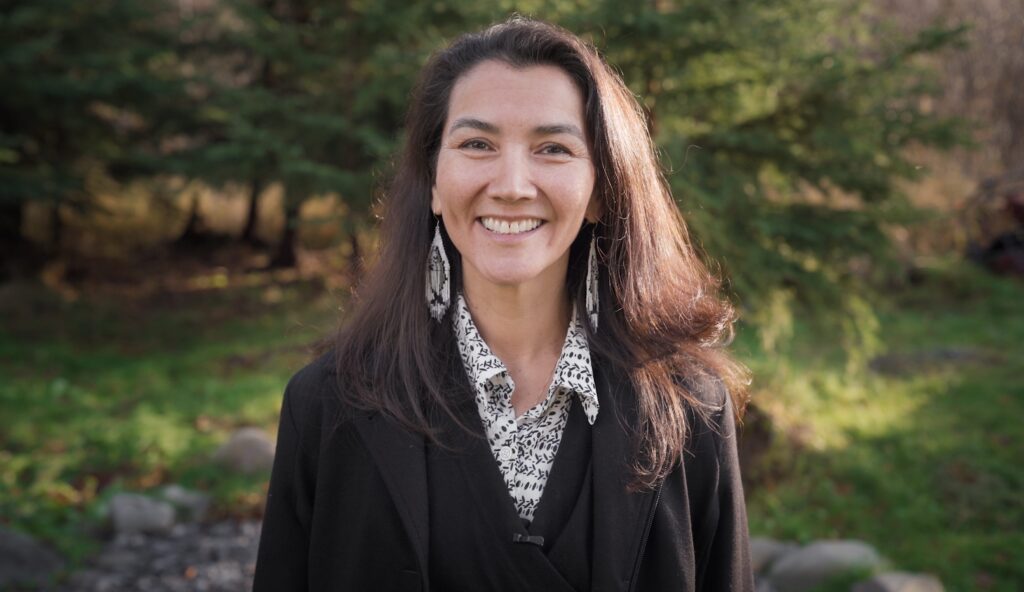
Archive portrait of Mary Peltola, photographed in 2022 during her service in the US House of Representatives. Source: Office of Representative Mary Peltola. Public domain, US government work.
Democrat Mary Peltola has defeated Republican incumbent Dan Sullivan in Alaska’s US Senate election, resolving the final uncalled Senate contest of the 2026 midterm elections and giving Democrats a 56-44 majority in the chamber for the next Congress.
The Associated Press declared Peltola the winner on Tuesday, 17 November, after an updated count put her above the 50 per cent first-choice threshold needed to win outright under Alaska’s ranked-choice voting system. The AP reported that she led Sullivan by 12,458 votes from 287,896 counted ballots. The Alaska Division of Elections still listed the general-election results as unofficial on Wednesday, 18 November, so the news agency’s call should not be confused with final state certification.
Peltola’s victory is historic. She becomes the first Alaska Native elected to the US Senate and the first Democrat to win an Alaska Senate race since Mark Begich in 2008. A Yup’ik woman from western Alaska, she previously became the first Alaska Native to serve in Congress when she won a 2022 special election for the state’s single House seat. She served through January 2025 before losing her bid for a second full term to Republican Nick Begich.
The result completes a wider Democratic advance in the midterms. The party flipped nine Republican-held Senate seats and will enter the next Congress with 56 of the chamber’s 100 seats, compared with 44 for Republicans. Reuters reported that this will be the Democrats’ largest Senate majority since 2009. Democrats have also secured control of the House of Representatives, giving the party majorities in both chambers when the new Congress convenes in January. Donald Trump remains president, but the new congressional balance will shape the administration’s legislative and oversight environment.
Campaign focused on costs and rural services
Peltola’s campaign centred on the cost of living and the practical pressures facing households across Alaska, particularly in remote communities. High fuel and food prices, housing affordability, access to fishing grounds and the availability of subsistence food featured in her appeal to voters.
In a statement after the result, Peltola said “the status quo in D.C. is not working for Alaska”. She said she had heard from families struggling to afford housing and heating, and from communities concerned about declining access to fish that have long supported local diets and livelihoods.
The issues have a particular significance in Alaska. Some isolated communities depend on diesel for electricity and heating and can be reached only by air or water. The cost of transporting food and other essentials can therefore be considerably higher than in more connected parts of the United States. Fishing, including salmon fishing, is also closely linked to subsistence, culture and local economies.
Reuters reported that Peltola had worked in the commercial fishing industry before entering politics. During the campaign she presented herself as an Alaska-focused candidate, arguing that she would work with people across party lines. In a message after her victory, she thanked voters and wrote: “Thank you, Alaska. Let’s get to work.”
Her victory came in a state carried by Trump by 13 percentage points in the 2024 presidential election. Peltola’s campaign sought to distinguish her from national Democratic politics by concentrating on local concerns and her own connections to communities along the Kuskokwim River in south-western Alaska.
Dispute over campaign allegations
The Senate race was complicated by allegations involving independent candidate Dan J. Sullivan Jr., a retired teacher whose name resembled that of the Republican incumbent. Republicans alleged that Peltola’s campaign had helped recruit the independent candidate to draw votes away from Dan Sullivan. Peltola denied involvement, and Sullivan Jr. also denied contact or coordination with her campaign.
The Justice Department has opened a criminal investigation into possible wrongdoing. The department’s actions do not establish that any offence occurred, and the allegations remain separate from the vote count. A federal judge dismissed a Justice Department lawsuit seeking to delay certification, although the department appealed, according to the Associated Press.
The Republican incumbent’s spokesperson said the campaign would allow the process to run until every legal vote had been counted and certified. The state election authority’s online results page remained marked unofficial at the time of this report.
Final result and next steps
Alaska uses ranked-choice voting for federal elections. A candidate who receives more than half of the first-choice votes wins without further rounds. If no candidate crosses that threshold, lower-placed candidates are eliminated and ballots are transferred according to voters’ next preferences. The updated count placed Peltola above the threshold, allowing the Associated Press to call the race without waiting for a ranked-choice redistribution.
Peltola will take her seat when the new Senate begins its term in January 2027. She will be only the fifth Democrat to represent Alaska in the Senate since statehood, and the first since Begich left office in 2015.
The state’s formal certification process remains the responsibility of Alaska election officials. Until that process is complete, the result is best described as called for Peltola by the Associated Press, with the state’s published results still marked unofficial.