The Algerian parliament has approved the deployment of army units to neighbouring Niger, opening the way for a military mission linked to the protection of Algerian interests in the Sahel.
The Council of the Nation and the People’s National Assembly backed President Abdelmadjid Tebboune’s request on Sunday, 25 October. The lower house announced its approval after the upper chamber had voted earlier in the day.
The Council of the Nation said all 148 votes cast supported the request, according to its statement carried by Algeria’s state news agency APS. The total comprised 131 members present and 17 proxy votes. The chamber said the constitutional threshold for its approval was 116 votes.
Article 91 of Algeria’s constitution requires approval by a two-thirds majority in each parliamentary chamber before the President can send army units abroad. Sunday’s votes authorised the proposed mission; they did not establish that troops had already arrived in Niger.
Members of the upper chamber told Anadolu that the military unit would secure oil projects belonging to state energy company Sonatrach. The vote followed a closed session called as an emergency meeting, the agency reported.
Reuters, citing a parliamentary statement, identified Madama in northern Niger, near the Libyan border, as the planned destination. The site previously served as a French base during Operation Barkhane. A Niger security source told the agency that no troops had officially deployed at the time of its report.
The decision follows a military cooperation protocol signed in Algiers on 21 October by Algeria’s army chief, General Saïd Chanegriha, and Niger’s Defence Minister, General Salifou Mody. Algeria Eco reported the agreement alongside the parliamentary approvals.
The two countries share a border and have been expanding cooperation in energy as well as defence. Niger also participates with Nigeria and Algeria in the Trans-Saharan Gas Pipeline project, which is intended to carry Nigerian gas through Niger to Algeria for onward export.
Sonatrach said on 4 June that work on the Algerian section had been formally launched at Aoulef, in Adrar. Nigeria’s Minister of State for Petroleum Resources responsible for gas, Ekperikpe Ekpo, attended alongside his Algerian and Nigerien counterparts.
The company said the Algerian route would follow the Trans-Saharan road corridor from the Niger border towards the Hassi R’Mel gas hub. From there, the planned pipeline would connect to Algeria’s existing gas transport and export infrastructure. The project involves NNPC, Niger’s Sonidep and Sonatrach.
That construction announcement concerned the Algerian section, rather than completion of the entire international pipeline. Sunday’s military authorisation likewise does not establish that the proposed export corridor is operational.
Niger’s government separately recorded a September visit by Algeria’s Hydrocarbons Minister, Mohamed Arkab, to review joint energy projects. Its account identified Sonatrach’s exploration partnership with Sonidep at the Kafra oil block and assessment of other blocks, including Bilma. It said the discussions were intended to strengthen coordination in refining and petrochemicals, alongside the development of gas infrastructure.
The government said the visit also covered maintenance work at the Zinder refinery and progress on the Trans-Saharan pipeline.
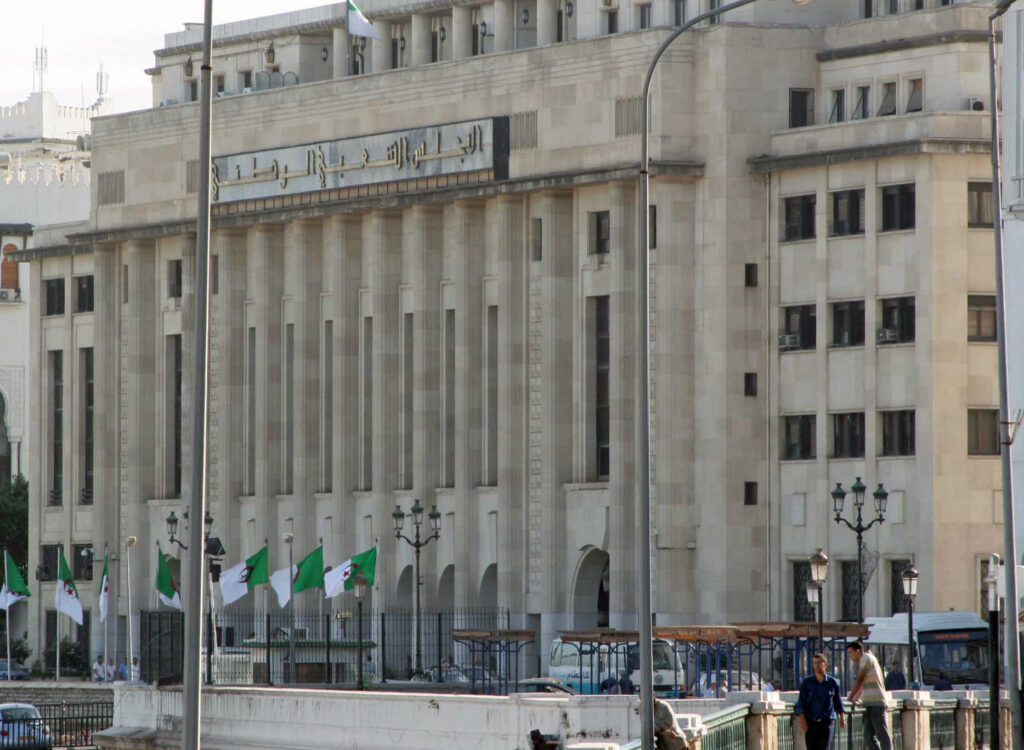
Archive image: Algeria’s People’s National Assembly, 10 August 2012, by Magharebia. Source. CC BY 2.0. Display versions may be resized or cropped. This photograph does not show the October 2026 vote.