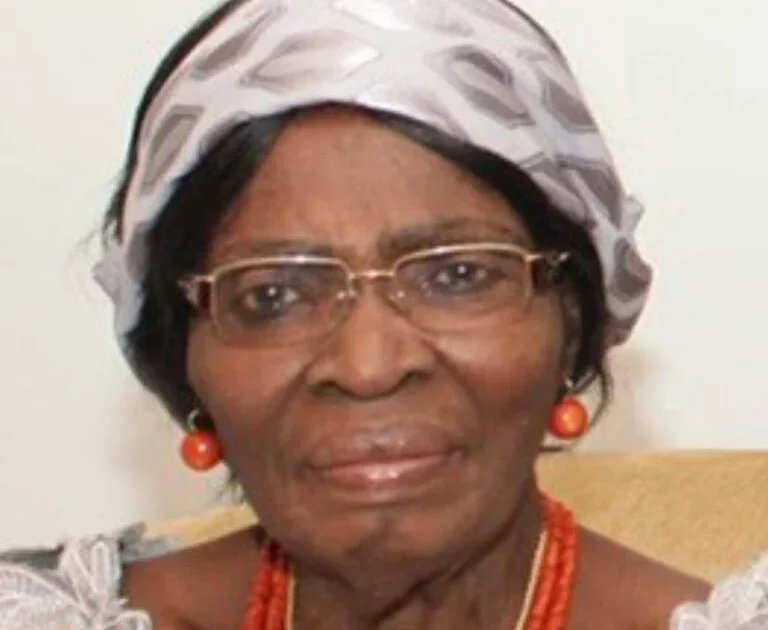
Professor Kamene Okonjo, the sociologist and women’s rights advocate whose research examined women’s political and economic lives, has died at 96. The Ogwashi-Uku royal family announced her death on Sunday, 25 October.
The family said she died on Friday, 23 October. Prince Ifeakanachukwu Emordi, palace secretary of Ogwashi-Uku Kingdom in Delta State, issued the announcement on behalf of the Umu Obi Obahai Royal Family.
Okonjo was the wife of the late Obi Chukwuka Okonjo, a professor and former traditional ruler of Ogwashi-Uku. The couple shared 66 years of marriage. Their children include the reigning Obi, Ifechukwude Anishi Okonjo II, and World Trade Organisation director-general Ngozi Okonjo-Iweala.
In the statement, reported by BusinessDay and The Guardian, the family recalled her commitment to scholarship, service and women’s empowerment. It also remembered her humility and the influence she had on her children, grandchildren and great-grandchildren.
Her academic work addressed the organisation of women’s lives within families, communities and political institutions. A 1992 article in the Journal of Comparative Family Studies identified her affiliation as the Department of Sociology and Anthropology at the University of Nigeria, Nsukka.
Among her publications was The Dual-Sex Political System in Operation: Igbo Women and Community Politics in Midwestern Nigeria. The chapter appeared in Women in Africa: Studies in Social and Economic Change, edited by Nancy J. Hafkin and Edna G. Bay and published by Stanford University Press in 1976.
Her later research included Rural Women’s Credit Systems: A Nigerian Example, published in Studies in Family Planning in November and December 1979. The article examined rotating credit arrangements through which rural Nigerian women organised savings and secured money for their families.
Its abstract explains how studying the groups revealed women’s family responsibilities and the economic priorities arising from them. It argued that such knowledge could help development programmes respond to the circumstances of the women they were intended to serve. The paper formed part of a special issue, Learning About Rural Women, edited by Sondra Zeidenstein.
Okonjo also contributed Sex Roles in Nigerian Politics to Christine Oppong’s collection Female and Male in West Africa, first published in 1983. Her published work subsequently extended to marriage and social change. The chapter considered women’s roles in Hausa, Igbo and Yoruba political systems. It examined how colonial rule marginalised female authority and how that exclusion continued after independence.
Her 1992 study, Aspects of Continuity and Change in Mate-Selection Among the Igbo West of the River Niger, appeared in the Journal of Comparative Family Studies. It examined marriage practices and women’s attitudes, drawing on participant observation and interviews with 250 women.
Ngozi Okonjo-Iweala became the first woman and first African to lead the WTO in March 2021. She previously served twice as Nigeria’s finance minister, from 2003 to 2006 and from 2011 to 2015. She began a second term in September 2025, following her reappointment by the organisation’s General Council in November 2024.
The royal family described Kamene Okonjo as a devoted mother and matriarch as well as a scholar. It asked the people of Ogwashi-Uku to join in commemorating her life and contributions.
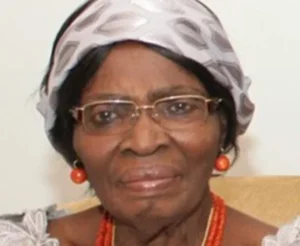
Portrait of Professor Kamene Okonjo via The PUNCH.