Abẹ̀bẹ̀, the Yoruba fan, has a ceremonial place in the worship of Ọ̀ṣun, the river deity associated with motherhood and beauty. In brass, beadwork and mirrors, the handheld object carries ideas of coolness, protection and spiritual authority.
For Talabi Adedoyin Faniyi, identified in Duke University’s Sacred Arts of the Black Atlantic catalogue as Ọ̀ṣun’s chief priestess in Osogbo, the mirrors on one beaded fan represent the deity’s eyes. They watch over worshippers and confront those who would threaten them, according to her explanation recorded in the catalogue.
The pair of Nigerian fans in that collection are predominantly yellow, Ọ̀ṣun’s emblematic colour. Faniyi interprets their floral patterns through the deity’s relationship with plants and the forest. Red, black and white designs refer to camwood powder, indigo and kaolin, materials with ritual significance.
The catalogue connects the name abẹ̀bẹ̀ with the Yoruba verb bẹ̀, to beg or beseech. Priestesses use the fan in appeals for calm. Its cooling action expresses a religious understanding of peace and wellbeing, rather than simply the movement of air.
Brass examples give the fan a different surface and weight. The High Museum of Art in Atlanta holds a Nigerian Yoruba fan dated to the late nineteenth or early twentieth century. Its account describes priestesses carrying brass fans in processions beside the Ọ̀ṣun River during annual celebrations dedicated to the deity.
The museum associates the object with Ọ̀ṣun’s beauty and fertility, and explains the cooling of the body as a parallel for relief from anxiety. These meanings belong to the devotional setting in which the fan is carried.
An example in the New Orleans Museum of Art places that metalworking tradition specifically in Osogbo. The museum records its Fan for an Osun Priestess as brass, made by an unidentified artist and dated to the nineteenth or twentieth century. The fan measures about 44 centimetres high and 30 centimetres across.
New York’s Metropolitan Museum of Art also holds a brass Osun Priestess Fan, attributed to a Yoruba artist from the Oshogbo region. Dated to the twentieth century, it stands 18 inches high. Claire and Michael Oliver gave it to the museum in 1996.
The fan also appears in the material culture of Yoruba-derived religions in Brazil. Georgetown University Library’s 2017 Sacred Arts of Orisha Traditions exhibition included a brass-and-copper Abébé Oxúm made by Afroarte Indústria in Rio de Janeiro in 1991. Its catalogue links the fan to cool river breezes and elegance.
That exhibition placed the fan within a set of regalia including a crown, sword and bell. A separate Brazilian fan-mirror, dated 1990, was associated with Iemanjá, the orixá of the sea. Its mirror was set inside the fan, demonstrating how the form serves different devotional identities.
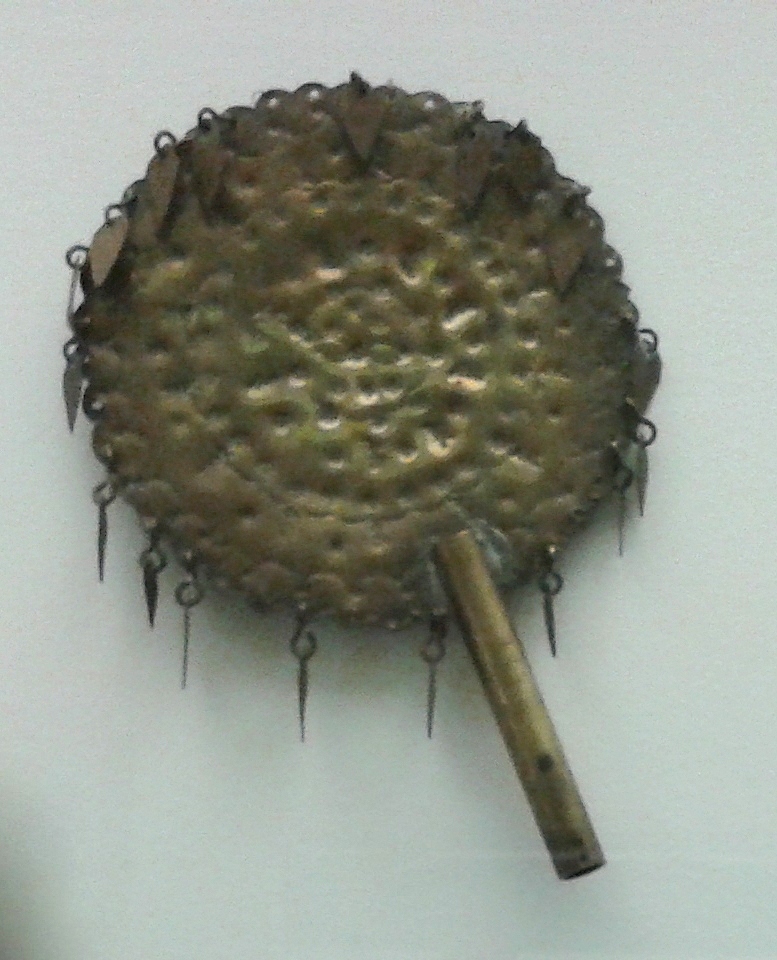
In Rio de Janeiro, the Museu Nacional’s catalogue records a nineteenth-century abebé as an object dedicated to Oxum, from the Coleção Polícia da Corte of the 1880s. The archive photograph accompanying this feature was taken at the museum in January 2015.
A Museu Histórico Nacional interpretation, presented through Google Arts & Culture, also notes that fans with bells, brass pendants or cowries can produce sound. The abẹ̀bẹ̀ can therefore enter a ceremony through movement, reflected light and the sound of its attachments.
Archive photograph: Dornicke, 10 January 2015, showing an abebé associated with Oxum at Museu Nacional/UFRJ, Rio de Janeiro. CC BY-SA 4.0. Display versions may be resized or cropped; prepared photographic adaptations are offered under the same licence. This image does not show the fans in the other collections discussed.