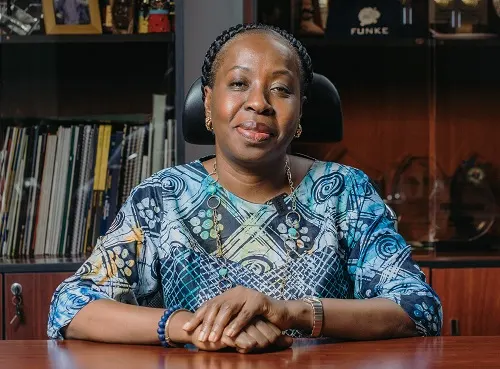
When Funke Opeke returned to Nigeria after two decades in the United States, she found a telecommunications market constrained by slow and expensive internet access, then turned that frustration into MainOne, the infrastructure company that built a 7,000-kilometre submarine cable and helped open West Africa’s digital economy to faster global connectivity.
Opeke’s journey is especially significant for Yoruba enterprise. Born in Ibadan and rooted in Ile-Oluji in Ondo State, she grew up in western Nigeria before studying electrical and electronics engineering at the University of Ife, now Obafemi Awolowo University. She later earned a master’s degree in electrical engineering from Columbia University in New York.
Her choice of engineering placed her in environments where women were often a small minority. In an oral-history interview with Harvard Business School, Opeke recalled approaching the challenge as a competitor who expected to meet the same standards as everyone else. That outlook would later become central to the way she entered one of Africa’s most demanding infrastructure sectors.
After graduate school, Opeke built a telecommunications career in the United States that included start-ups and senior responsibility at Verizon Communications. The work gave her experience in networks, wholesale telecommunications and the systems that allow businesses to move large volumes of data reliably.
She returned to Nigeria in 2005 to serve as chief technical officer at MTN Nigeria. After leaving the mobile operator, she became involved in efforts to revitalise NITEL, the former national telecommunications monopoly.
The NITEL experience did not produce the transformation she had hoped for, but it clarified the underlying problem. Nigeria lacked sufficient international broadband capacity and dependable infrastructure capable of supporting a modern digital economy.
Instead of returning to the United States, Opeke founded Main Street Technologies in 2008, the business that became MainOne. Her proposed solution was unusually ambitious: build a privately owned, open-access submarine cable from Portugal to the West African coast.
The obstacle was not merely technical. Opeke had to develop the feasibility studies, secure licences, negotiate across jurisdictions and persuade investors to finance a project whose failure would have consumed enormous sums. In an earlier industry interview, she identified raising capital as the hardest part of the undertaking.
For roughly the first year, she worked on the foundational plan largely by herself and committed her savings to proving that the project was viable. Early backing came from friends, family and angel investors, followed by larger African investors and development finance institutions.
MainOne’s cable entered service in 2010. Harvard Business School records the construction cost at $240 million and describes the route as a 7,000-kilometre high-capacity system stretching from Portugal along the West African coast.
The importance of the cable went beyond faster downloads. Reliable international connectivity became an enabling layer for banks, technology companies, media platforms, universities and emerging digital businesses. Opeke has pointed to companies such as CcHub and Andela as examples of organisations whose expansion required the type of connectivity MainOne helped provide.
MainOne continued to build beyond the undersea system. By the time Equinix completed its acquisition in April 2022, the company had data centres, more than 1,200 kilometres of terrestrial fibre and 65 points of presence across cities in Portugal, Nigeria, Ghana and Côte d’Ivoire.
Equinix valued the transaction at $320 million. Its announcement said MainOne had more than 800 business customers and nearly 500 employees at the time, demonstrating that the venture had grown from a difficult infrastructure proposal into a strategically important West African platform.
Opeke viewed the acquisition as a way to connect what MainOne had built to a larger global system and secure its long-term growth. She continued to lead the West African business after the transaction. Equinix appointed Wole Abu as regional managing director in November 2024, while Opeke remained a strategic adviser through March 2026.
Her story offers practical lessons for African founders. The first is to identify a genuine constraint rather than imitate a fashionable product. Opeke recognised that thousands of digital businesses would struggle without the underlying cable, fibre and data-centre infrastructure.
The second is that local relevance can be strengthened by global experience. Her years in the United States were not an escape from Nigeria but a source of technical knowledge, management discipline and industry relationships that could later be applied at home.
The third lesson is persistence supported by evidence. MainOne was not built on optimism alone. Feasibility work, licensing, engineering plans, investor confidence and delivery on time and within budget turned an improbable proposal into a functioning asset.
There is also a wider community lesson. Infrastructure businesses may be less visible than consumer applications, but their employment and economic effects spread across many industries. MainOne created direct technical jobs while helping other companies build services, attract customers and operate across borders.
For young women considering engineering, telecommunications or enterprise, Opeke’s career demonstrates the value of technical competence combined with the confidence to enter spaces where representation remains limited. For Yoruba communities, it is a reminder that heritage and identity can sit comfortably beside engineering, international finance and large-scale industrial ambition.
Funke Opeke did not begin with a promise to solve every aspect of Africa’s digital divide. She identified one critical gap, assembled the expertise and capital to address it, and built an institution capable of continuing beyond its founder.
Podium News invites readers to share the Yoruba and African founders whose work has created essential infrastructure, employment or new opportunities but deserves wider recognition.