The United States Justice Department has withdrawn its lawsuit seeking to stop California from counting ballots associated with approximately 20,000 registered voters whom federal officials alleged might not be American citizens, ending an urgent legal challenge brought during the 2026 midterm elections.
The department asked a federal court on Friday, 6 November, to dismiss the action after judges refused to order the state to separate the disputed ballots. The withdrawal came three days after the 3 November elections, while California was still processing millions of votes.
The Trump administration had sued California election officials in October, arguing that the state should investigate a federal list of roughly 20,000 people identified as potentially ineligible voters. Federal lawyers wanted ballots linked to those names set aside until their citizenship status could be checked.
California disputed the reliability of the list and maintained that it included eligible voters. State officials opposed changing established election procedures after voting had begun, arguing that doing so could prevent lawful votes from being counted.
US District Judge David O. Carter rejected the government’s request for emergency relief. The dispute then reached the Ninth Circuit Court of Appeals, where a divided panel also declined to intervene in the ballot-counting process.
The appellate proceedings raised questions about both the evidence used to identify suspected noncitizens and the practical consequences of separating ballots already entering the state’s election system. Judges considering the request warned of the risk of disenfranchising eligible voters and disrupting tabulation.
The federal government subsequently sought relief from the Supreme Court, but its effort to obtain an order before the ballots were counted did not produce the restriction it had requested. By Friday, the Justice Department said the remedy it had sought was no longer practicable because voting and ballot processing had progressed.
California’s election system separates identifying information from ballots during processing to protect voter secrecy. Once ballots are anonymised and counted, officials cannot simply retrieve a particular person’s ballot from the tally on the basis of a name appearing on a registration list.
The department’s withdrawal ends this particular attempt to compel California to segregate the ballots. It does not amount to a judicial finding that every person on the federal list was eligible, nor does it establish that the allegations of widespread unlawful voting were proved.
Federal officials have said they will continue investigating possible violations of election law. A separate federal lawsuit concerning California’s maintenance of its voter registration rolls also remains distinct from the abandoned emergency ballot challenge.
Voting by noncitizens in federal elections is prohibited under American law. The disagreement in this case centred on the accuracy of the government’s identification method, the state’s legal obligations and whether a court should alter election administration while voting and counting were under way.
The litigation unfolded amid a national midterm election in which the Associated Press projected that Democrats had secured control of both chambers of Congress. The agency called Democratic control of the Senate on election night and of the House early on 4 November. Those projections are not the same as final certification of individual state results.
California was still handling a substantial outstanding ballot count when the Justice Department moved to end the case. The Associated Press reported that approximately nine million ballots had been processed, with nearly five million remaining to be counted at that stage.
The dispute illustrates the difference between a suspected registration irregularity and a verified unlawful ballot. Investigators can examine individual allegations, but the court challenge sought a broad intervention affecting thousands of voters before their eligibility had been established through the proposed checks.
The government’s dismissal request leaves California’s existing ballot-counting process in place for the affected election. Any further enforcement action will have to proceed through separate investigations or litigation rather than the emergency order sought in this case.
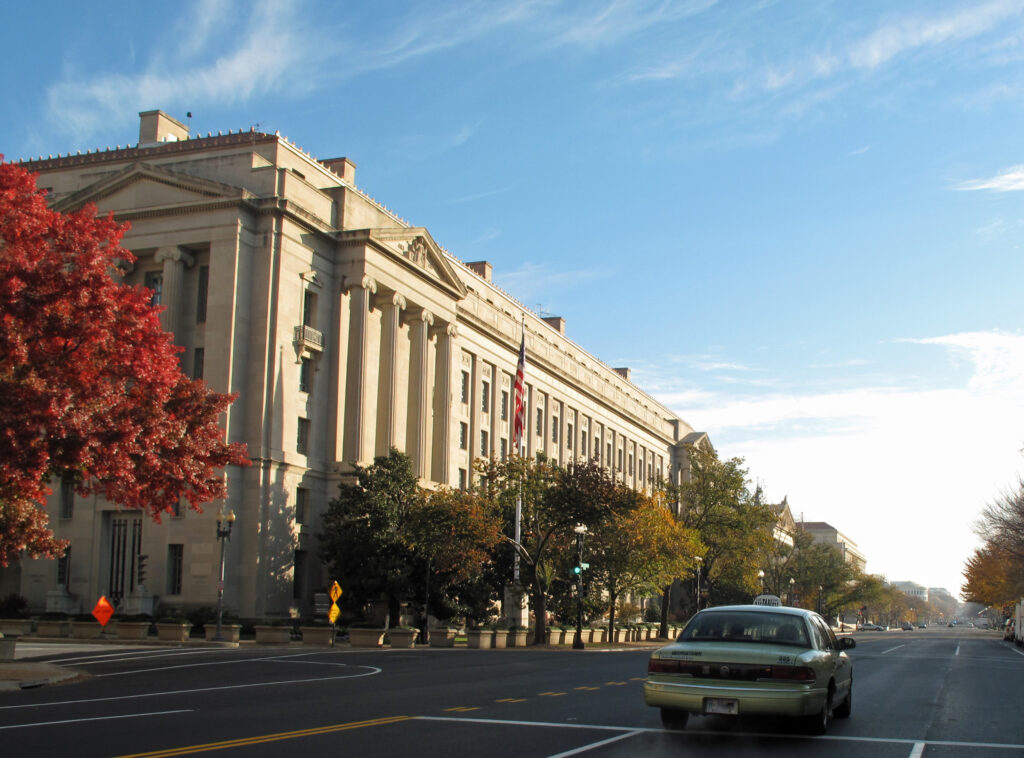
Archival image: US Department of Justice headquarters, Washington, DC, 2015. Source: Voice of America via Wikimedia Commons, public domain.