The United Nations peacekeeping mission in Western Sahara has begun closing after 35 years, following the Security Council’s failure to agree on a new mandate for the operation that was established to monitor a ceasefire and prepare a referendum on the territory’s future.
The United Nations Mission for the Referendum in Western Sahara, known as MINURSO, entered its winding-down phase on Sunday, 1 November 2026. The decision followed a confrontation between the United States and Russia at the Security Council on Friday, which left the mission without authorisation beyond 31 October.
Russia vetoed a United States-backed draft that would have renewed the mandate while advancing Morocco’s proposal for autonomy under Moroccan sovereignty as the basis for negotiations. A competing Russian proposal to extend the mission also failed to secure the votes required for adoption. The outcome ended a peacekeeping presence that had survived repeated diplomatic disagreements since 1991.
Secretary-General António Guterres said the United Nations remained committed to a just, lasting and mutually acceptable political settlement that provides for the self-determination of the people of Western Sahara. His spokesman, Stéphane Dujarric, explained that a smaller United Nations team would supervise the withdrawal of equipment and the return of assets belonging to countries that contributed personnel.
“This 1 November 2026 marks the start of the liquidation period.”
Stéphane Dujarric, spokesman for the United Nations Secretary-General
The mission was created under Security Council Resolution 690 in April 1991, as part of a settlement plan between Morocco and the Polisario Front. Its responsibilities included monitoring the ceasefire and organising a referendum intended to allow the Sahrawi people to decide whether the territory should become independent or integrate with Morocco. That vote never took place, principally because the parties could not agree on who should be eligible to participate.
Western Sahara, a former Spanish territory on Africa’s Atlantic coast, remains the subject of one of the continent’s longest unresolved territorial disputes. Morocco administers most of the territory and considers it part of the kingdom. The Polisario Front, supported by neighbouring Algeria, seeks an independent Sahrawi state. The United Nations continues to list Western Sahara as a non-self-governing territory.
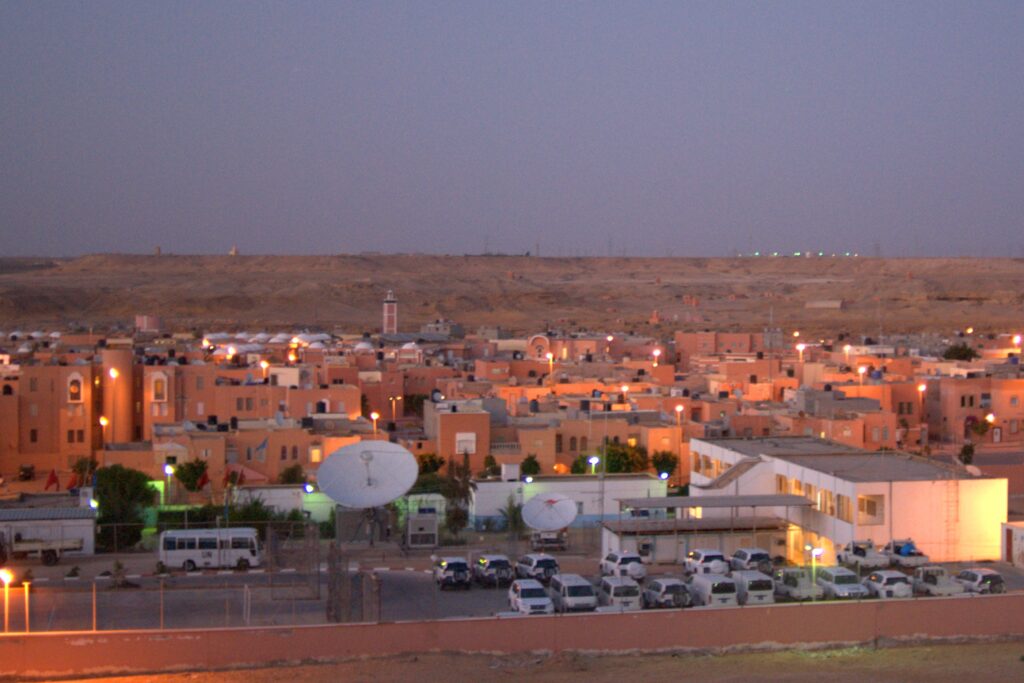
The diplomatic divide has implications far beyond the peacekeeping compound in Laayoune. Sahrawi refugees have lived for decades in camps around Tindouf in Algeria, while people inside the disputed territory face continuing uncertainty over its political status. The breakdown of the 1991 ceasefire arrangements in 2020 was followed by renewed tensions and intermittent hostilities, making the loss of an international monitoring presence particularly sensitive.
Morocco welcomed the non-renewal of MINURSO’s mandate. Its royal palace characterised the development as a significant step in its preferred direction for the dispute. Algeria’s foreign ministry expressed deep regret and criticised what it regarded as an excessively favourable United States position towards Morocco. The Polisario Front also voiced concern about the Security Council deadlock.
The latest dispute follows a change in the Council’s approach last year. Resolution 2797, adopted in October 2025, extended MINURSO until 31 October 2026 and called for negotiations taking Morocco’s autonomy proposal as a basis. It also referred to a mutually acceptable solution providing for Sahrawi self-determination. Those formulations have remained contentious because Morocco and the Polisario Front disagree fundamentally about whether independence should remain an available outcome.
The Secretary-General warned that the security situation across Western Sahara continued to carry a risk of escalating hostilities and urged all parties to exercise maximum restraint. The United Nations has said it remains available to support diplomatic efforts, but the end of the mission means that the peacekeeping mechanism established alongside the 1991 settlement plan is no longer operating under a Security Council mandate.
The closure also leaves a practical task for the United Nations and countries that supplied personnel. A reduced team will oversee the orderly return of national equipment and the disposal of United Nations assets. The mission’s departure does not itself resolve the competing claims over Western Sahara, and no agreement on the territory’s final political status has been announced.
Photograph: MINURSO headquarters in Laayoune, June 2012, an archival image by Guillaume Galdrat (cingularite), via Wikimedia Commons. CC BY-SA 2.0. Image resized for website display.