In the turquoise waters of the South Pacific, where the Solomon Islands scatter across the ocean like emerald jewels, lives one of humanity’s most extraordinary genetic wonders.
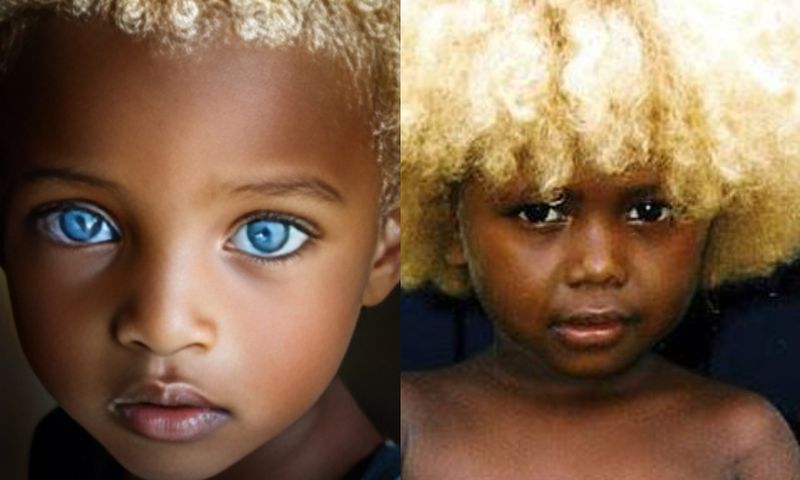
The Melanesian people, with their ebony skin and broad African features, have been nurturing a biological secret for millennia – children born with golden sun-kissed hair and occasionally, startling blue eyes that mirror the Pacific waters surrounding them.
This remarkable phenomenon, observed predominantly among the islands’ indigenous population, represents one of nature’s most striking examples of convergent evolution – where similar physical traits emerge independently in completely isolated populations.
While blonde hair in Europeans results from mutations in the MC1R gene, Melanesians owe their golden locks to a unique variant of the TYRP1 gene that affects melanin production specifically in hair follicles while preserving their rich skin pigmentation.
Genetic anthropologists from Stanford University and the University of Bristol have conducted extensive research on this population, collecting DNA samples from over 1,200 islanders.
Their findings, published in the Journal of Human Genetics, reveal that this mutation arose spontaneously between 5,000-10,000 years ago and became concentrated in the island population through generations of isolation. “It’s nature’s experiment,” explains Dr. Jonathan Friedlaender, lead researcher on the project. “The same way Australia has white kangaroos and India has black tigers, the Solomon Islands have developed this extraordinary trait completely independent of European influence.”
The blonde characteristic appears in about 10% of the indigenous population, with highest concentrations in the western islands of Rendova and New Georgia.
Village elders speak of ancient legends that attribute the golden hair to regular consumption of certain fish or prolonged exposure to sun and saltwater, though scientists have conclusively disproven these folk theories.
What makes the Melanesian blonde particularly fascinating is its lifecycle – most children are born with bright golden hair that gradually darkens during puberty, though about 30% retain significant lightness into adulthood.
The occasional appearance of blue eyes adds another layer to this genetic marvel. Ophthalmogeneticists believe this results from a separate mutation affecting melanin distribution in the iris, occurring in about 1-2% of the population.
Unlike European blue eyes which stem from a single genetic origin, the Melanesian variant appears to have developed through multiple mutation pathways.
Cultural anthropologists have documented how these physical traits are perceived within Melanesian society.
Contrary to Western beauty standards, traditional island cultures historically viewed blonde hair with some suspicion, associating it with supernatural qualities. “In our oral traditions, golden hair was sometimes linked to sea spirits or thought to indicate special spiritual powers,” explains tribal historian Paulino Ramo of the Roviana people.
Modern influences have shifted these perceptions, with many islanders now proudly embracing their unique heritage.
The scientific community continues to study this population for insights into human genetic diversity. Recent research has uncovered potential links between the TYRP1 mutation and enhanced vitamin D synthesis, which may have provided an evolutionary advantage in the islands’ environment.
Other studies examine how these genetic variations affect hair structure at the microscopic level, with potential applications in cosmetic science.
As globalization reaches even these remote islands, scientists race to document the genetic heritage before it potentially dilutes. “This is a living laboratory of human evolution,” says Dr. Friedlaender. “The Melanesians remind us that human biology still holds many mysteries, and that the story of our species is far more complex and beautiful than we ever imagined.”
For visitors to the Solomon Islands, encountering a dark-skinned child with golden curls playing in a village clearing remains one of the world’s most surreal and enlightening travel experiences – a vivid demonstration that human diversity will always surpass our attempts to categorize it.
As genetic science advances, the Melanesians stand as both a link to our shared African origins and a testament to nature’s endless capacity for surprise.