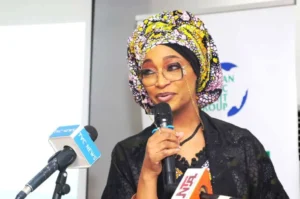
Nigeria’s Minister of Art, Culture, Tourism and the Creative Economy, Hannatu Musawa, has urged African governments to support a proposed expansion of the continent’s fashion industry, as organisers prepare to unveil a new growth roadmap in Lagos on Thursday, 5 November 2026.
The Confederation of African Fashion (CAFA) is promoting an ambition to increase the estimated value of Africa’s fashion economy from $30 billion to $500 billion. The figures are the organisation’s proposed starting estimate and long-term ambition, rather than evidence of investment already secured or growth already achieved.
Musawa’s position was conveyed in a statement issued on Monday by her Special Adviser on Media and Publicity, Nneka Anibeze, ahead of the Creative Africa Nexus Weekend, known as CANEX WKND. The minister called for stronger African institutional participation and greater investment in the industry’s manufacturing and commercial infrastructure.
The roadmap is scheduled for presentation at the Wole Soyinka Centre for Culture and the Creative Arts in Lagos, formerly the National Arts Theatre. Its unveiling will coincide with CAFA’s first anniversary, giving governments, designers, producers and investors an opportunity to consider the organisation’s proposals.
Musawa said the initiative, described as Afroliganza, seeks to develop an industry rooted in African heritage and led by African institutions. She identified employment for women and young people as a central objective, although no independently verified job-creation forecast or funding commitment was provided with the announcement.
CAFA president Lai Labode said the organisation was seeking closer alignment between African countries on sourcing, production, trade and intellectual property. The aim is to enable businesses to capture more value from design and manufacturing rather than relying primarily on exports of raw materials or informal distribution.
The programme includes proposals for local processing of textile inputs, improved access to international markets and measures to protect original African designs. CAFA’s ‘Own What We Create’ initiative addresses intellectual property, while its proposed Certified Seal and Heritage Mark are intended to help identify products meeting defined standards.
These measures remain proposals or developing programmes. Their commercial effect will depend on participating governments, enforceable standards, financing and uptake by manufacturers and retailers. No continent-wide implementation timetable has been confirmed.
Nigeria signed the African Fashion Industry Growth Charter on 5 November 2025, with Musawa signing on behalf of the Federal Government. CAFA says Rwanda is moving towards becoming another participating country and that it is seeking broader African Union adoption of the charter.
The organisation, registered in Rwanda with an office in Kigali, is also pursuing international commercial links. It reports a memorandum of understanding with Türkiye’s ASRIAD and has proposed African Global Fashion Houses as platforms for designers seeking customers outside the continent.
Another element is the proposed African Global Fashion Games, planned to debut in Nigeria in 2028. Organisers envisage competitions involving national teams alongside investor meetings, business discussions and opportunities for commercial partnerships. The event has not yet taken place.
CAFA has invited designers, artisans, diplomats, investors and policymakers to engage with its exhibition during CANEX WKND from 5 to 8 November. The gathering is organised by the African Export-Import Bank and brings together participants from fashion, film, music, literature, visual arts and other creative sectors.
For Nigeria’s designers and textile businesses, the immediate questions concern how the proposed framework would translate into production finance, reliable supply chains, intellectual property enforcement and access to buyers. Those practical details will be important in assessing the roadmap after its formal presentation.
The $500 billion ambition should therefore be understood as a target advanced by the initiative, not a current valuation of Africa’s fashion sector. The Lagos presentation is expected to provide further details of the proposed route towards that goal.